



 For all latest news, follow the Daily Sun's Google News channel.


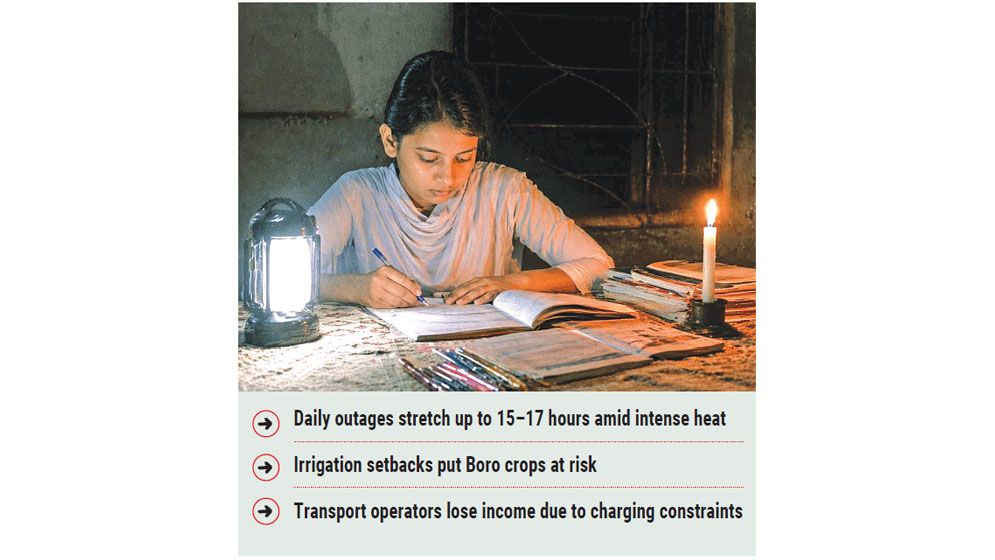
Kalai upazila in Joypurhat is reeling under an acute electricity crisis, compounding the impact of an intense heatwave sweeping across the region during the Bengali month of Baishakh.
As temperatures continue to rise, hovering between 37 and 38 degrees Celsius on Saturday, residents report enduring prolonged power outages averaging 15 to 17 hours within a 24-hour period.
The ongoing crisis has brought daily life to a near standstill, severely affecting agriculture, commerce, and education. According to sources at the Kalai Zonal Rural Electrification Office, the upazila requires approximately 24.5 megawatts of electricity per day. However, only around 7 megawatts are currently being supplied, leaving a deficit of nearly 17.5 megawatts. As a result, residents are receiving less than one-third of the required electricity.
During peak hours, demand rises to about 26 megawatts, while supply drops to as low as 13 megawatts, further worsening the situation. Although authorities have planned a rotational load-shedding schedule, providing one hour of electricity after one and a half hours of outage across eight feeders, this system has proven difficult to implement effectively. Consequently, residents are often left without power for extended periods both day and night.
The crisis has particularly affected students sitting for the ongoing Secondary School Certificate (SSC) examinations. Extreme heat coupled with erratic electricity supply has made studying increasingly difficult. Rakibul Hasan, an SSC candidate from Kalai municipal area, said frequent power cuts at night disrupt sleep, leaving him fatigued during examinations.
Another student, Mahamuda Shely, reported being unable to study during the day due to the heat, while at night she is forced to rely on dim emergency lighting. She added that such conditions are placing significant strain on her eyesight and making preparation extremely challenging. Power interruptions during examinations are also affecting students’ concentration.
Parents have expressed deep concern, warning that if the situation persists, it could have a serious impact on students’ academic performance. They have urged authorities to ensure uninterrupted electricity supply at least during the examination period.
Households are also facing significant hardship. Parul Akter, a homemaker, said power outages occur multiple times a day, often lasting up to two hours. “Children cannot sleep due to the heat, and cooking is frequently disrupted,” she said.
The transport sector has not been spared. Auto-rickshaw drivers report being unable to charge their batteries at night due to the lack of electricity, leading to reduced working hours and declining incomes. Liton Mia, a driver, said he cannot operate his vehicle without sufficient battery charge, making it difficult to support his family.
The agricultural sector is similarly under threat. Irrigation activities dependent on electric deep tube wells have been severely disrupted. Helal Uddin Pramanik, owner of a deep tube well covering around 290 bighas of Boro paddy fields, said he has been struggling for the past two weeks due to frequent power cuts. He warned that continued disruption could lead to significant crop losses.
According to the Meteorological Department, a moderate heatwave is currently passing over the region. High humidity levels are intensifying the discomfort, exacerbating public suffering.
Md Zobayer Ali Basunia, deputy general manager (Engineering) at the Kalai Zonal Office, stated that the crisis stems from a fuel shortage affecting the national grid. “We are not receiving adequate electricity supply from the grid, which is forcing us to implement load-shedding. It is difficult to say when the situation will improve,” he said.