


 For all latest news, follow the Daily Sun's Google News channel.


Abundant harvests, broken markets: Bangladesh’s farming paradox
COLD STORAGE SHORTAGES AND UNDERDEVELOPED PROCESSING INDUSTRIES TRAP FARMERS IN DISTRESS CYCLES

When COVID-19 shut offices and factories across Bangladesh in mid-2020, Anik Mahmud (not his real name) packed his life into a few bags and boarded a bus north to Rangpur.
His private-sector job in the city had vanished overnight. With a wife, a three-year-old son and no clear prospects in Dhaka, returning home was not so much a choice as a necessity.
Like thousands of others forced out of urban employment during the pandemic, Anik turned back to the land he had once hoped to leave behind.
With no formal training in agriculture, he began watching YouTube videos late into the night – glossy success stories of farmers in Rajshahi, Chuadanga and Jhenaidah who had turned small plots into profitable ventures. Encouraged by what he saw and buoyed by the fact that he had inherited about 12 bighas of agricultural land, he decided to invest what little savings he had into farming, focusing on crops the videos promised were “high-value”: tomatoes, onions and fruits such as guava, malta and jujube.
As an educated young man, he tried to do things properly. He sourced quality seeds and saplings, followed modern cultivation methods and paid close attention to fertiliser schedules and pest control, as far as his limited resources allowed.
The results, at first, were promising. Tomatoes ripened evenly. Onions bulbed well. Fruit trees flourished. For a brief moment, it seemed the gamble had paid off.
Then the prices collapsed.
For around two weeks, Anik sold tomatoes at reasonable rates. As peak season arrived and supply flooded the market, prices plunged so sharply that harvesting no longer made economic sense. Eventually, he left ripe tomatoes to rot in the field – the cost of picking and transporting them to the local arot (wholesale market) exceeded what traders were willing to pay.
Onions brought a different disappointment. Prices at harvest barely covered production costs. Hoping to sell later, when prices usually rise in November and December, Anik stored his onions at home. Without cold storage or technical know-how, nearly half the produce rotted. The rest was sold months later at roughly the same price he had been offered at harvest.
By his second year, he stopped growing onions, tomatoes and most vegetables altogether.
More than four years on, Anik is still farming, surviving on modest profits from a mixed fruit garden. But the sense of wasted potential lingers.
During the monsoon months from June to August, when guava production peaks and other seasonal fruits – mango, jackfruit, watermelon and litchi – flood local markets, he is forced to sell guava for just Tk15-20 a kilogram (Tk600-800 per mound). In winter, when prices rise to Tk50-70 a kilogram, production falls sharply.
“That’s when you realise the problem isn’t farming – it’s what happens after harvest,” Anik told the Daily Sun, adding, “If I could store guava for two or three months, or if there were small processing plants nearby to make juice or pulp, I wouldn’t have to sell everything at throwaway prices.”
Without cold storage or agro-processing facilities at the local level, he adds, farmers remain trapped in a cycle where abundance brings loss and profit depends more on timing than effort.
Plenty in the fields, pressure in the markets
Bangladesh today grows more food than at any point in its history. Yet farmers across the country are routinely forced to sell their produce at distress prices, while consumers continue to pay exorbitant rates for the same food just months later.
This contradiction lies at the heart of the country’s agriculture sector in 2025: record production without price stability; self-sufficiency without security for either producers or consumers.
Nowhere is this contradiction starker than in the onion market.
In the aftermath of the 5 August 2024 ouster of the Awami League government, several political figures and media commentators in a neighbouring country publicly claimed Bangladesh would “collapse” without onion imports from their territory.
Less than a year on, Bangladesh has not only disproved that claim but has met almost 100% of its domestic onion demand in 2025 through local production alone – a symbolic milestone in the country’s long march towards food self-reliance.
Yet behind this apparent triumph lies a harsher truth.
Even as farmers harvested surplus onions, many suffered heavy losses because prices collapsed during peak season and storage facilities were inadequate. When supply later tightened, prices rose again, hurting consumers. This cycle, repeated across multiple crops, exposes why Bangladesh’s agricultural success remains incomplete.
From hunger to self-sufficiency
In 1972, the newly independent Bangladesh struggled to feed a population of around 70 million. Food shortages were common, dependence on foreign aid was high and agricultural infrastructure was weak. Rice shortages were routine, and food security fragile.
By 2025, the country feeds around 180 million people, largely through domestic production. Rice output now hovers in the mid-30 million tonnes annually, placing Bangladesh among the world’s leading producers and rendering it largely self-sufficient in its staple food.
This transformation was driven by decades of investment in irrigation, high-yield varieties, mechanisation and a steadily improving knowledge base among farmers. Multiple cropping cycles – Aus, Aman and Boro – ensure year-round rice availability, while advances in seed technology have sustained output even under mounting climate stress.
Bangladesh’s experience stands as a rare example of long-term policy continuity delivering structural change.
From seasons to year-round supply
The agricultural story does not end with rice.
Over the past two decades, Bangladesh has diversified dramatically into vegetables and fruits. Crops once confined to short seasons are now grown throughout the year. Papaya, gourds, pumpkin, guava and lemon have become near-constant features in markets.
Fruit seasons have expanded as well. Mango, litchi, watermelon and pineapple now arrive earlier and stay longer, thanks to new varieties and staggered planting methods. Farmers have embraced crops once considered exotic – malta, mandarin, dragon fruit, persimmon and strawberry – now grown across multiple districts.
According to Bangladesh Bureau of Statistics (BBS) data, vegetable production exceeded 17 million tonnes in 2024-25, while fruit output surged, with watermelon recording especially sharp increases in acreage and yield.
But abundance has brought new vulnerabilities.
“Production has moved faster than markets,” said Kawsar Ahmed, upazila agriculture officer of Jagannathpur in Sunamganj, adding, “Farmers produce more, but everyone harvests at the same time, causing seasonal oversupply.”
“Farmers can now grow vegetables year-round, but storage, processing and organised buyers have not kept pace. When supply peaks, prices crash – not because demand disappears, but because the system cannot absorb abundance,” he maintained.
Despite greater availability, the absence of storage, processing and market coordination has prevented diversification from translating into stable incomes
The onion paradox
In 2024-25, Bangladesh produced approximately 4.4 million tonnes of onions, exceeding estimated domestic demand of around 3.5 million tonnes.
On paper, this surplus should have ensured stable prices and farmer profitability. Instead, prices collapsed during the peak harvest.
Farmers in Pabna, Faridpur and Rajshahi were forced to sell below production costs due to inadequate storage. Studies show average losses of around 24%, while up to 30% of onions were lost post-harvest through dehydration, rotting and mishandling.
“We grow the food, but others make the money,” said Abdul Karim, an onion farmer from Sujanagar in Pabna.
Months later, when supply tightened, prices rose sharply again.
“During harvest vegetables are cheap, but a few months later prices double or triple,” said Farhana Akter, a homemaker in Dhaka’s Mirpur. “If the country produces so much, why do we still pay so much?”
Echoing the concern, Md Zahid Hasan, a university student who went to the Palashi kitchen market in the capital’s Nilkhet last Wednesday, told the Daily Sun, “We read that farmers are losing money and consumers are paying more. That means the system is broken in between. Someone is benefiting, but it’s neither the farmer nor the buyer.”
Potatoes: bigger crop, deeper losses
The potato sector mirrors the same dysfunction on a larger scale.
Bangladesh is one of the world’s major potato producers. Yet bumper harvests repeatedly trigger price crashes. Despite record output, many farmers are unable to store potatoes due to limited cold storage capacity and rising rental costs.
“Production was very good, but cold storage rent went up and prices went down,” said Mosharraf Hossain, a farmer from Rangpur. “I sold at a price that didn’t even cover labour.”
Experts warn that without processing industries – flakes, starch, chips – and export facilitation, the sector will remain trapped in cycles of overproduction and loss.
The invisible drain of post-harvest loss
Post-harvest losses continue to undermine Bangladesh’s agricultural gains. Estimates suggest up to 21 million tonnes of food are lost annually due to inadequate storage, poor transport and lack of processing.
For fruits and vegetables alone, losses range between 17% and 32%.
“Every kilogram wasted is money out of farmers’ pockets,” said Jesse Wood, deputy country director of the World Food Programme in Bangladesh.
FAO officials echo the concern, noting that global food insecurity persists not because of scarcity, but because of waste and weak distribution systems.
According to economist and researcher Dr Jahangir Alam, however, Bangladesh produces nearly 50 million tonnes of perishable commodities – potatoes, vegetables, fruits, fish, meat, and milk. About 25% of this, roughly 12.5 million tonnes, is wasted.
“With proper processing and preservation, we could save around 10 million tonnes, preventing huge losses. The financial value of this lost produce runs into several billion dollars, though precise calculations are difficult.”
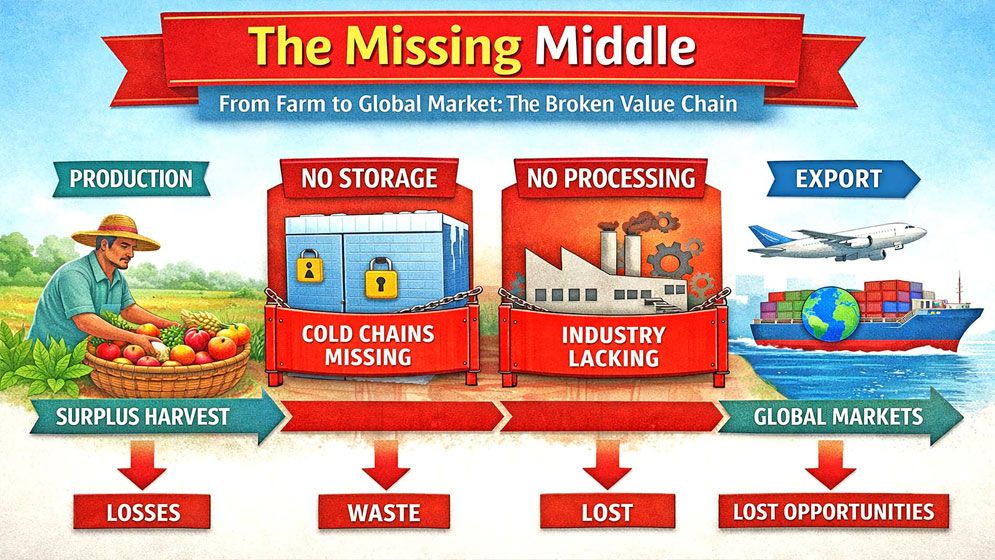
Processing: the missing middle
Bangladesh’s agro-processing sector remains underdeveloped relative to production. Mangoes, jackfruit, pineapple and tomatoes are sold fresh at low prices, with minimal processing into pulp, juice or paste. Onion dehydration and vegetable freezing facilities are rare.
Despite being a strong production hub, the country continues to import processed foods it already grows – a missed economic opportunity.
From surplus to security
Bangladesh has just over 400 cold storage facilities. More than 95% are used almost exclusively for potatoes, leaving onions, fruits and vegetables exposed to spoilage and price swings.
Cold storage that accommodates diversified produce could reduce losses dramatically. Processing facilities could absorb seasonal gluts, stabilise prices and create rural jobs.
Exports offer another outlet – but only with improved standards, grading and logistics.
Beyond production
Bangladesh has proven it can grow enough food. The challenge now is ensuring fair returns for farmers, reasonable prices for consumers and resilience against market shocks and climate stress.
Agriculture Adviser Lt Gen (retd) Md Jahangir Alam Chowdhury put it succinctly in a recent programme: “We hope no food scarcity will occur if we can reduce post-harvest loss and wastage.”
For farmers like Anik Mahmud, the lesson is already clear. The problem is no longer what happens in the field – but what fails to happen after harvest.
The untapped potential
At the consumer end of the global food system, the fastest growth is no longer in fresh produce but in what happens after harvest.
Processed fruits, vegetables and crop-based foods – frozen, dried, pulped, canned or dehydrated – now form one of the largest segments of the global food economy. According to estimates by international market research firms, the Food and Agriculture Organization (FAO) and global industry analysts, the overall processed food market is valued at more than US$5 trillion a year, while the global market for processed fruits and vegetables alone exceeds US$350 billion annually.
Demand is being driven by urbanisation, rising incomes, longer supply chains and changing consumption habits. For hundreds of millions of consumers across Europe, North America and East Asia, food increasingly arrives not as a fresh harvest but as a frozen packet, a bottle of juice, a can of pulp or a dehydrated ingredient.
Supermarket shelves in these regions are dominated by tomato paste, frozen vegetables, fruit concentrates, dehydrated onions and potato-based products – items that can travel long distances, remain shelf-stable and offer predictable quality. The World Bank notes that value addition through processing often multiplies farmgate prices several times before products reach consumers.
Yet global supply remains concentrated among a relatively small group of producers.
The United States, China and the European Union together account for a large share of global exports of processed fruits and vegetables, backed by industrial-scale processing plants, advanced cold chains and strict quality controls. Thailand has emerged as a global leader in processed pineapple and tropical fruit products, while India has become a major supplier of processed vegetables, mango pulp and dehydrated onions to international markets.
For Bangladesh – a country that already produces surplus fruits, vegetables and staple crops – this global market represents not competition, but absence.
Despite bumper harvests of mango, jackfruit, pineapple, tomato, onion and potato, Bangladesh remains largely locked out of where value is created. Fresh produce is sold quickly at low prices, often under distress, while the processing, branding and export margins are captured elsewhere.
Challenges holding back agro-processing sector
M Masrur Reaz, chairman and founder of Policy Exchange Bangladesh, told the Daily Sun that the country’s agro-processing industry faces significant hurdles from policy and regulatory complexities.
“Multiple licensing requirements across agencies create costly delays and burdens for businesses,” he said.
Trade facilitation is another challenge: the lack of accredited testing labs and inconsistent quality standards make accessing markets such as the EU and US difficult. Recurring export restrictions and non-tariff barriers further undermine competitiveness.
Weak links between farmers and processors also harm the value chain, leading to poor product quality and high post-harvest losses. These issues are worsened by inadequate infrastructure, including a fragmented cold chain and limited rural storage, which cause perishable goods to spoil. Small firms are particularly vulnerable, lacking resources for temperature-controlled logistics.
“A major financing gap exists,” Masrur Reaz noted, adding, “SMEs and small farmers receive only around 10% of the agricultural investment they need.”
To strengthen the sector, he recommends a multi-pronged approach. Policy reforms should include a “one-stop” agribusiness approval system and a predictable tax roadmap. Trade facilitation could improve through internationally accredited testing labs, green channels for chemical registration, and alignment of local safety regulations with global standards such as HACCP and GAP.
Masrur Reaz also called for SME-focused credit lines, blended finance, and PPP-led expansion of cold chains and multimodal transport.
Strengthening the value chain requires promoting contract farming and out-grower schemes, enhancing livestock productivity, and reducing import duties on key inputs and packaging materials, he said.
Economist Dr Jahangir added, “The main reason we cannot expand the processing industry or improve preservation is insufficient policy support, lack of incentives, and an unstable business environment. These factors discourage investment. To change this, we need a stable environment, free from price volatility, that encourages public-private partnerships to build industries.”
International collaboration, such as with China, could also support industry growth, and some initiatives are already underway, he observed.
At a recent industry roundtable, Md Abul Hashem, president of the Bangladesh Agro-Processors’ Association, warned that without internationally recognised testing infrastructure and stronger export strategies, Bangladesh will continue to miss out on the multibillion-dollar potential of processed food exports.
Business leaders have also stressed that poor compliance with global standards, weak certification systems and inadequate logistics are major obstacles to export diversification.
The implications are profound. Without processing capacity, farmers must sell immediately after harvest, when prices are at their lowest. With no cold chain or industrial buyers to absorb surplus, abundance becomes a liability rather than an asset.
In effect, Bangladesh continues to operate at the lowest rung of the global food value chain – exporting little, importing processed foods it already grows, and absorbing the losses of inefficiency domestically.
The contrast with regional peers is stark. India, facing similar volatility in onion prices, has invested heavily in dehydration plants that convert surplus onions into flakes and powder for export. Thailand’s pineapple farmers are buffered from seasonal price crashes by an export-oriented processing industry that absorbs excess supply. Even Vietnam has rapidly expanded frozen fruit and vegetable exports, turning smallholder production into foreign exchange earnings.
Bangladesh has the raw material to do the same – land, labour, climate and experience – but lacks the missing middle between farm and market.
For farmers like Anik Mahmud, the logic is intuitive. “If guava could be turned into juice or pulp here,” he says, “we wouldn’t have to beg buyers when everyone harvests at once.”
What is missing is not productivity, but infrastructure, coordination and policy focus.
Policy gaps and coordination challenges
A senior official at the Department of Agricultural Extension (DAE), speaking on condition of anonymity, said the gap between agricultural potential and market outcomes ultimately comes down to political will and weak policy design.
“Designing effective measures requires people with technical understanding at the policymaking level,” the official told the Daily Sun. “You need informed decisions on fair pricing mechanisms, export planning and incentives for investment in local, small-scale and export-oriented agro-processing industries. But too often, those at the top are non-technical, and that limits how far policy can go.”
The official also pointed to a lack of synchronisation between key government agencies, particularly the DAE and the Department of Agricultural Marketing (DAM). While the DAE is mandated to focus on production and the DAM on marketing, poor coordination between the two leaves critical gaps in pricing and market management.
“As a result, farmers suffer at harvest time and consumers suffer later,” the official said. “Production increases, but the system fails to manage what comes next.”
Standards, youth engagement
Agriculturist Kawsar Ahmed stressed that breaking into global agro and agro-processed markets will depend not on volume alone, but on quality and standards.
“To secure a meaningful share of the world market, Bangladesh must consistently meet international standards,” he said, pointing out that buyers are increasingly sensitive to quality, safety and traceability rather than price alone.
He noted that the DAE has recently launched a small-scale programme to train farmers in Good Agricultural Practices (GAP) – a move he described as necessary but insufficient.
“Once these programmes are expanded and farmers are prepared to produce according to the specific demands of different export markets, Bangladesh will be in a much stronger position globally,” he said.
Kawsar Ahmed also underlined the importance of attracting educated young people into agriculture through incentives and institutional support. Younger farmers, he argued, are more likely to adopt modern techniques, mechanisation and market-oriented thinking.
“Equally important is a shift in social attitudes,” he noted, adding, “Farming must be seen as a viable, skilled profession – not a last resort.”
The reporter can be reached at: [email protected]