


 For all latest news, follow the Daily Sun's Google News channel.


President breaks silence with stunning facts
Haider Ali and Zainal Abedin
Published: 23 Feb 2026, 10:51 AM

Kaler Kantho Executive Editor Haider Ali in conversation with President Mohammed Shahabuddin.
It reads like the enthralling tale of a president confined within his own palace. That year and a half of confinement is now over. In a sense of relief, President Mohammed Shahabuddin spoke candidly about the events of that closed chapter in his life. The exclusive interview was conducted last Friday night at the President’s Office in Bangabhaban by Kaler Kantho Executive Editor Haider Ali and Special Correspondent Zainal Abedin.
Haider Ali: Assalamu Alaikum.
How are you, Your Excellency?
President Mohammed Shahabuddin: I have been quite well for about a week now.
Haider Ali: Were you not well before that?
(The President smiles enigmatically.)
Haider Ali: How did you spend the one and a half years of the interim government at Bangabhaban?
President: (After a pause and a long sigh) During that period, I was not part of any discussions, yet numerous conspiracies were carried out against me.
Kaler Kantho: Could you elaborate?
President: There were many attempts to permanently destroy law and order in the country and to create a constitutional vacuum.
(He falls silent.)
Kaler Kantho: Were those attempts successful?
President: I remained firm and unwavering in my decisions. As a result, none of the conspiracies succeeded. In particular, numerous plots to unseat the President through unconstitutional means failed.
Therefore, I cannot say that my experience of that year and a half at Bangabhaban was pleasant. The storm I endured—whether anyone else could have withstood such a storm, I do not know.
Kaler Kantho: We saw protests demanding your resignation. There were marches towards Bangabhaban and demonstrations. What was the atmosphere like inside, and what were your thoughts at the time?
President: There were countless attempts to uproot me. But I did not break down under any circumstances.
I said that my blood would be shed at Bangabhaban if necessary. Let it be shed. I would become part of another chapter of history. But I would uphold constitutional continuity—I remained steadfast in that decision. It was almighty Allah’s will and my own determination.
Kaler Kantho: Who led those movements, and why was there such hostility towards you?
President: On 22 October 2024, Bangabhaban was surrounded. So many parties, platforms, alliances—created overnight. The same type of people under different forums and names. Where did they get so much money?
When they laid siege, forces from the Army’s Ninth Division arrived and provided three layers of security. Then a young woman jumped over the barbed-wire fence. It was astonishing. These were hired individuals. When sound grenades were used, she jumped down and remained lying there so photographs could be taken, even calling to the cameraman. It was clearly intended for blackmail. Later, female police and army personnel carried her away in a jeep.
That night was terrifying for me. People gathered from various directions, even attempting to loot Bangabhaban as had happened elsewhere. We remained inside. I was not going to flee. The armed forces, with firm resolve, brought the situation under control.
Around midnight, Nahid Islam, then Information Adviser and a leader of the Anti-Discrimination Student Movement, called to say the agitators were not their people and that efforts were underway to disperse them. By around 2 or 3am, the situation was cleared.
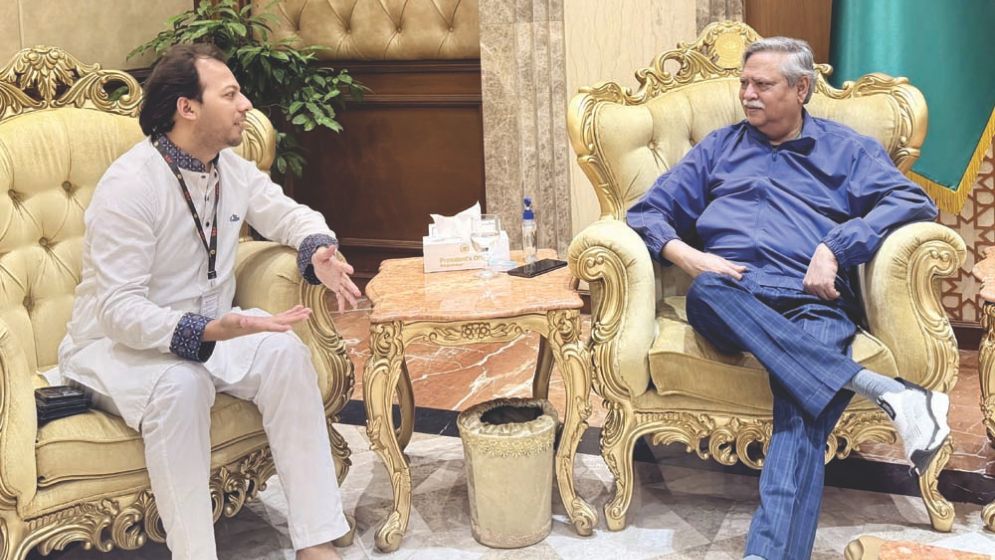 Kaler Kantho Special Correspondent Zainal Abedin in conversation with President Mohammed Shahabuddin at Bangabhaban.
Kaler Kantho: Did you find anyone standing by you during that difficult time?
President: I can say without hesitation that even in those hard times, the top leadership of the BNP stood by me. They clearly expressed their commitment to maintaining constitutional continuity.
I had many curiosities about BNP Chairperson Tarique Rahman, but gradually I realised he is a very sincere person. He was so cordial. During my difficult time, the BNP’s cooperation was one hundred per cent.
Kaler Kantho: Why was there an initiative from within the interim government to remove you? Who do you think instigated it?
President: Essentially, under pressure from certain leaders of the mass uprising, steps were taken to remove me. Political parties discussed the matter at length. Even the interim government decided that I could only be removed if the political parties so desired.
At one point, there was a risk that a majority might form against me, or that psychological pressure would force me to resign. However, senior BNP leaders assured me of their support and opposition to any unconstitutional removal. Ultimately, the initiative failed because of the BNP and its allies.
There was even a plot to bring in a former Chief Justice to replace me through unconstitutional means. An adviser met him for hours, but the judge refused, stating he could not assume the presidency in such a manner. His firmness foiled that attempt.
Kaler Kantho: How did you learn of these matters?
President: I come from the judiciary. I became aware through judicial circles.
Kaler Kantho: What sustained your morale?
President: Alone, it would have been difficult. The BNP’s assurances helped, as did the full support of the armed forces. They told me that as Supreme Commander of the Armed Forces, my defeat would mean theirs. They would not allow any unconstitutional act.
Diplomatic circles were also opposed to my removal through unlawful means. That too was a source of strength.
Kaler Kantho: Did you maintain communication with the Chief Adviser?
President: I received no call from Dr Yunus during that crisis, nor did I seek one. He did not consult me, even though constitutionally he was required to brief me after foreign visits. He travelled abroad 14 or 15 times and did not inform me once, either orally or in writing.
Even regarding the recent agreement with the United States before the election, I was not informed. That is a constitutional obligation.
Kaler Kantho: Were your relations with him normal?
President: The process of forming that government began at my initiative. Yet afterwards, he did not coordinate with me. He never visited me even once. I was completely sidelined.
Two of my foreign visits—one to Kosovo and another to Qatar—were blocked. In the case of Qatar, a draft letter was prepared stating that I was too busy to attend. I returned it with a question mark and formally protested the discourteous conduct of the Foreign Ministry. There was no reply.
It seemed the government did not want my name to appear anywhere. Even in national commemorative publications, my message and photograph were omitted. My portrait was removed from Bangladesh missions abroad overnight—breaking long-standing practice. I considered that perhaps the first step towards my removal.
Kaler Kantho: Did you protest?
President: I wrote to the Foreign Adviser expressing my grievance. He remained silent.
Kaler Kantho: Would you like to mention any other incidents?
President: On one occasion, after winning the election of the Dhaka Reporters Unity, the entire committee came to pay me a courtesy call. As someone who is friendly towards journalists, I met them. It was a very ordinary meeting. We exchanged a few words and then had a photo session.
When the matter was published in several newspapers the following day, the Chief Adviser’s Press Wing did not take it normally. They aggressively tried to find out who in Bangabhaban’s Press Wing had been responsible. In fact, no one from the Press Wing had done anything. I myself had invited the journalists after receiving their letter. Yet they rather shamelessly removed three people from here — the Press Secretary, the Deputy Press Secretary and the Assistant Press Secretary. The entire Press Wing was withdrawn.
Kaler Kantho: So you now have no Press Wing?
President: No. All three were taken away. Even two photographers who had worked here for 30 years were withdrawn. The Press Wing was completely dismantled. We cannot issue any press releases from here. If Bangladesh’s cricket team wins somewhere, we cannot even issue a congratulatory message. It has rendered us entirely handicapped.
As President, I personally phoned the Cabinet Secretary repeatedly, as well as the Principal Secretary and the Establishment Secretary. No one paid any heed.
All this was done to prevent my exposure to the people of Bangladesh. On various important national days, when official commemorative supplements are published, the interim government stopped including the President’s photograph and message. The supplements are still published, but without my message. You may verify whether any message of mine has been issued over the past year and a half. Perhaps tomorrow (Saturday), God willing, my message will appear on the occasion of 21 February.