


 For all latest news, follow the Daily Sun's Google News channel.


WB sees 3.4% growth, says faster reforms key to revival
Daily Sun Report, Dhaka
Published: 07 Oct 2026, 12:00 AM
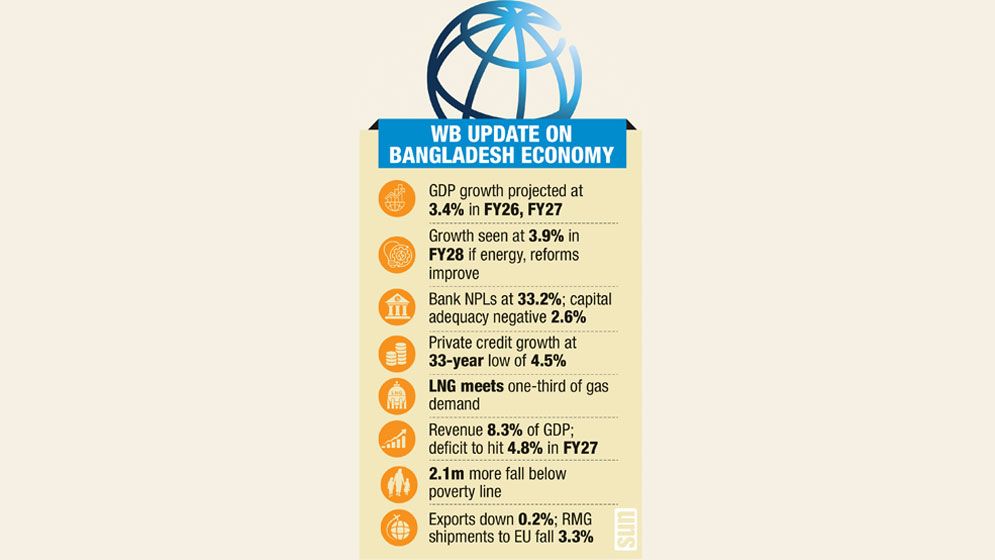
Bangladesh can return to an investment-led growth path by speeding up reforms in banking, energy and revenue mobilisation, the World Bank said on Tuesday, projecting GDP growth of 3.4% in both FY26 and FY27 amid energy shortages, banking-sector weakness and tighter fiscal conditions.
In its latest Bangladesh Development Update, the global lender said growth could recover modestly to 3.9% in FY28 if energy supply improves and the government accelerates its reform efforts.
"Bangladesh needs to respond with urgency and speed up the reforms essential for protecting the poor and creating more and better jobs. The time to act is now," said Jean Pesme, World Bank division director for Bangladesh and Bhutan.
He said fast and bold reforms in banking, domestic revenue mobilisation and energy were needed to avert an economic downturn and return the country to an inclusive growth path driven by private investment.
The report said the rebound expected after the return of political stability had not yet materialised.
Private investment contracted for a second consecutive year as energy challenges, higher production costs and high interest rates outweighed the benefits of reduced political uncertainty.
Investment activity has weakened, exports have lost momentum and inflation remains elevated, reducing household purchasing power and raising business costs.
Banking sector under pressure
The banking sector remains a major risk to recovery, the report said. The system-wide non-performing loan (NPL) ratio rose to 33.2% in June 2026 from 20.2% in December 2024.
The capital adequacy ratio fell to negative 2.6%, against a regulatory minimum of 10%.
NPLs were highest at Islamic banks (58.9%) and state-owned commercial banks (43.2%).
Bangladesh Bank had provided Tk760 billion ($6.2 billion) in uncollateralised liquidity support to weak banks by June.
The World Bank warned, however, that continued regulatory forbearance and repeated liquidity support could delay balance-sheet repair and undermine confidence.
Private-sector credit growth fell to a 33-year low of 4.5% in June, limiting financing for businesses and investment. The World Bank called for decisive, time-bound action to restructure weak banks and resolve non-performing loans.
Energy shortages weigh on investment
Energy supply has emerged as another major constraint. Domestic gas production has declined while reliance on imported LNG has grown, with imports now meeting about one-third of gas demand. Fuel and gas shortages have disrupted industrial output, while transmission and distribution bottlenecks have limited the effective use of power-generation capacity.
Factories operated below capacity or temporarily shut down, and businesses faced higher costs from power shortages and reliance on diesel generators.
A prolonged deterioration in energy supply could delay the recovery of private investment and industrial activity, the bank warned.
Low revenue limits fiscal space
Domestic revenue collection was an estimated 8.3% of GDP in FY26, among the lowest levels globally. The fiscal deficit widened to 3.9% of GDP in FY26 from 3.5% in FY25, and the World Bank projects it will widen further to 4.8% in FY27 and 4.9% in FY28.
Rising interest payments, subsidies, social spending and bank recapitalisation costs will add pressure on public finances, leaving less room for productive public investment.
Poverty and jobs
The slowdown has also affected employment and incomes. The World Bank estimated that about 2.1 million more people fell below the $3-a-day international poverty line in FY26, taking the poverty rate at that threshold to 10.1%.
National poverty is estimated to have risen to 22.5% in FY26 from 18.7% in 2022, and is projected to reach 22.8% in FY27.
Job creation stalled in FY26, and women lost jobs, the report said. Persistent inflation and declining real wages for low-paid workers further weakened purchasing power.
About half of the poorest households remain outside any social protection programme. The bank recommended better targeting and implementation of the government's Dynamic Social Registry to close coverage gaps. It said consolidating multiple food subsidies and combining the Family Card with better-targeted existing cash programmes could lift an additional 2.85 million people out of poverty.
Export competition
Overall exports contracted by 0.2% in FY26, while ready-made garment exports to the European Union fell 3.3%.
Weak EU demand would slow RMG exports in the short term, the World Bank said, while greater competition for market share would pose longer-term challenges.
Buyers are increasingly prioritising flexibility, compliance, supply-chain transparency and resilience over low production costs alone.
South Asia outlook
The update was released alongside the World Bank's South Asia Economic Update, which projects regional growth at 6.9% this year, slowing to 6.7% in 2027 as global headwinds increase.
"South Asia has demonstrated remarkable resilience in a challenging global environment. But the region needs to invest in new drivers of growth to sustain momentum and create more jobs," said Johannes Zutt, World Bank Vice President for South Asia.
He said countries should invest in skills, infrastructure and an enabling environment so workers and businesses can benefit from fast-growing AI-related global value chains.
The report said AI adoption is rising across South Asia but remains well behind advanced economies. Businesses are using it to identify new market opportunities, while governments are increasingly applying it to improve public services.
Franziska Ohnsorge, World Bank Group Chief Economist for Asia, said AI could transform the region's development trajectory by boosting labour productivity, expanding export opportunities and improving public service delivery. Governments must first address foundational gaps to benefit fully, she said.