


 For all latest news, follow the Daily Sun's Google News channel.


Downpour brings Dhaka low
Transport collapses, livelihoods suffer as experts blame years of poor planning

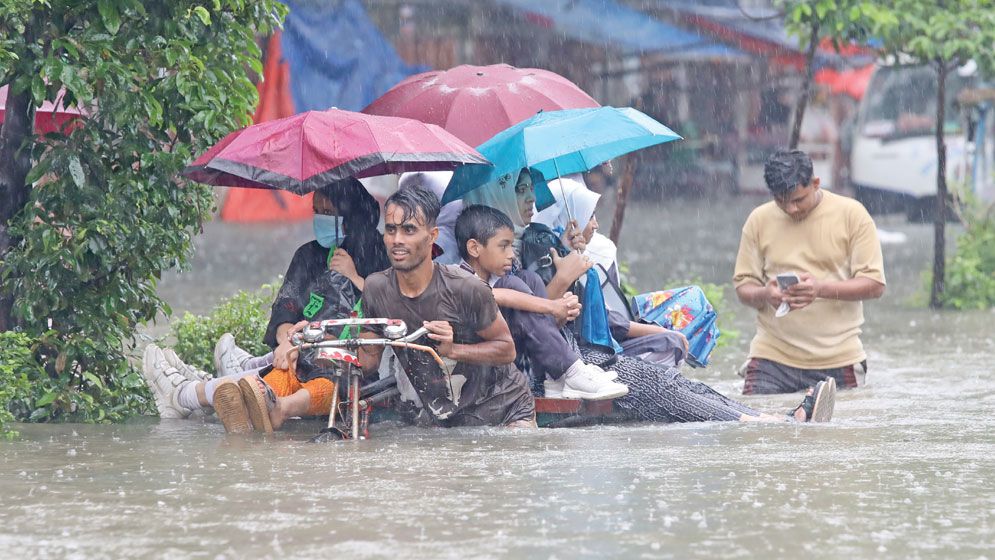
New Market area, Sunday morning. - Daily SUN Photo
Torrential rain left large parts of Dhaka under water on Sunday, bringing the capital to a standstill, stranding commuters, wiping out the day’s earnings of thousands of low-income workers and once again exposing the chronic failures of the city’s urban planning and drainage system.
While many residents stayed indoors enjoying the rainy weather and watching the FIFA World Cup quarter-finals, the downpour turned into a day of misery for those who depend on daily wages.
Street vendors found no customers, rickshaw pullers waited endlessly for passengers, commuters struggled to find transport and businesses remained shuttered as roads and neighbourhoods disappeared under floodwater.
Rain that began on Saturday night transformed Dhaka’s busy streets into waterlogged roads, deserted pavements and silent marketplaces.
At Lalbagh in Old Dhaka, rickshaw pullers roamed the streets with empty vehicles or waited beneath plastic sheets, hoping the rain would ease.
Shahjahan Ali, a rickshaw puller, said, “I took my rickshaw out at 7am. I thought the rain would stop later in the morning. Now it will be impossible for me to pay the rental for my rickshaw, let alone manage the money for my family’s expenses tomorrow.”
The stretch from Shapla Chattar to Fakirapool via Notre Dame College remained submerged under 3.5 to 4 feet of water.
For roadside cobbler Jibon Robidas, whose stall stands opposite Notre Dame College, the rain wiped out almost an entire day’s income. Normally earning between Tk800 and Tk1,000 a day, he had managed less than Tk30 by evening.
Sitting inside his plastic-covered stall, he said, “A rainy day is a day of hardship for me. With such a small income, it is already difficult to pay house rent, cover my children’s education expenses and manage daily meals. Losing even a single day’s earnings adds to the burden. I opened my shop hoping to make at least some money, but hardly anyone came out in the rain.”
At Farmgate, jhalmuri vendor Kamal Hossain was discussing his poor sales when flower seller Aleya Begum lamented that, unlike snacks, the flowers she had bought would perish overnight and could not be sold the following day.
Water also inundated roads and alleyways in Banani, Kakoli, Shewrapara, Kazipara and Mirpur-10.
CNG auto-rickshaw driver Billal Hossain faced a double blow after his vehicle broke down in floodwater.
“I took a passenger from Mohakhali to West Shewrapara. On my way back, a private car sped past and splashed water into the engine. It stalled immediately. I couldn’t earn even the minimum amount because there were so few passengers, and now I have to spend money repairing the vehicle,” he said.
Commuters endure hours of suffering
Persistent rain flooded roads and lanes across the capital, with water reaching knee to waist level in many areas, severely disrupting traffic on the first working day of the week.
The shortage of public transport left office workers, students and Higher Secondary Certificate (HSC) examinees struggling to reach their destinations.
Standing outside Abul Hotel in Malibagh, Jharna Akter, who was trying to take her daughter to an HSC examination centre at Viqarunnisa Noon School and College, said, “There is no transport to take us there. We have been waiting for a CNG auto-rickshaw for the last 20 minutes. I don’t know what to do.”
Vehicles crawled through submerged roads while many battery-operated auto-rickshaws stayed off the streets, further reducing transport options.
Office commuters reported waiting for long periods and, in some cases, being charged excessive fares.
Ashok Biswas, who took more than three hours to travel from Kuril Chowrasta to Motijheel, said, “Dhaka is becoming unliveable every day. I started at 8:40am but reached my office at 11:45am because of gridlock caused by rainwater. Someone has to explain why the capital is in this condition.”
At New Market, shops remained closed throughout the morning.
Firozul Islam, office secretary of the New Market Traders’ Association, said electricity connections had been disconnected as a precaution.
“A decision on reopening the shops will be taken on Monday after assessing the situation,” he said.
According to the Bangladesh Meteorological Department (BMD), Dhaka received 76 millimetres of rainfall between midnight and 6:00am on Sunday, followed by another 82 millimetres over the next six hours, bringing the total rainfall to 158 millimetres in just 12 hours.
Experts blame planning failures
Urban planners said the recurring waterlogging reflects years of poor planning, encroachment on natural water retention areas and inadequate drainage infrastructure.
Shaikh Muhammad Mehedi Ahsan, vice-president of the Bangladesh Institute of Planners, said one of the principal causes of waterlogging was the city’s dysfunctional drainage network.
“The places where water is supposed to be retained and the natural channels through which it should flow no longer exist. So how can waterlogging be resolved? Waterlogging can be significantly reduced through proper planning and effective implementation,” he said.
He added that the situation would improve if the two city corporations ensured water retention areas and drainage channels remained functional and free from obstruction.
Dhaka South City Corporation (DSCC) Administrator Mohammad Abdus Salam said continuous heavy rainfall had caused temporary waterlogging but workers had been on the ground since early morning.
“We are making every effort to remove waterlogging and other obstacles so that normal city life can resume as quickly as possible,” he said.
Dhaka North City Corporation (DNCC) Administrator Shafiqul Islam Khan Milton urged residents to cooperate with efforts to tackle the situation.
“The exceptionally heavy rainfall has placed excessive pressure on the city’s natural drainage system, causing water to accumulate in some areas and disrupting the movement of residents. The DNCC has already intensified cleaning operations to keep drains, canals and other water discharge channels functional,” he said, adding that manpower and equipment had been deployed to remove accumulated water as quickly as possible.
The BMD has forecast further heavy rainfall in Dhaka and several other parts of the country.
Flights delayed, international services diverted
The adverse weather also disrupted operations at Hazrat Shahjalal International Airport, where heavy rain, strong winds and poor visibility delayed more than 50 arriving and departing flights.
At least two international flights were diverted after failing to land in Dhaka.
A US-Bangla Airlines flight from Dubai was diverted to Sylhet Osmani International Airport, while a China Southern Airlines flight from Guangzhou landed instead at Netaji Subhas Chandra Bose International Airport in Kolkata.
Airport officials said flights operated by Etihad Airways, Air Arabia, Emirates, FlyDubai, Biman Bangladesh Airlines, US-Bangla Airlines and Malaysia Airlines were among those delayed after circling over Dhaka before landing.
Officials said the severe weather complicated both take-offs and landings, forcing several aircraft to divert or reschedule.
The delays also disrupted overall airport operations, leaving many passengers waiting for hours as inbound international flights arrived well behind schedule.