


 For all latest news, follow the Daily Sun's Google News channel.


Parliament passes civil service reform bills, sets 32-yr age limit for govt jobs
July Charter again sparks heated JS debate

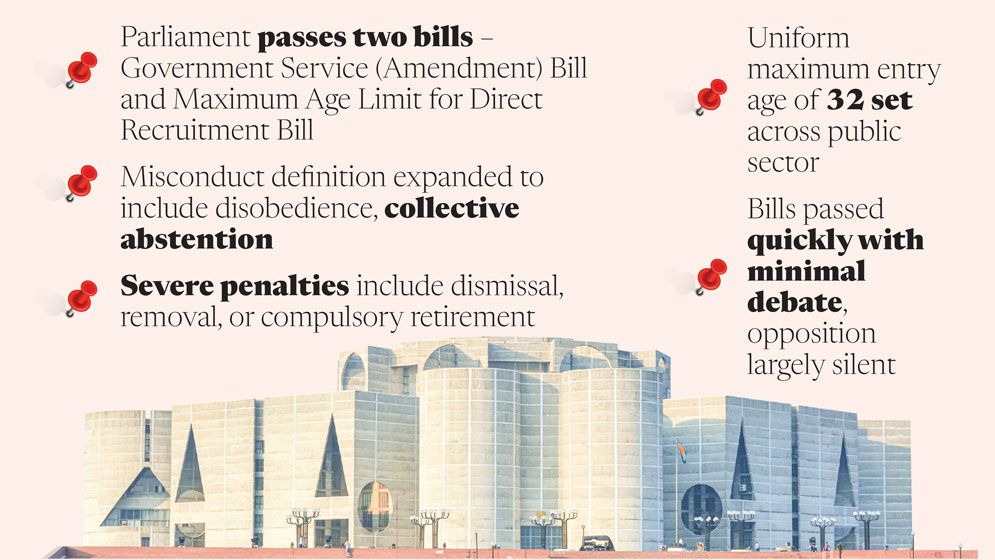
The 13th National Parliament on Sunday passed two landmark pieces of legislation aimed at overhaulng the country’s public administration, introducing stringent disciplinary measures for civil servants and establishing a uniform maximum entry age of 32 for government service.
In a session marked by swift proceedings, the Government Service (Amendment) Bill, 2026, was passed by voice vote in just under four minutes.
Presided over by Speaker Maj (retd) Hafiz Uddin Ahmed, the legislation converts an ordinance – promulgated during the previous interim government’s tenure – into law, significantly broadening the definition of professional misconduct.
Under the new provisions, “misconduct causing disruption in public service” now includes disobeying lawful orders or collectively abstaining from duties following a resignation. Those found guilty face severe penalties, including dismissal, removal from service, or compulsory retirement.
State Minister for Public Administration Md Abdul Bari told the House that the amendments were essential to “ensure accountability among public servants and establish discipline in the workplace.”
However, the lack of floor debate drew immediate attention. Opposition members remained silent during the voice vote, prompting a sharp rebuke from Chief Whip Nurul Islam Moni.
“The fighters of the July movement are present here,” Moni said, referencing the student-led uprising that reshaped the nation’s political landscape. “The anti-autocracy movement
began over opposition issues and the demand to increase the age limit. It is disappointing that [the opposition] did not say ‘yes’ today.”
The disciplinary crackdown follows a period of unrest within the civil service. After the interim government initially issued the ordinance last year, employees from various ministries staged day-long protests at the Secretariat.
The new law now formalises the state’s power to penalise acts of insubordination and the incitement of strikes.
Uniform age limit established
In a separate move, the parliament also passed the Maximum Age Limit for Direct Recruitment Bill, 2026.
The law sets a blanket ceiling of 32 years for entry into all cadres of the Bangladesh Civil Service (BCS) and non-cadre roles.
This 32-year limit will also apply to autonomous, statutory, and self-governing bodies. Notably, the Act mandates a reduction in the entry age for certain specialised roles where the limit had previously been as high as 45.
Opposition leader Shafiqur Rahman raised a point of order during the session, arguing that the 133 ordinances issued during the interim government – of which 98 have been recommended for passage – deserved individual, rigorous debate.
“Each ordinance is linked to the spirit of the July uprising,” he noted.
Responding to the concerns, Law Minister Asaduzzaman assured the House that while these specific bills had received unanimous committee approval, other ordinances would be placed before parliament gradually to allow for detailed scrutiny.
The passage of these bills marks a significant step in the administration’s efforts to standardise recruitment and curb the culture of bureaucratic protest, effectively codifying the transitional reforms initiated under the recent interim administration.
The laws now await the President’s assent.
Debate over the July Charter
The parliament once again witnessed heated exchanges between treasury and opposition members on Sunday over the July National Charter 2025, during a discussion held under Rule 62 of the Rules of Procedure.
During the two-hour debate on an adjournment motion, treasury bench members reiterated that the government is committed to fully implementing the July Charter, though not in accordance with the July National Charter (Constitutional Reform) Implementation Order, 2025.
They placed particular emphasis on determining an appropriate method for its implementation.
Opposition members, meanwhile, sharply criticised the BNP’s stance on the Charter and broader constitutional reform issues.
They argued that proposals such as the formation of an upper house, appointments through a neutral body, and a revised caretaker government framework had already been discussed in the referendum process. According to them, BNP’s current opposition reflects a reluctance to implement these provisions.
Rule 62 allows for adjournment motions, a rarely used parliamentary mechanism intended to facilitate urgent discussion on matters of significant public importance.
This marked the second such debate during the first session of the 13th National Parliament, and only the fifth instance in Bangladesh’s 53-year parliamentary history.
BNP MP Zainul Abedin Farroque, representing Noakhali-2, moved the motion, calling for an urgent debate on the roadmap for constitutional amendments and legal reforms outlined in the July Charter.
Speaker Maj (retd) Hafiz Uddin Ahmed presided over the sitting and initiated the discussion, suspending other scheduled business, including deliberations on the motion of thanks for the President’s address.
A similar two-hour debate had taken place on 31 March following a motion submitted by Opposition Leader Dr Shafiqur Rahman regarding the Charter’s implementation and the reform council.
However, no resolution was reached then, and Sunday’s proceedings likewise concluded without a decision, underscoring the persistence – and intensification – of political divisions over the issue.
In his motion, Farroque described the July Charter as a crucial document for achieving political consensus. He stressed that its method of implementation is a matter of pressing national importance, warranting thorough parliamentary scrutiny.
Participants from the treasury bench included Home Minister Salahuddin Ahmed, speaking on behalf of the Leader of the House and Prime Minister Tarique Rahman, Law Minister Md Asaduzzaman, and BNP MPs Mir Mohammed Helal Uddin, Barrister Andaleeve Rahman Partho, and Zainul Abedin Farooq.
From the opposition bench, contributions came from Opposition Leader and Jamaat-e-Islami Ameer Dr Shafiqur Rahman, NCP MP Akhter Hossen, and Jamaat MPs Barrister Nazibur Rahman Momen and Gazi Enamul Haque.
The July Charter is widely regarded as a foundational document for the “New Bangladesh” that emerged following the 2024 uprising. It outlines a range of reform proposals aimed at ensuring judicial independence, administrative transparency, and electoral integrity.
During the debate, NCP MP Akhter Hossen criticised BNP’s shifting position, alleging that the party was retreating from earlier commitments reached through the consensus commission. He suggested that BNP was attempting to revert to previous constitutional arrangements, including a presidential system.
He further noted that various stakeholders had previously called for the formation of a Constituent Assembly or a Constitutional Reform Council with substantive powers, but that such proposals now appeared to have been sidelined.
Treasury members rejected these accusations, asserting that they remain firmly committed to the Charter, which they described as a reflection of the people’s aspirations and the sacrifices made during the July uprising.
Law Minister Md Asaduzzaman strongly opposed the opposition’s proposal for a referendum on the Charter’s implementation process, describing it as unconstitutional. He argued that the Charter itself clearly outlines its implementation framework and does not require further validation through a referendum.
He also criticised the proposed referendum schedule for omitting key constitutional provisions while attempting to introduce them indirectly, characterising such efforts as legally invalid from the outset.
Describing the Charter as a document “written in the blood of martyrs”, the minister emphasised its symbolic and political significance.
He maintained that its implementation must follow constitutional procedures, particularly Article 142, which governs amendments.
Drawing a distinction between reform and amendment, he stated that while all constitutional amendments constitute reform, not all reforms necessarily require amendment.
However, he stressed that any reform must ultimately be enacted through parliamentary approval.
Home Minister Salahuddin Ahmed, in his remarks, underscored that constitutions are not “reformed” in abstract terms but are amended, repealed, or suspended through formal processes.
He affirmed the government’s commitment to incorporating the essence of the July Charter and Declaration into the Constitution, potentially within the Fourth Schedule.
He further stated that Parliament holds the sovereign authority to determine the form and scope of constitutional amendments.
He proposed the formation of a special parliamentary committee comprising government, opposition, and independent members to deliberate on the issue collectively.
Addressing historical amendments, the Home Minister criticised aspects of the 15th Amendment, noting that some provisions had already been declared unconstitutional by the High Court.
He indicated that the remaining provisions would be reviewed and, if necessary, repealed or amended by Parliament.
He also expressed the government’s intention to reinstate certain constitutional principles, including “full trust and faith in the Almighty Allah”, which had been removed in previous amendments.
Additionally, he highlighted plans to establish a 100-member upper house, with representation allocated proportionally among political parties, reflecting what he described as a public mandate.
Sound system disruption halts proceedings
Shortly after the Home Minister’s speech, a technical fault in the sound system disrupted proceedings, prompting the Speaker to adjourn the session until Monday.
Earlier, a similar malfunction had forced a temporary suspension of the sitting while Chief Whip Nurul Islam Mini was speaking. The session was also paused to allow for Maghrib prayers.
Emotional address on ‘Aynaghar’
Jamaat MP Barrister Mir Ahmed Bin Kasem Arman delivered an emotional speech concerning “Aynaghar”, referring to alleged secret detention facilities.
Speaking on a point of order, he claimed that many individuals, including himself, had been victims of repression during the previous regime. He recounted his own experience of detention and the fear of imminent death.
Arman also questioned proposals to repeal the Enforced Disappearance (Prevention and Remedy) Ordinance and the Human Rights Ordinance, arguing that such laws were necessary to prevent future abuses.
In response, Law Minister Asaduzzaman criticised the ordinance on enforced disappearances, suggesting that it prescribed comparatively lenient penalties.
He noted that existing provisions under the ICT Act 1973 classify disappearance as a crime against humanity, carrying far harsher punishment.
He nevertheless acknowledged the need for a robust legal framework to ensure justice for victims and accountability for perpetrators.
In concluding remarks, Speaker Hafiz Uddin Ahmed emphasised the responsibility of Parliament to enact stringent laws to ensure that such incidents do not recur in the future.
The reporters can be reached at: [email protected] and [email protected]