


 For all latest news, follow the Daily Sun's Google News channel.


Bangladesh is witnessing what many political observers are calling a “Tarique spring”, marked by the growing popularity of Tarique Rahman, chairman of the Bangladesh Nationalist Party (BNP). Across the country, people are flocking to see and hear him, placing renewed faith in his leadership, his pro-people political messaging and his approachable, conciliatory conduct at party programmes.Beyond Bangladesh’s borders, Tarique Rahman has also begun to attract international attention. Sections of the global media have highlighted his political prospects and his stated ambition to rebuild a country that, in his view, has been left in ruins after the fall of the Awami League government. Several international outlets have published analyses focusing on his leadership potential and the changing political landscape in Bangladesh. The UK-based weekly The Economist, for instance, recently described Tarique Rahman as the frontrunner to become Bangladesh’s next prime minister ahead of the general election scheduled for 12 February. In an analysis published in early February, the magazine referred to him as “the 60-year-old scion of a famous political family” and noted his leading position in the race.
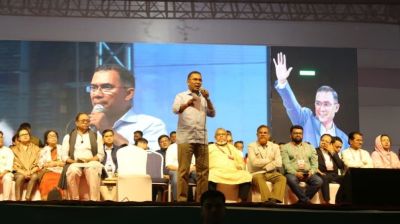
Similarly, the US-based TIME magazine, in an article published in late January, called Tarique Rahman the “clear front runner” in the upcoming election. The piece, partly based on an interview with him, stated that the polls were called following the ouster of Sheikh Hasina in a student-led popular uprising 18 months earlier.Alongside such international coverage, several local and international survey reports suggest that Tarique Rahman has emerged as the country’s most popular political leader at a time when many believe a leadership vacuum followed the death of his mother, former prime minister Khaleda Zia, widely regarded by her supporters as an uncompromising champion of democracy.The scale of Tarique Rahman’s popularity first became evident on the day of his historic return to Bangladesh. Since then, crowds from all walks of life have gathered wherever he goes, often just to catch a brief glimpse of him. To many observers, his ability to draw people in has evoked comparisons with the Pied Piper of Hamelin, as supporters follow him with remarkable enthusiasm, inspired by his words and actions.That emotional surge was most visible on 25 December 2025, the day of his return from London after nearly 18 years in exile. Millions of people from across the country converged on Dhaka, lining the streets and gathering along the Purbachal Expressway, the designated reception venue. The route from Hazrat Shahjalal International Airport to the Purbachal 300-foot road turned into a vast human sea, bringing much of the capital to a standstill.It took more than three hours for Tarique Rahman to reach the stage, as his red-and-green-decorated bus moved slowly through the crowds. Supporters waved national flags, carried the BNP’s symbol of the sheaf of paddy, beat drums and chanted slogans. Tarique Rahman responded by waving back continuously, creating an intensely emotional atmosphere.Addressing the reception rally, he struck a confident and forward-looking tone. “Standing on Bangladesh soil today, as a member of the Bangladesh Nationalist Party, I want to say before all of you that I have a plan for the people of my country, for my country,” he declared, drawing loud applause.His popularity was again on display during his subsequent election campaign. He began his nationwide electioneering in the Sylhet division on 22 January, after offering prayers at the shrines of Hazrat Shah Jalal and Shah Poran. The rallies that followed drew tens of thousands of people from surrounding districts, demonstrating a level of public mobilisation rarely seen in recent years.As his tour continued through Sylhet, Chattogram, Rajshahi, Rangpur, Barishal, Mymensingh, Khulna and Dhaka divisions, Tarique Rahman gradually shifted his emphasis from conventional political rhetoric to a development-focused narrative. He spoke repeatedly about rebuilding the country and restoring citizens’ rights, themes that appeared to resonate strongly with audiences. At each venue, crowds packed not only the rally grounds but also the surrounding roads, listening in near silence to his speeches.Local media have frequently described these gatherings as “human seas”, and the sheer scale of the turnouts has become a central topic of political discussion. After nearly two decades, Tarique Rahman has once again addressed public meetings at some of the country’s largest and most historic grounds. For the first time as BNP chairman, he has also been seen engaging directly and personally with supporters. Notably, a rally held in his own constituency of Dhaka-17 drew spontaneous participation from people of all backgrounds.Several factors appear to be driving this surge in popularity. One is the widespread expectation of new leadership after years of political turbulence. Many citizens see in Tarique Rahman the possibility of change and renewal. Another key factor is his repeated promise to restore democracy and return voting rights to the people, a message that has struck a chord with voters who feel politically disenfranchised.Economic proposals have also played a significant role. His much-discussed 31-point state reform plan includes pledges such as waiving agricultural loans, introducing family cards for women, farmer cards for cultivators and health cards for the general public, alongside commitments to tackle unemployment. These ideas have generated particular interest among young people and marginalised communities. In recent weeks, he has also made dozens of area-specific promises while campaigning in more than 20 districts.There is, finally, a strong emotional element. Tarique Rahman’s physical presence in the country after years of exile has energised supporters who remain deeply attached to the legacy of Ziaur Rahman and Khaleda Zia. Many ordinary citizens view him as a leader who has endured hardship for his stance against authoritarianism and for his efforts to restore democracy and people’s rights.

☀️
🌐
English
বাংলা
Russian
Hindi
Chinese