


 For all latest news, follow the Daily Sun's Google News channel.


Jiangxi Dialogue focuses on youth development
The opening ceremony also saw the signing of two cooperation agreements
Mohammad Saiyedul Islam, China Correspondent:
Published: 26 Sep 2026, 05:11 PM
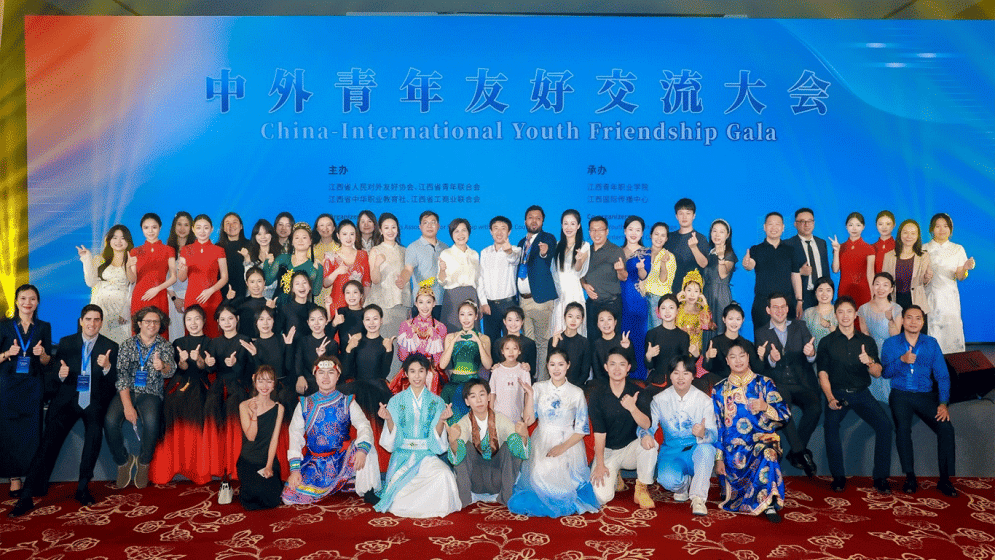
Photo: Daily Sun
Aiming to strengthen people-to-people friendship, youth exchanges and practical cooperation across borders, a youth dialogue held in China brought together voices from all over the world to explore how youth can drive cooperation, innovation and people-to-people friendship across borders.
The event titled “The Dialogue between Youth Leaders
from Jiangxi and International Friendship Partners at Different Levels 2026”
was held in China’s Jiangxi province from 21 to 25 September.
Under the theme “Energy of Youth for a Better
World,” the Dialogue combined high-level discussions with industrial visits,
business matchmaking and cultural exchanges, creating a platform where
international youth could move beyond dialogue to explore practical cooperation
in green development, economic and trade collaboration, vocational education
and youth development.
The event was hosted by the Chinese People’s
Association for Friendship with Foreign Countries (CPAFFC) and jointly organised
by the Jiangxi Provincial Association for Friendship with Foreign Countries,
the China Friendship Foundation for Peace and Development, the Jiangxi
Provincial Youth Federation, the Jiangxi Branch of the China Vocational
Education Association and the Jiangxi Provincial Federation of Industry and
Commerce.
More than 100 young participants from 25 countries,
including Bangladesh, Nepal, Cambodia, Indonesia, Sri Lanka, South Korea, Laos,
Thailand, Japan, Pakistan, Spain, Russia, Italy, Bulgaria, Ireland, France,
Portugal, Zambia, Algeria, Nigeria, Botswana, Argentina, Australia, New Zealand
and Fiji, as well as China’s Macao region, took part in the event.
Xia Wenyong, vice governor of Jiangxi Province, Sun
Xueqing, vice president of the CPAFFC, Anoop Ranjan Bhattarai, chairman of the
Nepal-China Executives Council, and Lopez, second deputy mayor of Alcorcón,
Spain, attended the opening ceremony and delivered speeches.
In his address, Xia Wenyong welcomed the
international participants and introduced Jiangxi’s economic and social
development. He emphasized the role of people-to-people friendship, sister-city
exchanges and youth engagement as important forces behind Jiangxi’s
international exchanges and opening-up.
Xia called on international partners to make better
use of their networks and resources to promote cooperation with Jiangxi’s
industrial chains. He also encouraged sister cities to maintain regular
communication, expand areas of cooperation and deepen mutual understanding and
cultural exchange.
Addressing the young leaders, he encouraged them to
act as ambassadors of friendship, strengthen mutual learning and sustain
cross-border friendships, thereby contributing youthful energy to long-term
cooperation.
Sun Xueqing said people-to-people diplomacy serves
as an important foundation for strengthening friendship among peoples and
supporting state-to-state relations. He encouraged international partners and
young leaders to make full use of their advantages in resources, technology,
networks and platforms to deepen practical cooperation and promote mutually
beneficial development.
He also called on young people to promote mutual
learning among civilisations with an open and inclusive outlook and to use
international cooperation and sister-city exchange platforms to build new
bridges connecting people and communities.
The opening ceremony also saw the signing of two
cooperation agreements. Ji’an City of Jiangxi and Alcorcón City of Spain signed
a cooperation agreement. In contrast, the Jiangxi Provincial People’s Association
for Friendship with Foreign Countries and the Cambodia-ASEAN Investors
Association signed another agreement, creating new channels for cooperation in
areas of mutual interest.
Bangladesh voices at the dialogue
Bangladesh was represented by two participants
invited by the Jiangxi Provincial Foreign Affairs Office. They are Mohammad
Tawhidur Rahman, chief executive of Lilliput Essentials Company in Bangladesh,
and Dr Mohammad Saiyedul Islam, senior lecturer and researcher at the School of
Overseas Education (School of Foreign Languages), Sanming University.
Mohammad Tawhidur Rahman took part in the dialogue
on “Youth Perspectives: Embracing Inclusive Collaboration for Win-Win
Development.” He shared perspectives on the role of young people in promoting
inclusive collaboration and mutually beneficial development.
Dr Mohammad Saiyedul Islam participated in the
International Symposium on Youth Development and the 9th Forum on the Communist
Youth League and Youth Development, where he delivered a presentation titled
“The Similarities and Differences in the Growth and Development of Chinese and
Bangladeshi Youth: Reflections from My Experience.”
Drawing on his experience of studying and working in
China, Dr Saiyedul discussed the similarities and differences he has observed
in the educational experiences, aspirations, and development paths of young
people in China and Bangladesh. His presentation also highlighted the role of
education, international exposure, and people-to-people exchanges in shaping
young people's development.
For the Bangladeshi participants, the event provided
an opportunity not only to exchange views with young representatives from
different countries but also to develop connections with Chinese institutions,
businesses and youth organisations.
From dialogue to firsthand experience
The programme extended beyond conference halls, with
participants visiting Ji’an and Fuzhou to gain firsthand knowledge of Jiangxi’s
economic and social development and explore opportunities for cooperation in
economic, trade, cultural and tourism sectors.
The delegation visited the Zixi County Two Mountains
Transformation Center, Dajue Mountain, Lingzhi Town, Wenchangli Historical and
Cultural Park, and Jiangxi Weijia Bamboo Culture Technology Co Ltd.
The field visits offered participants an opportunity
to observe local approaches to ecological development, cultural preservation,
rural revitalisation, and industrial development.
The “Two Mountains” concept, often associated with
the idea that lucid waters and lush mountains are invaluable assets, was
reflected in visits highlighting the integration of ecological protection with
economic development. Participants also experienced local cultural heritage and
tourism resources, gaining a closer understanding of Jiangxi beyond its
economic statistics.
The cultural experiences were designed to complement
the policy and business discussions, allowing participants to understand local
development through direct observation and interaction with communities and
enterprises.
Building connections among young people
The five-day programme brought together youth
representatives with diverse cultural, educational and professional
backgrounds. Discussions covered economic and trade cooperation, education,
vocational training, green development, cultural exchange and youth development.
The participation of representatives from 25
countries created opportunities for participants to compare experiences and
explore common challenges facing young people in different societies.
Organisers described youth exchanges and
people-to-people friendship as important components of international
cooperation. The programme sought to encourage young leaders to use their
respective networks and expertise to create new opportunities for cooperation
and strengthen understanding among peoples.
The event also reflected Jiangxi’s efforts to expand
international exchanges through sister-city relationships, youth organisations,
business networks and people-to-people diplomacy.
By combining thematic discussions with industrial
and cultural visits, the dialogue provided participants with both a platform
for exchanging ideas and an opportunity to see Jiangxi’s development firsthand.
For the international youth representatives, the
programme offered an opportunity to transform professional contacts into
personal connections and explore areas where cooperation could continue after
the event.
The Jiangxi dialogue concluded with a shared focus
on turning youth exchanges into lasting partnerships. Through face-to-face
dialogue, field visits and cultural experiences, participants gained a closer
understanding of Jiangxi while building connections that could support future
cooperation among institutions, businesses and young people.
As international challenges increasingly require
cooperation across borders, the gathering underscored the role of young people
in building bridges of friendship, promoting mutual understanding and creating
new opportunities for practical cooperation.