



 For all latest news, follow the Daily Sun's Google News channel.


Living on neighbours' kindness, charity
Cold winds in winter pass straight through
Kongkon Karmaker, Nilphamari
Published: 28 Jun 2026, 06:21 PM
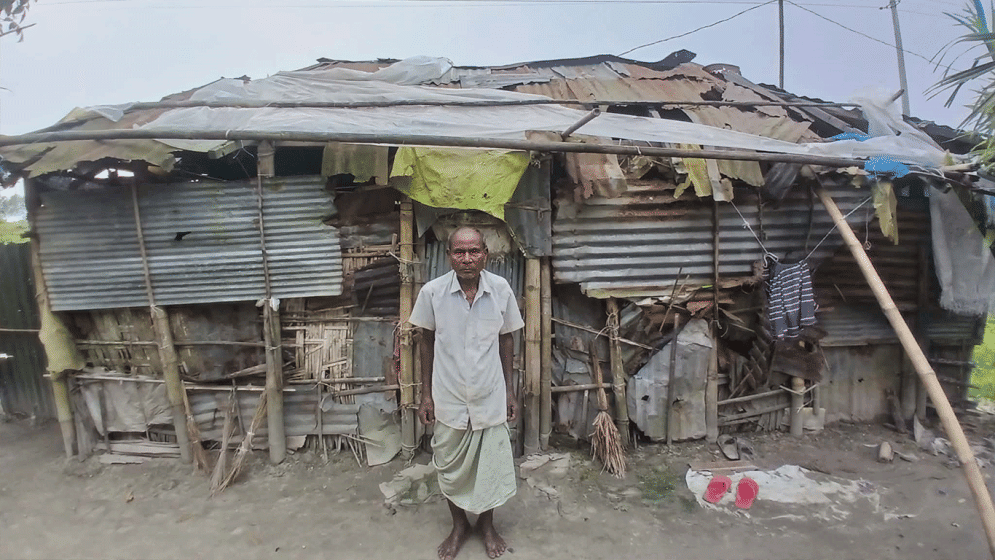
Durgacharan Roy in front of his thatched house in Nilphamari. Photo: Kongkon Karmaker
When clouds move over Kishoreganj upazila of Nilphamari district in northern Bangladesh, Durgacharan Roy, 60, starts getting ready. He drags old clothing into a corner, gathers whatever polythene he can find, and waits.
The tin roof begins to hammer. Water finds the holes–there
are many– and seeps through. By the time the storm is done, the floor is
submerged to the knee.
"When the storms come, I sit in a corner with
clothes and polythene over my head," he says. "What else can I
do?"
He is over 60, lives alone, and has for more than a
decade occupied a shack on the embankment of an irrigation canal in Madhyapara
village, Nilphamari district. Calling it a shelter is generous. The walls are
rusted tin sheets, palm fronds, plastic bags, old sacks, torn mosquito netting–
whatever was available, pressed together.
Cold winds in winter pass straight through. Snakes
come in through the gaps. So do frogs, insects, rainwater. The room offers the
idea of shelter more than the reality of it.
He and his late wife settled here about twelve years
ago. Landless, with nowhere else to go, the canal embankment was what they
could get. His wife died a decade back. His son married, moved away, and the
contact thinned out and then stopped entirely.
"I don't know where he is now,"
Durgacharan says. Just that, quietly.
He worked as a day labourer for years–the kind of
work where you are paid only for the days your body cooperates. His body
stopped cooperating. Now he has no income at all. He eats when neighbours bring
something. When they don't, he doesn't eat.
"Whatever people give me, I eat," he says.
"If nobody gives me anything, I stay hungry."
Moli Rani, who lives nearby, confirms it
matter-of-factly. "He cannot eat properly. Whatever neighbours provide, he
eats. Otherwise he has nothing." Harikrishna Roy puts it simply: "The
government should stand beside him. People who have the ability should also
help."
Bangladesh runs an elderly allowance programme–monthly
payments for low-income citizens over 60. Millions receive it. Durgacharan
qualifies by every measure that should count.
He has applied. Multiple times. He has walked to
government offices, asked local elected representatives, and waited for answers
that did not come.
"I've applied many times," he says.
"Nobody has given it to me. There's been no answer."
His roof leaks because repairs cost money he doesn't
have. His meals depend on whoever happens to feel generous that day. He knows
this clearly, without self-pity, as simple fact: "How can I repair the
house when I cannot even find food?"
After journalists raised his case, local officials
responded. The upazila social welfare officer said he was looking into the
matter and would try to get Durgacharan enrolled in government programmes quickly.
The UNO said officials would assess the situation and pursue available schemes
through social services and the union parishad.
These are not bad answers. They are just very late
ones.
Bangladesh's welfare architecture has grown
considerably over two decades. Elderly allowances, widow payments, disability
support–the coverage, on paper, is real. But the system works through local
administration, and local administration works through visibility. You have to
be known. You have to have someone who will put your name forward. You have to
be able to navigate offices that are not always easy to navigate.
For the landless, the isolated, the socially
peripheral–the people the programmes were ostensibly built for–that last step
can be the impossible one.
Durgacharan has been making that case for years,
getting nowhere. Old enough to qualify. Poor enough to qualify. Invisible
enough to fall through anyway.
As evening comes in over Madhyapara, he goes back to
the shack by the canal.
"I am a very poor man," he says. A pause.
"This sorrow–who do I tell it to?"