


 For all latest news, follow the Daily Sun's Google News channel.


Rare astronomical event to put sun above Kaaba on Arafat Day
According to astronomers, the event will take place at noon on Wednesday (27 May)
Gulf News, Dubai
Published: 25 May 2026, 04:16 PM

File Photo
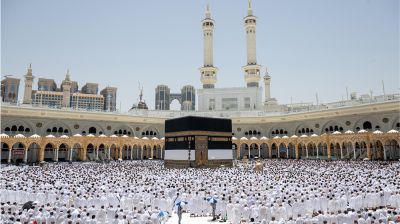
A rare astronomical alignment is set to coincide with one of the holiest days in the Islamic calendar this year, as the sun is expected to align directly above the Kaaba in Mecca on the Day of Arafat, a phenomenon that occurs only once every 33 years.
According to astronomers, the event will take place
at noon on Wednesday (27 May), corresponding to the ninth day of Dhul Hijjah
1447H, when the sun will stand directly above the Kaaba, causing shadows to
disappear completely in Mecca at the precise moment of alignment, Gulf News reported.
The phenomenon of the sun aligning above the Kaaba
normally occurs twice each year due to Mecca’s geographical location near
latitude 21.4 degrees north, as the sun appears to move between the equator and
the Tropic of Cancer.
What makes this year’s event unusual is its
coincidence with the Day of Arafat, a rare overlap last recorded in 1993.
Astronomers say the alignment results from differences between the lunar Hijri
calendar and the solar Gregorian calendar, with the lunar cycle requiring
roughly 33 years to realign with the same solar dates.
The National Center for Meteorology of Saudi Arabia
stressed that the alignment is a natural and recurring astronomical phenomenon
and does not necessarily lead to exceptional increases in temperatures.
The centre said weather conditions are influenced by
multiple climatic factors, including humidity levels, cloud cover, wind speed
and air mass movement, rather than the angle of sunlight alone.
Hussein Al Qahtani, official spokesperson for the
National Center for Meteorology, said the phenomenon is monitored annually as
part of normal astronomical observations, adding that claims linking the event
to unprecedented heat levels require scientific clarification.
He added that the centre relies on an integrated
system of observation stations, modern technologies and numerical forecasting
models to ensure the accuracy of weather data and temperature reports, urging
the public to rely on official sources for updates and forecasts.