



 For all latest news, follow the Daily Sun's Google News channel.


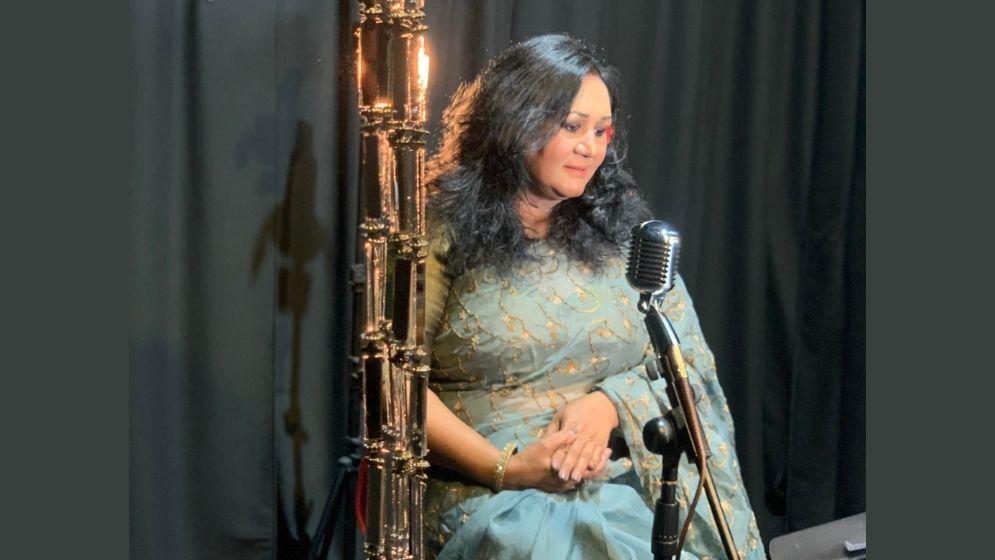
Photo: Courtesy
Fahmida Nabi is a noted vocalist of the country, celebrated for her versatility and emotive voice. Emerging from a distinguished musical family, she is the daughter of legendary singer Mahmudun Nabi. Fahmida gained popularity through playback singing and modern songs, earning critical acclaim for her expressive style. The National Film Award-winning singer has established herself as a leading figure in the country’s music scene, contributing significantly to contemporary Bangladeshi music.
In a candid conversation with the Daily Sun, the prominent artiste reflects on her recent work, the shifting values of the music scene, and the enduring need for authenticity in art. Here is an excerpt of the conversation.
What are you currently working on? Could you tell us about your recent musical projects?
I recently returned to the country after spending about two months abroad. In the meantime, I managed to complete some work, while a few projects are still pending. However, to be completely honest, I often find myself questioning the very foundation on which our music industry is functioning today. At its core, the music industry is meant to create songs--new expressions, fresh ideas--but I wonder, are we truly creating anything new anymore?
-69f35ba69b4e7.jpg)
What I see instead is a repetition of the past. Traditional forms like ‘palagan’ and ‘folk’ songs are being re-presented by contemporary artistes, often dressed in modern aesthetics, but without adding any meaningful originality. While there is nothing wrong with celebrating heritage, the absence of new compositions is concerning. The simplicity, vitality, and soul of songwriting seem to be fading away.
As an artiste, I feel incomplete if I’m not singing my own songs. Music is deeply personal to me-it is not just a profession but a way of life. So, I continue to create music in my own way and release it through my own platform. This is how I spend most of my time now. It doesn’t feel like conventional “work”; rather, it feels like a continuous search-an attempt to rediscover something new, something meaningful within myself and within music.
After such a long and successful career, how do you choose your projects these days?
When I approach a new project, I find myself instinctively following a familiar formula that I’ve developed over the years. If it’s a love song, I immerse myself in the emotion of love; if it’s about life, I try to embody that essence. It has almost become second nature--a rhythm I can’t easily break away from.
-69f35bc9ac003.jpg)
Of course, not every song resonates equally. Some compositions don’t quite work, while others stand out as truly good. I rely heavily on my instincts--when I listen to a piece, I try to feel whether it aligns with my experience and artistic identity. I believe in blending new ideas with my past journey, creating something that carries both familiarity and freshness.
However, one of the challenges I face is the lack of a dedicated producer. Everything I do, I have to manage myself--from conceptualisation to execution.
What are your thoughts on the current state of the music industry?
I believe we, as senior artistes, still have a lot to offer the younger generation. Unfortunately, there seems to be a reluctance to learn. Many young performers today are more focused on becoming celebrities rather than becoming true artistes.
But an artiste, in its purest form, is not defined by celebrity status. The idea of a “celebrity artiste” has become a trend, almost a cultural obsession. Yet, in reality, an artiste is simply an artiste--nothing more, nothing less. The pursuit of fame often overshadows the pursuit of artistic depth. This reality can be disheartening. There is a sense of disappointment, but that doesn’t mean I’m willing to give up. I still hold on to hope. I want to believe that something beautiful can emerge from this chaos--if not today, then perhaps tomorrow.
How has the industry changed since you began your career?
The changes have been significant. In our time, music had a certain authenticity. Take a song like “Ke Dilo Piriter Bera Lichhur Bagane”--it was rooted in palagan, carrying its own identity and cultural depth. Today, while the format has evolved, the essence of creation seems to be missing.
-69f35bb5e2b56.jpg)
What we often see now is the repackaging of old songs--adding modern beats, changing arrangements, and presenting them as something new. But in reality, nothing original is being created. Instead, this practice risks diluting the audience’s understanding of music.
There is also a contradiction in how the industry operates. We criticise those who fail to create original work, yet we continue to promote and support them. At the same time, genuinely talented individuals who strive to create something meaningful are often overlooked. This cycle has been repeating year after year.
Do you think the value of senior artistes in the industry is declining?
Senior artistes have always been undervalued to some extent, and that reality continues today. What is ironic is that today’s juniors will eventually become tomorrow’s seniors, yet the cycle of neglect persists.
If we look at neighbouring countries, we see a stark contrast. Senior artistes are treated with respect, and there is a structured system--especially in terms of royalties--that ensures their contributions are recognised even after their lifetime. For instance, songs by legendary singers continue to generate royalties, providing lasting value to their legacy.
Here, however, we are constantly struggling. There is a lack of respect and an unhealthy tendency to pull others down. Instead of uplifting one another, many are focused on competition in the most negative sense.
Today’s artistes seem to have more opportunities than those in the past. What is your view on this?
Yes, undoubtedly. Today’s artistes have far more opportunities compared to our time. Back then, there was a noticeable gap between generations, but there was also mutual respect and admiration. Music was pursued with sincerity, and there was less interference in each other’s creative journeys. Today, however, music has increasingly become a commercial product. When music is treated purely as a commodity, its essence begins to fade. True talent is not something that should be “used” and discarded like a product. Talent is infinite--it grows with nurturing and passion.
When love for music is replaced by market-driven thinking, the art itself suffers. That is one of the biggest challenges we face today.
How important are musical training and discipline for a singer in today’s fast-paced industry?
Discipline is essential-not just in music, but in every aspect of life. For an artiste, discipline takes on a deeper meaning. While artistes may have unconventional routines--staying up late, working through the night--their commitment to their craft must remain unwavering.
-69f35c4b87df3.jpg)
A single mistake in a song can disrupt the entire composition. That is why discipline is crucial. An artiste may think differently from others, may live differently, but that does not mean they can abandon structure and responsibility. In fact, the more creative an individual is, the more discipline they need to maintain balance. It is this discipline that shapes their art and sustains their career.
Is there any unfulfilled musical ambition or genre you still wish to explore?
As human beings, we are never truly satisfied--and that is what keeps us alive. Even the most successful individuals continue to seek something more. This desire to grow, to explore, to achieve--this is what drives us forward.
If I ever reach a point where I feel completely fulfilled as an artiste, that would mean I have stopped evolving. And to me, that would feel like a kind of death. I don’t want to exist in that state.
I still have dreams--many dreams--but the challenge lies in finding the right space to realise them. There is so much clutter in the industry today, along with strong egos that hinder collaboration. Ego, in particular, is one of the most damaging traits for an artiste. It prevents teamwork and stifles creativity. Respect, humility, and understanding are often missing, and without these, meaningful work becomes difficult. Despite these challenges, I still want to create. I still hold on to my dreams.
What’s your advice to new-generation singers?
Learning is a personal journey--no one can force it upon you. An artiste must have the willingness to learn from within. Challenges play an important role in this process, as they push individuals to grow and evolve.
For young singers, it is important to understand the true meaning of respect, love, and independence. Humility is essential--but it cannot be superficial. True humility comes from within, and without that inner sincerity, talent cannot fully flourish.
Art is deeply connected to the heart. If something does not come from within, it will not resonate with others. Those who are truly talented deserve respect, and I have great respect for young artistes who are sincere in their craft.
However, for those who ignore talent and focus only on superficial success, I have little to say. True artistry speaks for itself--and in the end, it is authenticity that endures.