



 For all latest news, follow the Daily Sun's Google News channel.


IMF talks to test govt’s reform resolve
Daily Sun Report, Dhaka
Published: 13 Oct 2026, 12:00 AM
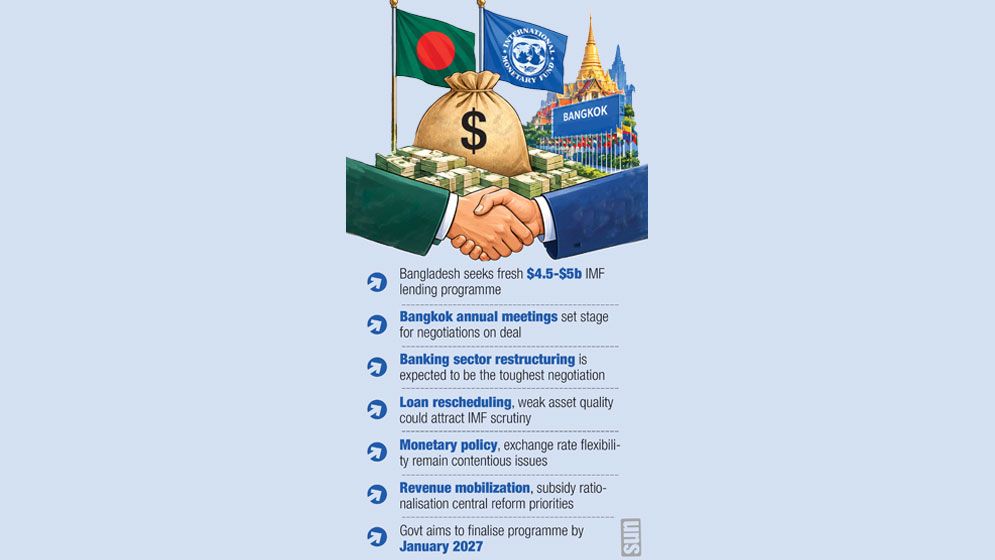
Bangladesh is preparing to negotiate a fresh $4.5 billion to $5 billion loan programme with the International Monetary Fund (IMF), with banking sector restructuring, higher revenue collection, subsidy rationalisation and exchange rate reforms likely to prove the biggest hurdles to an agreement.
The negotiations are expected to begin on the sidelines of the IMF-World Bank Annual Meetings in Bangkok, Thailand, on 12-18 October, where a high-level Bangladesh delegation led by Finance Minister Amir Khosru Mahmud Chowdhury is attending.
The government aims to finalise the programme by January 2027, although differences over reform conditions and implementation deadlines could delay a deal.
The IMF is expected to seek a credible plan to address weaknesses in the banking sector, complete outstanding reforms under the previous programme and strengthen macroeconomic stability.
An IMF mission that visited Bangladesh in July highlighted banking sector stress, weak revenue mobilisation and inflation risks, urging the government to boost tax collection, rationalise subsidies, maintain tight monetary policy and allow greater exchange rate flexibility.
Banking reform poses toughest challenge
The most difficult issue is likely to be establishing the true financial condition of troubled banks and setting out time-bound restructuring plans.
The IMF may demand more accurate assessments of non-performing loans (NPLs) and capital shortfalls, alongside credible measures for recapitalisation, management reform, asset quality improvement and loan recovery.
Dr Zahid Hussain, former lead economist at the World Bank’s Dhaka office, said the IMF might take issue with some recent measures adopted by Bangladesh Bank. Loan rescheduling could understate the extent of defaulted loans, while emergency liquidity support alone would not resolve structural weaknesses. Informal directives influencing foreign exchange rates could also conflict with the push for a market-based system, he said.
Dr Md Ezazul Islam, director general of the Bangladesh Institute of Bank Management (BIBM), said the IMF's proposed reforms were necessary to improve the banking sector, adding that they could become the biggest obstacle to finalising the new programme.
Monetary policy and loan concessions under scrutiny
Bangladesh Bank's decision to cut its policy rate despite persistent inflation could also draw questions.
In its monetary policy statement issued on 30 June, the central bank reduced the rate by 50 basis points, from 10% to 9.5%.
It kept the rate unchanged for the October-December quarter.
The IMF has repeatedly advocated tight monetary policy to contain inflation. Bangladesh Bank may therefore have to explain the rate cut and assess its implications.
Arief Hossain Khan, executive director and spokesperson of Bangladesh Bank, said the IMF might raise questions about the reduction but that the central bank would explain its decision in the context of prevailing economic conditions.
The IMF may also scrutinise loan rescheduling, restructuring and one-time settlement arrangements introduced this year. Under an exit policy launched in July, eligible borrowers can receive interest concessions by repaying loans in a lump sum.
Although the central bank says the measure will help genuinely distressed businesses resume operations, the IMF may question whether reclassified loans reflect sustainable repayment capacity or mask underlying asset-quality problems.
Exchange rate management is another likely point of contention. The IMF may seek greater transparency in rate-setting, less administrative influence and a clearer plan to improve market efficiency and foreign currency supply.
Revenue and subsidy reforms remain priorities
The IMF is also likely to press Bangladesh to widen its tax base, review exemptions and accelerate automation of revenue administration.
Discussions could cover a uniform 15 per cent value-added tax (VAT) rate, exemptions for selected sectors and deadlines for meeting revenue collection targets.
The government will need to balance higher collections against their potential effects on business costs, investment and consumers, making tax efficiency and fairness important alongside revenue growth.
Subsidies on electricity and fertiliser are also expected to feature in the talks. The IMF may seek a clear timetable for rationalising support and bringing public expenditure to more sustainable levels.
New programme follows exit from previous deal
Bangladesh previously secured a $5.5 billion IMF lending programme but exited after some conditions were deemed inconsistent with the new government's priorities.
The country is now seeking fresh financing amid persistent inflation, sluggish growth and pressure on foreign exchange reserves.
The proposed $4.5 billion to $5 billion facility remains a negotiating target, not a confirmed loan amount. Its final size, duration, disbursement schedule and conditions will depend on the outcome of discussions. Ministry of Finance sources said an IMF mission could visit Bangladesh in late October to advance negotiations.
The Bangladesh delegation is also scheduled to meet representatives of Fitch Ratings, JPMorgan, China's Vice Finance Minister Liao Min, China Exim Bank and Makhtar Diop, managing director of the International Finance Corporation.
Discussions are expected to cover the economy, investment, financing and cooperation with international financial institutions.
Read More