


 For all latest news, follow the Daily Sun's Google News channel.


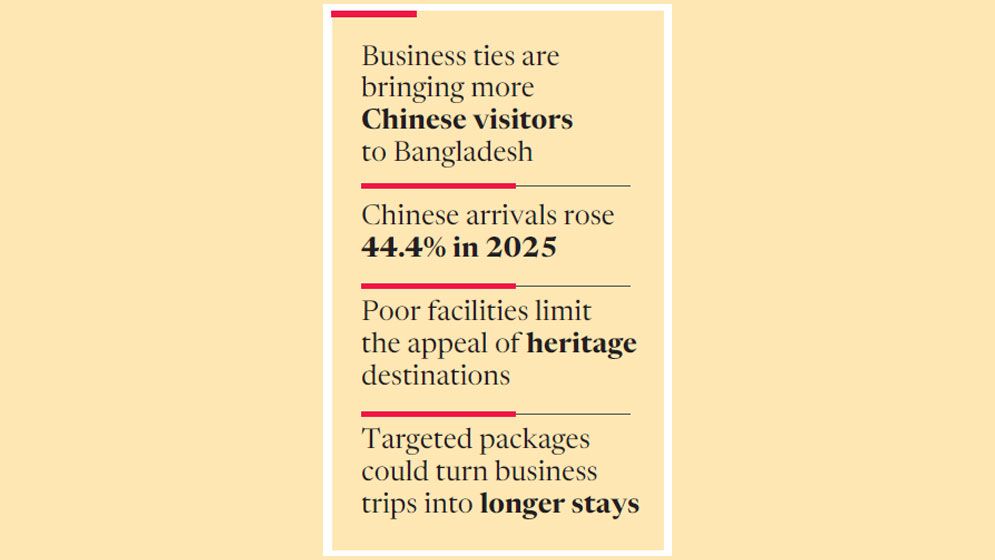
China’s expanding economic presence in Bangladesh is bringing more Chinese visitors to the country, creating an opportunity to turn business travel into a broader tourism market. But poor visitor facilities, limited travel packages and inadequate information continue to prevent Bangladesh from fully capitalising on its growing connections with China.
The shortcomings became evident when a Chinese visitor travelled to Bangladesh to explore its Buddhist heritage.
At the birthplace of Atish Dipankar, one of the region’s most celebrated Buddhist scholars, the visitor reportedly struggled to locate the site, with little effective signage and the driver having to ask local people for directions.
At Mainamati, an important centre of Buddhist archaeology, the visitor found few facilities for resting, using a washroom, eating or shopping after several hours exploring the historic complex, according to Masud Hossain, managing director of The Bengal Tours Ltd.
The experience highlighted a central contradiction: Bangladesh has significant cultural attractions but has yet to develop the services needed to turn them into compelling tourism experiences.
A growing Chinese footprint
Official data from the Special Branch of Police show that Chinese arrivals increased by 44.4% in 2025 compared with 2024. Tourism operators say the growth reflects expanding business, investment and people-to-people links between the two countries.
Masum Pervez, chief executive of Tourifye, said his company handled 10,822 visitors in 2024, around 60% of whom were Chinese. In 2025, the total rose to 12,059, with Chinese visitors accounting for approximately 90%. So far in 2026, the company has handled 11,793 visitors, around 85% of them Chinese, he told the Daily Sun.
These are company-level figures, not national arrival statistics, but they illustrate the growing importance of the Chinese market.
Chinese companies and professionals are active in Bangladesh’s infrastructure, energy, manufacturing, garments, textiles, chemicals, machinery and trading sectors. Their activities bring workers, executives, investors, business partners and officials to the country.
Md Mazharul Islam, deputy director of Statistics, Research and Planning at the Bangladesh Tourism Board, said the increase in Chinese visitors was closely linked to Chinese involvement in major projects and expanding business activities. “When the number of Chinese-led projects increases, workers and officials also come to Bangladesh,” he told the Daily Sun.
Chinese participation in exhibitions and trade-related events is also increasing, he added.
This growing movement gives Bangladesh an established connection with a substantial potential tourism market. Visitors arriving for professional engagements could return for holidays, bring their families or extend future business trips to explore the country.
Turning business travel into tourism
Many Chinese visitors, however, do not come primarily for leisure. Hossain said they often attend meetings, seminars, exhibitions and investment-related or official engagements before leaving.
“They come, attend meetings with the government or their counterparts and leave,” he said.
Such trips generate fewer opportunities for tourism spending than holidays involving several destinations, local restaurants, shopping and guided excursions.
Nevertheless, some Chinese visitors already explore beyond their business commitments. Pervez said they visit Dhaka, nearby resorts and heritage sites, sample local street food and go shopping. Accommodation preferences range from five-star hotels to smaller Chinese-run guesthouses and restaurants, particularly in Uttara.
The challenge is to encourage more visitors to stay longer and discover destinations beyond their immediate business commitments.
Turning heritage into an experience
Bangladesh’s Buddhist archaeological heritage could provide a starting point. Sites such as Paharpur and Mainamati connect the country with a wider Asian cultural history, while its rivers, wetlands, the Sundarbans, distinctive cuisine and historic settlements offer other attractions.
Hossain believes these assets could appeal to Chinese travellers, given Bangladesh’s historical links with the Buddhist world and the Maritime Silk Road. But he said the country had yet to package them into a coherent tourism product for the Chinese market.
The difficulties encountered at Atish Dipankar’s birthplace and Mainamati illustrate the gap between having attractions and delivering a complete visitor experience. Clear signage, digital maps, convenient transport, clean toilets, rest areas, food options, trained guides and reliable information are essential to making destinations accessible.
Nusrat Jahan, associate professor in the University of Dhaka’s Department of Tourism and Hospitality Management, said Bangladesh should tailor tourism offerings to specific markets rather than promote every destination indiscriminately.
“Every destination does not have to be promoted to every market,” she told the Daily Sun.
For Chinese travellers, she said, authorities should identify preferred destinations, improve information sources and strengthen communication with Chinese travel operators.
A Buddhist heritage circuit linking Paharpur and Mainamati, food and cultural tours, short Dhaka itineraries and nature packages featuring the Sundarbans could provide distinct options. Well-designed itineraries would make it easier for business visitors to add leisure trips to their schedules.
Building a China-ready tourism market
Improving the visitor experience must begin at the point of arrival.
Mohd Khorshed Alam, president of the Bangladesh China Chamber of Commerce and Industry, said Chinese visitors increasingly came to assess investment opportunities, explore business prospects and understand Bangladesh’s economic environment. Their growing familiarity with the country could become a valuable tourism asset, he told the Daily Sun.
But Khorshed Alam identified airport facilities, baggage handling, immigration procedures and ease of movement as areas requiring improvement. Difficulties entering the country, followed by inconvenient transport and poorly equipped attractions, can discourage visitors from returning or recommending Bangladesh to others.
Nusrat Jahan also stressed the need for quality accommodation, trained hospitality workers, suitable restaurants, better transport connections and accessible online ticketing.
Chinese-language information, digital maps and guides familiar with visitors’ needs could further improve the experience. Tourism authorities and operators should also work more closely with Chinese travel agencies to develop and promote suitable itineraries.
Rather than marketing hundreds of destinations at once, Bangladesh could initially concentrate on a small number of well-developed products supported by reliable services and convenient booking arrangements.
The aim is to make it easy for someone arriving in Dhaka for a business meeting to spend a weekend exploring the country instead of leaving as soon as the engagement ends.