


 For all latest news, follow the Daily Sun's Google News channel.


Waterlogging forces families into roadside shelters in Bhabadah
2 lakh people affected as crisis persists for nearly 3 months
Daily Sun Report, Benapole
Published: 20 Sep 2026, 12:00 AM
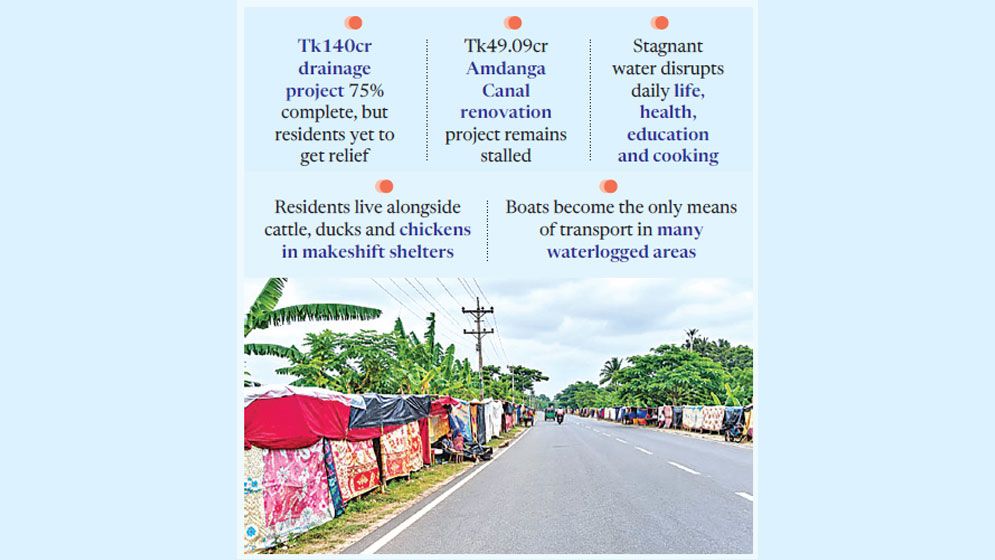
A tiny shelter made of polythene stands beside a road. Ducks and chickens occupy one side of the makeshift home, while a single cot takes up the other. At night, the entire family sleeps together on the cot.
Nearby, meals are cooked on an earthen stove under the open sky. Water stretches as far as the eye can see.
This is how several families in Dumurtala village of Abhaynagar upazila in Jashore’s waterlogged Bhabadah region have been living after their homes went under water. With roads and homesteads inundated, boats have become the only means of transport in many areas.
The waterlogging has persisted for nearly three months, affecting around two lakh people directly or indirectly across Abhaynagar, Manirampur and Keshabpur upazilas.
Despite the passage of three months, there has been little relief from the stagnant water. Prolonged waterlogging has disrupted normal life, while the health and education sectors are also facing growing challenges.
For many families, cooking and arranging daily meals have become increasingly difficult. Road communication has been severely disrupted as water levels remain high, leaving boats as the only means of movement in some areas.
Many affected residents have abandoned their flooded homes and taken shelter beside roads and on other elevated areas, where they are living with their cattle, ducks and chickens.
Shib Pada Biswas, a resident of Dumurtala village, said, “We have become aquatic creatures, living with snakes and frogs. The government and Allah together have turned us into water-dwelling creatures. We do not want to live like this.”
Leaders of the Bhabadah Water Drainage Movement Committee said they have been campaigning for years for a permanent solution to the waterlogging crisis.
Ranjit Baowali, convener of the committee, died after years of involvement in the movement without seeing a lasting solution to the problem. Committee leaders warned that if immediate measures are not taken to drain the stagnant water, they will once again organise sit-in programmes on the streets with farmers and workers.
During the Pakistan era, 21-vent, nine-vent and six-vent sluice gates were constructed over the Sri River at a place known as Bhabadah in Bhabanipur village.
Once considered one of the region’s major water-management projects, local residents now allege that the system has, over the years, contributed to the prolonged waterlogging that repeatedly affects surrounding communities.
A project worth around Tk140 crore is currently being implemented under the supervision of the Bangladesh Army, but affected residents say it has yet to bring them relief from the waterlogging.
Palash Kumar Banerjee, executive engineer of the Jashore Water Development Board, said around 75 per cent of the project work has been completed.
“Work is being carried out wherever obstacles to water drainage are being identified,” he said. “Once the river excavation is fully completed, we expect there will be no waterlogging in the area for the next five to seven years.”
Meanwhile, a separate project worth around Tk49.09 crore has been undertaken to renovate the Amdanga Canal, one of the major drainage routes for the Bhabadah region. However, despite the appointment of a contractor nearly two years ago, work on the project has yet to begin.
According to officials concerned, the contractor has been unable to start work because the district administration has yet to complete the required land acquisition.
Local residents allege that delays in renovating the Amdanga Canal and implementing other drainage infrastructure projects are prolonging their suffering.
Their question remains: if the water does not recede even after projects are approved and funds allocated, when will the people of Bhabadah finally see a permanent end to the crisis?