


 For all latest news, follow the Daily Sun's Google News channel.


China, Bangladesh for stronger co-op on higher education, research
Daily Sun Report, Dhaka
Published: 26 Aug 2026, 09:07 PM
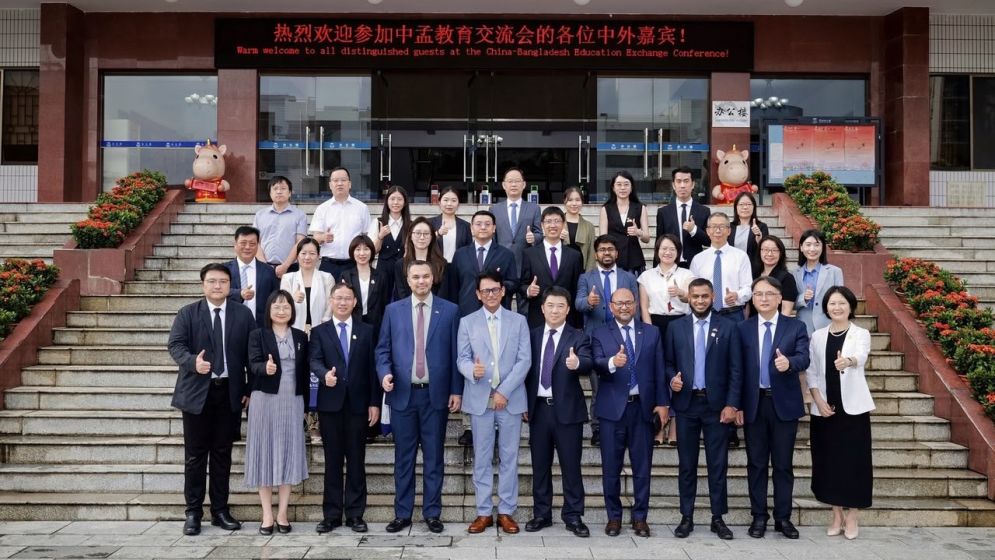
Photo: Courtesy
Officials from China and Bangladesh on Wednesday called for
further strengthening higher education cooperation and joint research
initiatives on the road to consolidating people-to-people ties between the two countries.
The two sides laid emphasis on the issued at the
“China-Bangladesh Education Exchange Conference” held at South China Normal
University in Guangzhou city of Guangdong province, China, on Wednesday.
The conference concluded with both sides expressing a strong
commitment to increasing university cooperation, academic exchanges and
long-term educational partnerships between China and Bangladesh.
During the conference, Bangladesh Prime Minister’s Adviser
for Education Mahdi Amin highlighted educational exchange as the key means of
strengthening people-to-people connectivity between Bangladesh and China.
He said, “We want to increase people-to-people ties between
the two countries, and education exchange can be the biggest means of doing so.
Our students will have opportunities to pursue higher education and research in
China, while Chinese students will also come to Bangladesh to participate in
summer schools and educational activities on various campuses.”
Highlighting the advantages of China’s current education
system, Mahdi Amin said efforts are also being made to regularly coordinate
with Chinese institutions on how to further improve the academic environment
and facilities for Bangladeshi students already studying in China.
However, stressing that simply sending students abroad is
not enough, the adviser emphasized joint research and technology transfer. He
said joint research and laboratory sharing are needed to gain experience from
the success of Chinese universities in research and global rankings. In
particular, he said, utilizing China’s experience in the technical education
and polytechnic sectors to train Bangladeshi teachers could bring significant
changes on the ground.
The adviser expressed hope that this bond would not remain
limited to theoretical discussions in classrooms but would bring together the
talent and expertise of the two countries in institutional and practical
fields.
He also stressed the importance of establishing “Chinese
Language Centers” in Bangladesh with the support of Chinese universities, which
would provide qualified teachers, well-structured courses, educational
materials and institutional support.
The adviser also invited officials from the Chinese
government and Chinese universities to visit Bangladesh so that they could gain
a better understanding of the country’s education landscape, engage directly
with Bangladeshi institutions, and explore practical opportunities for
long-term academic and institutional cooperation.
Education Minister ANM Ehsanul Haque Milon called for a
deeper and more structured educational partnership between Bangladesh and
China. He emphasized long-term cooperation among universities through joint
research, scholarships, student and faculty exchanges, short-term training, and
joint master’s and PhD programs. He also encouraged institutions on both sides
to develop sustainable academic partnerships.
At the conference, Xu Shimin, chief education officer at the
Guangdong province, reaffirmed the province’s commitment to international
education and its willingness to welcome more Bangladeshi students.
A total of 261 Bangladeshi students studied in Guangdong
during the 2024–2025 academic year, while 20 received Guangdong Government
Scholarships in 2025, Xu Shimin noted.
The conference was held as part of a Bangladeshi education
delegation’s three-day official visit to China at the invitation of the Chinese
government.
Earlier in the morning, a meeting on China-Bangladesh education cooperation was held. Discussions focused on four major areas: opportunities for Bangladeshi students to study in China, mutual cooperation between universities, joint research, and technical education and skills development.