


 For all latest news, follow the Daily Sun's Google News channel.


The silent exodus: Who will farm Bangladesh in 2050?
Ageing farmers, shrinking land and the future of food security
M Munir Hossain, Dhaka
Published: 21 Jan 2026, 12:00 AM
On a crisp winter morning in Bogura, 67-year-old Abdul Karim inspects his potato field with the ease of habit and muscle memory. The land has fed his family for generations; he knows its mood swings with the seasons, its risks, its limits.

Just a few hundred metres away, Abdul Karim’s nephew, 28-year-old Anis Rahman, monitors the pH levels of a hydroponic nutrient solution for his high-value strawberries, his tablet computer glowing in the poly-shed’s light.
One scene is the enduring image of Bangladesh’s agricultural past; the other, a fragile glimpse of its possible future.
This younger figure – Anis Rahman – is not one person so much as many. He is a composite portrait, drawn from conversations with educated young Bangladeshis who see a future in agriculture only if it looks nothing like the past.
Together, the two images frame one of Bangladesh’s most under-reported national emergencies: agriculture is ageing rapidly, even as food demand rises and arable land faces mounting pressures.
The question is no longer “whether young people, especially educated ones, are leaving farming” – they already have. The more urgent question is whether the country can invitingly reinvent farming to bring them back.
An ageing backbone
Agriculture remains a cornerstone of Bangladesh’s economy. It contributes roughly 11%-12% of GDP and supports livelihoods – directly and indirectly – for millions, according to government data. But its demographic foundation is shifting in ways that may prove destabilising.
Labour Force Survey data from the Bangladesh Bureau of Statistics (BBS) show a steady decline in agricultural employment over the past decade.
In 2010, about 19% of the total workforce was employed in agriculture. By 2022, that figure had dropped to 15.7%.
Among youth, the shift is even sharper. In 2010, nearly half of young workers aged 15–24 were engaged in agriculture. By 2022, that share had fallen to around 41%, reflecting both rural-to-urban migration and changing aspirations.
This demographic shift is also increasingly gendered; as young men migrate to cities, women are stepping in as the de facto managers of the fields, yet they remain tethered by a lack of formal land titles and credit access.
BBS data also point to an ageing farm population. While no official “average farmer age” is published, sectoral surveys and academic studies suggest a growing proportion of farm operators are now over 50 – a threshold that, in many contexts, signals retirement within a decade.
This trend mirrors global patterns, notes agriculture economist and researcher Dr Jahangir Alam, adding that declining agricultural labour, including among educated youth, is a normal feature of economic development.
“Almost every country in the world experiences this transition,” he says. “The key issue is not whether labour declines, but whether productivity declines.”
For Bangladesh, that distinction is critical.
Fewer hands, higher stakes
As agriculture’s share of employment falls, Bangladesh faces pressures unlike those of many countries that underwent similar transitions.
The population continues to grow, food demand is rising, and arable land is under constant threat from urbanisation and infrastructure expansion.
Between 2015 and 2020, agriculture’s share of total employment fell from roughly 43% to 39%, while service-sector jobs expanded. This structural shift is common across emerging economies.
But in Bangladesh – where the population exceeds 170 million and food imports already strain foreign exchange reserves – the margin for error is thin.
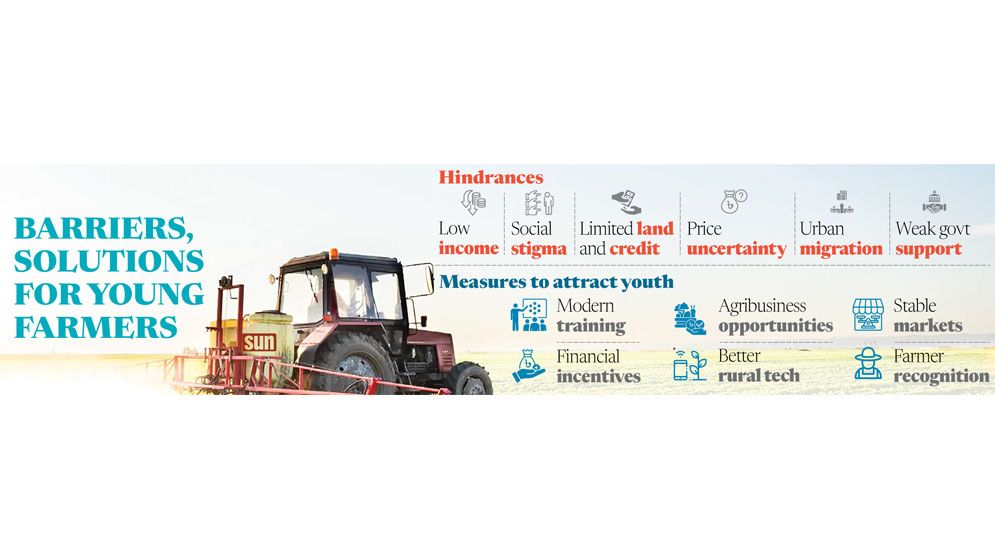
Income disparities compound the problem. Labour Force Survey data show earnings in agriculture remain 30%-40% lower than comparable jobs in industry and services, making farming an unattractive option for educated youth.
Dr Jahangir argues that reversing this trend does not require forcing people back to the land – but transforming who farms and how.
“We must ensure farmers are qualified, skilled and trained so they can adopt modern and mechanised methods,” he says. “If labour is skilled and technology is adopted, gross output will increase. Production costs will fall, and inflationary pressure will ease.”
In other words, fewer farmers can feed more people – but only if productivity rises sharply.
A policy contradiction: ambition without alignment
On paper, Bangladesh’s policy framework acknowledges this reality. Government strategies, five-year plans and sectoral roadmaps repeatedly emphasise modernisation, youth engagement and climate resilience.
In practice, implementation has lagged.
Multiple public agencies are tasked with production planning, price monitoring and market stabilisation. Yet coordination remains weak, and no institution produces a unified demand–supply forecast to guide planting decisions, imports or price intervention.
The consequences are visible. In recent years, potato farmers have repeatedly faced price collapses caused by overproduction, despite strong domestic demand. Without timely market signals or price support, farmers were left to absorb losses – reinforcing the perception that agriculture is unpredictable and risky.
“Young people see this volatility and walk away,” says Dr Jahangir, adding, “They don’t want a career where success depends on luck.”
At the local level, this disconnect between ambition and execution is equally evident. “We talk about agro-processing and value addition,” says Kawsar Ahmed, upazila agriculture officer of Jagannathpur in Sunamganj, “but unless raw material supply is assured and farmers are organised, processing plants end up benefiting traders more than growers.”
Budget promises, budget realities
The disconnect between policy rhetoric and outcomes is most evident in public spending.
In his fiscal 2025-26 (FY26) budget speech, the finance adviser reaffirmed the government’s commitment to strengthening agriculture, fisheries and livestock to ensure food security for a growing population.
But budget documents tell a more complicated story.
Total spending on agriculture, food, fisheries and livestock rose nominally to Tk39,620 crore. Yet agriculture’s share of the Annual Development Programme (ADP) declined from 5.0% to 4.7% – even as the sector faces intensifying climate stress, land loss and demographic decline.
More revealing is how the money is spent. A large portion of agricultural allocations continues to go toward fertiliser and input subsidies.
These subsidies play a stabilising role, protecting staple crop production and shielding farmers from price spikes. But economists describe them as largely defensive.
“What we are funding is survival, not transition,” says one agriculture policy analyst. “It helps older farmers maintain output, but it does little to attract young entrants.”
Dr Jahangir agrees that subsidies alone are not the answer – but insists profitability is non-negotiable.
“In countries like the United States, Germany, Japan or France, farming is lucrative,” he says. “Farmers earn well, enjoy better livelihoods, and income is relatively certain because governments support agriculture in many forms.”
“Farming must be made profitable here too through more subsidies and incentives,” he adds. “Only then will educated youth stay or return.”
Missing systems, rising risks
Experts argue that attracting young farmers requires shifting public investment toward system-building reforms that reduce risk and reward innovation.
One glaring gap is the absence of a functional warehouse receipt system. Without access to certified storage, farmers are forced to sell immediately after harvest, when prices are lowest. A warehouse receipt system would allow them to store produce, use receipts as collateral for loans, and sell when prices improve – a reform credited with stabilising incomes in countries such as India and Kenya.
Beyond storage, a fragmented cold-chain means nearly 25%-30% of high-value produce perishes before reaching urban markets – a logistical failure that effectively serves as a hidden tax on the farmer’s toil.
Crop insurance is another missing pillar. Bangladesh is among the countries most vulnerable to climate change. Research cited by FAO and national think tanks suggests a 1°C rise in temperature could reduce rice yields by up to 7% without adaptation.
Yet comprehensive crop insurance remains largely theoretical.
“For educated youth, the uncertainty is the biggest deterrent,” says Kawsar Ahmed. “A graduate considering farming knows that one flood or cyclone can wipe out years of investment. Without insurance or guaranteed buy-back arrangements, the risk is simply too high.”
Dr Jahangir stresses the need for climate-resilient crop varieties and cash support after disasters, alongside insurance. “Farmers need certainty,” he says. “Without it, investment will not come.”
The finance gap
Even when young people want to farm differently, access to finance remains a major barrier.
Bangladesh Bank’s revised agricultural credit policy emphasises modernisation, climate-smart agriculture and youth engagement. The central bank has raised the farm loan disbursement target to Tk390 billion for FY26.
But at branch level, the picture is far less encouraging.
A senior official at a Rajshahi Krishi Unnayan Bank branch in Mithapukur upazila, Rangpur, speaking on condition of anonymity, says the branch receives hundreds of applications each year from aspiring young agri-entrepreneurs – but approves only a handful.
“Decisions are often influenced by existing bank-client relationships,” he says. “Not by the quality of the project.”
Collateral requirements are a major obstacle. Banks routinely ask for security worth twice the loan amount, with land required to be mutated in the borrower’s name. This effectively excludes young farmers operating on leased land – a common reality in rural Bangladesh.
“If someone applies for Tk20 lakh, they must show Tk40 lakh worth of property,” the banker says. “If they had that kind of asset, why would they come to the bank?”
Upazila agriculture officer Kawsar Ahmed echoes this concern, arguing that low-interest loans and credit guarantees for youth-led farmer groups and local processors are essential if agriculture is to attract skilled entrants. “Easy-term finance is not a luxury,” he says. “It is the foundation.”
Dr Jahangir notes that agriculture receives only about 2% of total banking-sector loans – a figure he says must increase significantly, with priority given to skilled and educated farmers.
“Finance must be easy-term and accessible,” he says. “Otherwise mechanisation and modern farming will remain slogans.”
A failed return to the land
For many, a return to the land has proven unviable.
Thirty-five-year-old Mahmud (not his real name), a private-sector employee, lost his job in mid-2020 amid the COVID-19 pandemic.
He left Dhaka for his village home in Rangpur and tried his luck in agriculture on the 10 bighas of land he had inherited from his father. Investing his limited savings, he cultivated vegetables on two bighas, while the rest – low-lying and suitable mainly for rice – were used for rice farming and the trimester-based fattening of four cows.
Mahmud found that rice cultivation barely covered costs once hired labour was accounted for. Vegetable prices fluctuated sharply, collapsing during peak harvest periods because of seasonal oversupply. Cow fattening also proved discouraging, squeezed by high feed prices and entrenched syndicates among local butchers and middlemen.
Within a year, Mahmud estimates he lost around Tk3 lakh, including about Tk1.5 lakh spent building a cowshed, as volatile prices, rising input costs and limited bargaining power eroded his returns.
Discouraged, he began seeking urban employment once the pandemic eased and soon secured a job in Dhaka, returning to the capital.
“I feel I could continue agriculture,” he says, “had the market been devoid of middlemen and prices fixed or monitored properly.”
From labour to enterprise
For educated youth, the problem is not agriculture itself – but how it is structured.
“I don’t want to be known only as a chashi,” says Anis. “I want to be a producer, a brand, a business owner.”
Sub-sectors such as high-value horticulture, aquaculture, seed production, agri-processing and food logistics offer higher margins and reward skill and technology. FAO and World Bank research identify them as central to future food security and employment.
“Training is critical,” says Kawsar Ahmed. “Young farmers need skills in grading, quality standards, processing operations and Good Agricultural Practices if they are to produce for high-end or export markets.”
He adds that organising farmers into clusters or cooperatives and promoting contract farming can help ensure stable raw material supply, making agro-processing viable for both growers and investors.
Dignity, perception and the future
Beyond economics lies a quieter barrier: social perception.
Farming remains associated with hardship. Families urge educated children to leave the land, not modernise it.
“This is a crisis of dignity,” says a sociologist at the University of Dhaka.
Dr Jahangir agrees. “Social dignity will improve when farming becomes more profitable than other professions,” he says.
Kawsar Ahmed argues that recognising farmers as a dignified and technically skilled class – and involving trained professionals in policy-making – is essential if agriculture is to be seen as a modern career rather than a last resort.
A narrowing window
As the sun dips over Rangpur, Abdul Karim rests in the fading light. “Who will take over?” he asks.
For farmers like Mahmud, the exit has already happened. For Anis’s generation, the door is still ajar.
Whether it stays open depends on choices being made now – in budgets, banks, laboratories and classrooms.
The reporter can be reached at: [email protected]