


 For all latest news, follow the Daily Sun's Google News channel.


DU Hindi Department’s Educational Tour to India
A cultural bridge connecting Bangladesh and India
Anjay Ranjan Das
Published: 16 Oct 2026, 04:23 PM
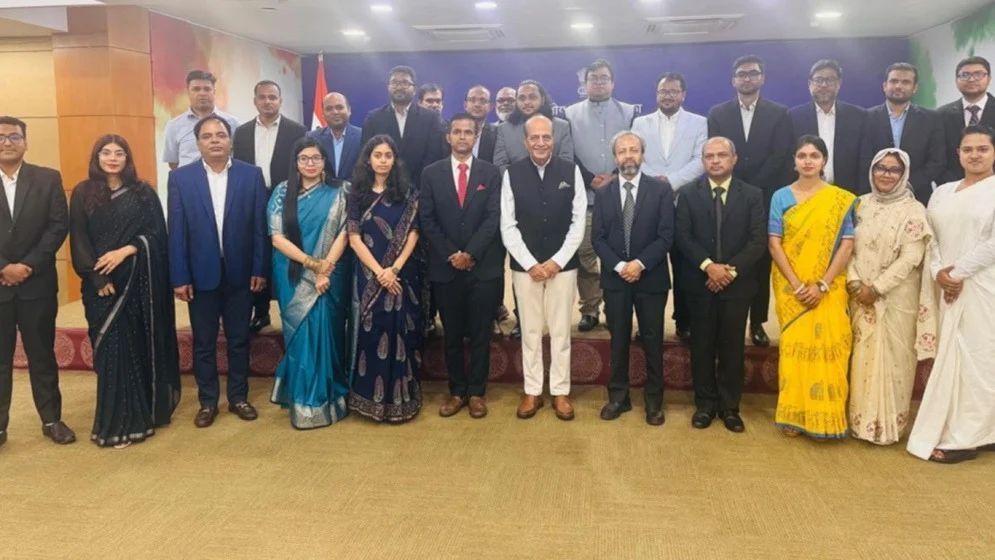
Members of the visiting delegation with Indian High Commissioner to Bangladesh Dinesh Trivedi. Photo: Collected
A 25-member delegation of students and teachers from the Hindi Language Department of Dhaka University’s Institute of Modern Languages has completed a 10-day educational tour of India, exploring the country’s linguistic, cultural and historical heritage while strengthening academic ties between the two neighbours.
The visit, held from 1 to 10 July under the Indian Council for Cultural Relations’ (ICCR) Student Tour Programme 2026–27, was jointly organised by the Indian High Commission in Dhaka and the ICCR.
Led by Institute of Modern Languages Director Professor Mohammad Absar Kamal, the delegation visited Delhi, the historic city of Varanasi and Agra, taking part in academic exchanges, institutional visits and cultural programmes.
The tour aimed to explore opportunities to improve Hindi language education at Dhaka University, expand access to academic resources and research, and strengthen links with Indian universities and specialised language-learning institutions.
Academic exchanges in Delhi
The delegation began its programme in Delhi on 1 July. The following day, it met Sahitya Akademi Secretary Dr Varun Gulati at Rabindra Bhavan before visiting Jawaharlal Nehru University (JNU).
At JNU, the team took part in an academic exchange with teachers and students in the presence of Professor Shobha Shivasankaran, dean of the School of Language, Literature and Culture Studies, and Professor Sudhir Pratap Singh, head of the Centre of Indian Languages.
The group also visited Delhi Public School in Vasant Kunj and the Piprahwa Buddha Relics International Exhibition at Qila Rai Pithora in Lado Sarai.
On 3 July, the delegation visited the Pradhanmantri Sangrahalaya and Humayun’s Tomb, a Unesco World Heritage Site, before meeting academics and students at the Hindi Department of the University of Delhi.
The exchange was attended by Professor Rajni Abbi, director of the university’s South Campus; Professor Urmi Nanda Biswas, dean of the Faculty of Arts; and Professor Sudha Singh, head of the Hindi Department.
The following day, the team explored the National Museum, Qutub Minar, the Red Fort and the historic Jama Masjid. In the evening, members watched the Hindi musical drama Shashi Punnu at the LTG Auditorium in Mandi House.
Varanasi and Agra: heritage and learning
On 5 July, the delegation travelled to Varanasi in Uttar Pradesh, where a cruise along the Ganges from Assi Ghat to Namo Ghat offered an opportunity to experience the city’s historic riverfront and ghats.
The next day, the team met Banaras Hindu University Vice-Chancellor Professor Ajit Kumar Chaturvedi and held an academic exchange with teachers and students of the university’s Hindi Department in the presence of its head, Professor Raj Kumar.
The delegation also visited Sarnath and the Sarnath Archaeological Museum, gaining insights into India’s Buddhist heritage.
After travelling via Delhi to Agra on 7 July, the group visited the Tomb of Itimad-ud-Daulah, Akbar’s Tomb at Sikandra and the Uttar Pradesh Handicrafts Complex.
On 8 July, the delegation visited the headquarters of the Central Institute of Hindi in Agra, where it met Director Professor Hari Shankar and exchanged views with teachers and students.
The programme also included visits to the Taj Mahal and Agra Fort, both Unesco World Heritage Sites, offering further exposure to India’s architectural, artistic and historical traditions.
Building bridges through language and culture
On 9 July, the delegation met ICCR Director General K Nandini Singla at Azad Bhavan in Delhi. She highlighted the role of young people, language and cultural exchange in strengthening the longstanding friendship between Bangladesh and India.
The team also met international students studying in Delhi under ICCR scholarships and attended a special lecture and demonstration on Indian classical dance.
The delegation returned to Dhaka on 10 July with experiences spanning India’s history, art, literature, languages and cultural diversity. ICCR Assistant Programme Officer SM Lotwal accompanied the group throughout the tour, helping coordinate its activities.
Following the visit, the Indian High Commission in Dhaka hosted a special interaction with delegation members on 20 July, chaired by Indian High Commissioner to Bangladesh Dinesh Dwivedi.
Welcoming the participants, Dwivedi said educational and cultural exchange programmes of this kind could play an important role in strengthening the longstanding friendship between the two countries.
Delegation members shared their experiences and thanked the Indian High Commission, including Counsellor Nirupath Singh and Second Secretary Pooja Jha, as well as the ICCR, for planning and implementing the tour.
The visit highlighted the potential for closer cooperation between Bangladeshi and Indian academic institutions, particularly in Hindi language education, research and cultural studies, while providing students with direct exposure to the language and heritage they study.
The writer is a teacher (Hindi Language), Institute of Modern Languages, University of Dhaka.
Email: [email protected]