




 For all latest news, follow the Daily Sun's Google News channel.


US stocks soar as Nvidia reinstates Huang, reviving AI trade
Reuters, Milan
Published: 23 Nov 2026, 10:03 PM
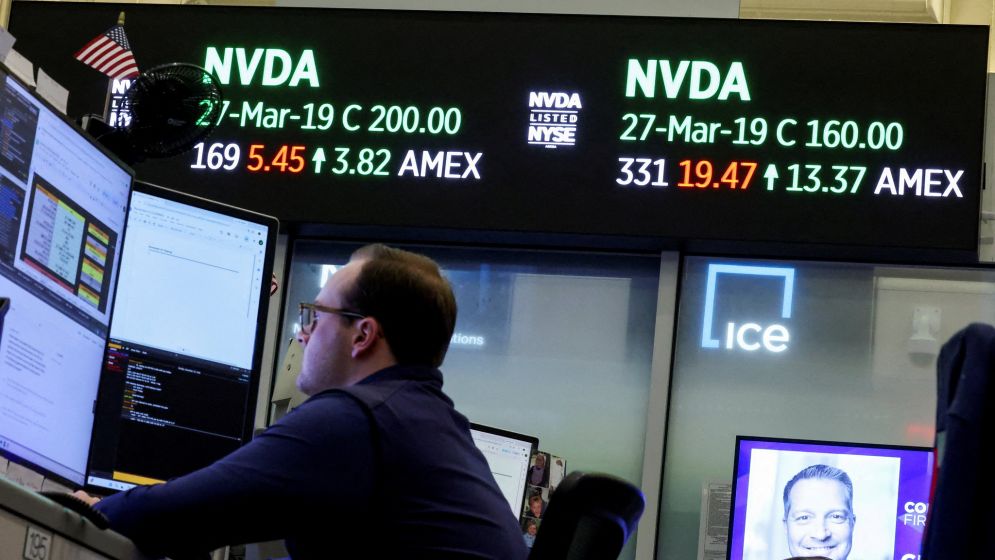
NVIDIA trades are displayed on a ticker, as a futures-options trader works on the floor of the New York Stock Exchange's NYSE American (AMEX), after Nvidia's board reinstated Jensen Huang as CEO, in New York City, US, 23 November 2026. Photo: REUTERS
US stocks soared on Monday after Nvidia reinstated Jensen
Huang as chief executive with immediate effect, ending a leadership crisis at
the chipmaker that had helped trigger last week's global market rout.
Nvidia shares surged 33%, driving a broad rally across
chip-related and technology stocks on Wall Street. The Nasdaq 100 rose more
than 6% by 1434 GMT and the S&P 500 added more than 4%, while Europe's
region-wide STOXX 600 extended gains, rising by 1.5%, led by semiconductor and
other technology stocks.
The Nasdaq-100 was on track for a more than $2 trillion
surge in market value on Monday, and was set for its biggest one-day percentage
gain since April 2025.
The Nvidia rally marked an extraordinary reversal for the
company that followed calls from US President Donald Trump for his return after
Huang resigned over revelations of extramarital affairs, including one with an
alleged Chinese spy.
The rebound followed Nvidia's announcement it had reinstated Huang as CEO, an extraordinary reversal after his departure fuelled doubts over the AI investment boom. Huang resigned amid reports of extramarital affairs, including one with a woman suspected of being a Chinese spy.
"It's better than a soap opera," said Andrea
Scauri, senior portfolio manager at Lemanik in Milan.
"Joking aside, it's obvious that putting Huang back in
charge of Nvidia removes any doubts the market may have had about the support
Nvidia will continue to provide to the companies it is currently financing,
both on the debt side and through equity."
President Donald Trump welcomed the reinstatement of Huang
as CEO, saying his return poses no risk to US national security.
US lawmakers from both parties, however, offered sharp
criticism of Nvidia's decision to reinstate Jensen Huang as CEO and said
Congress must pass legislation to crack down on US chip exports to China and
get answers.
Representative Don Bacon, a Republican, said, "Huang
was compromised and exploited by a Chinese spy. Nvidia should have moved on
without Huang and ignored the administration’s inexplicable desire to save Huang.
Congress needs to get to the bottom of who approved high-end computer chips
sales to China."
Huang has
separately agreed to a closed-door interview with three House committees,
slated for 1 December.
Democratic Representative Debbie Dingell said the Nvidia
board "made an irresponsible decision to reinstate Jensen Huang before
Congress has even heard from him regarding national security concerns. The
board must explain why it was willing to move ahead without those
answers."
AI spending doubts
Investors have increasingly questioned whether the vast sums
being poured into AI data centres will generate enough returns to justify the
investments.
The leadership crisis at Nvidia, expectations of tighter Federal Reserve policy and fears AI-related spending could slow after the US midterm elections amplified these concerns.
Last week's 10% drop in the Nasdaq was its biggest decline
since the March 2020 pandemic-driven selloff, while volatility pushed Wall
Street's so-called fear gauge above 40 for the first time since April 2025.
Deutsche Bank strategist Jim Reid said fears surrounding the
AI trade had spread into a broader risk-off, prompting investors globally to
seek liquidity.
"This was no longer simply a tech selloff," he
wrote.
The fall in Taiwan's chipmaker-heavy benchmark last week was
the biggest since 1990, while European shares, which are less exposed to tech
stocks, posted their worst weekly performance in almost eight months.
On Monday, Taiwan stocks rose 2.4% before Nvidia's
announcement, with government support helping to stabilise the market. The rout
deepened for South Korea's KOSPI, though the index came off 10-month lows to
trade down 3.3%.
The KOSPI was global equities' leading light in the first
half of this year, as bets on chip demand more than doubled the index's value
in six months.
Following the selloff, the index has halved from its peak,
and South Korea's finance minister reiterated on Monday the government's plans
to stabilise the market if necessary.
Taiwan's financial regulator has ordered a tightening of
short-selling rules for stocks, while in China, stock exchanges announced a
batch of support measures such as easing requirements for margin financing.
Safe-haven demand into US bonds, meanwhile, reversed after
Friday's surge, with US 10-year Treasury yields adding around 6 basis points to
4.97%.
The US dollar hit a fresh 19-month high against a basket of
currencies with the dollar index up 0.3% at 104.1.
Gold also extended gains to trade up 4.3% at $3,683 per
ounce. Bitcoin rallied more than 4%.
Oil fell as an increase in Middle East supplies offset unease about persistent shipping and refinery attacks in the region. Brent was down 2% at $90.7 a barrel.