


 For all latest news, follow the Daily Sun's Google News channel.


China, Bangladesh eye deeper cooperation under Belt and Road Initiative
Chinese envoy highlights political trust, industrial collaboration, green energy and digital economy as key areas for future partnership
Daily Sun Report, Dhaka
Published: 23 Nov 2026, 02:39 PM
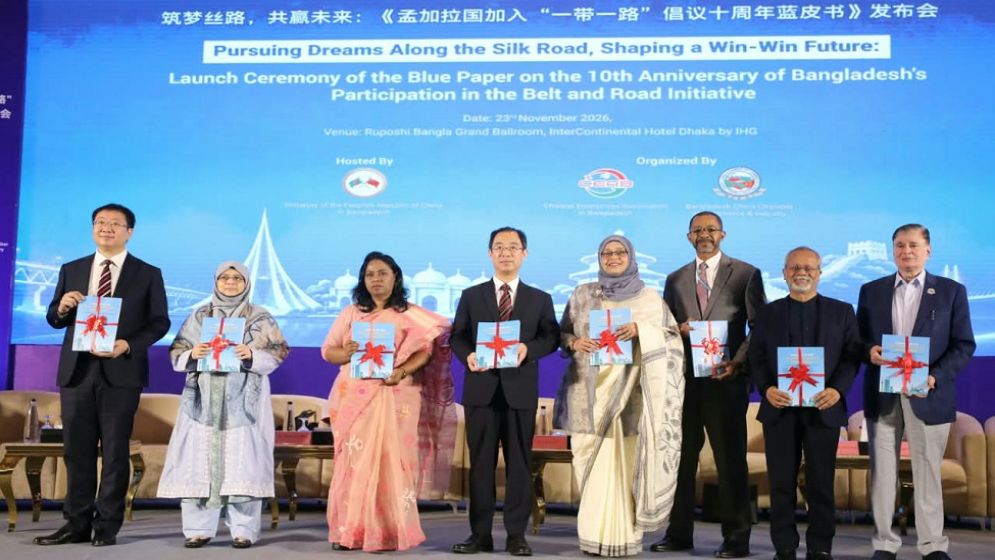
China, Bangladesh eye deeper cooperation under Belt and Road Initiative. Photo: Kamrul Islam Ratan
China and Bangladesh should expand cooperation under the Belt and Road Initiative (BRI), focusing not only on infrastructure but also on trade, technology, green energy, healthcare, education and the digital economy, Chinese Charge d’Affaires to Bangladesh Dr Liu Yuyin said on Monday.
He said political trust, mutual respect and economic cooperation had been the main drivers of progress in bilateral relations over the past decade.
“Looking ahead, China stands ready to work hand in hand with Bangladesh to move beyond hard connectivity towards greater soft connectivity,” he said.
Liu was speaking at a conference titled “Pursuing Dreams Along the Silk Road, Shaping a Win-Win Future: Launch Ceremony of the Blue Paper on the 10th Anniversary of Bangladesh's Participation in the Belt and Road Initiative” at Hotel InterContinental in Dhaka.
The Chinese Enterprises Association in Bangladesh organised the event.
Liu said BRI cooperation had made remarkable progress over the past 10 years, backed by political guidance from the leadership of both countries.
Recalling Chinese President Xi Jinping's visit to Bangladesh on 14 October 2016, he said the two countries signed a memorandum of understanding on BRI cooperation during the visit. It was the first intergovernmental agreement on joint Belt and Road cooperation between China and a South Asian country, he added.
Highlighting the development of bilateral ties, Liu said relations had evolved from a strategic partnership of cooperation in 2016 to a comprehensive strategic cooperative partnership in 2024 and, further, to a China-Bangladesh community with a shared future in a new era this year.
He said China firmly supported Bangladesh in protecting its independence, sovereignty and territorial integrity, while respecting its right to pursue a development path suited to its national conditions.
Bangladesh, in turn, adhered to the One-China principle and opposed Taiwan independence in any form, he said.
According to Liu, mutual respect and support on each other's core interests had laid a strong foundation of trust for long-term cooperation in project financing, security guarantees and policy coordination.
He said China did not seek to export its development model, impose its will or attach political conditions to cooperation with other countries.
“Every bridge built by China is a bridge for Bangladesh, and every road constructed is a road for Bangladesh,” he said.
Liu also highlighted China's Global Development Initiative, proposed by President Xi Jinping at the 76th session of the United Nations General Assembly in September 2021, as a complement to BRI cooperation.
The initiative could help Bangladesh improve infrastructure, strengthen resilience and build local capacity, ensuring that development capabilities remain rooted in the country, he said.
On economic cooperation, Liu said China's economic growth and industrial capabilities offered significant opportunities for Bangladesh, particularly in the readymade garment, food processing, leather and fisheries sectors.
He said China's consumer market of more than 1.4 billion people could provide substantial opportunities for Bangladeshi products.
He also identified textiles and garments, photovoltaic modules, battery energy storage, electric vehicle assembly and electronic information industries as potential areas for expanding industrial cooperation.
“Industrial chains are evolving from ‘Made in China’ towards a new model of ‘Chinese technology plus Bangladesh manufacturing’,” he said.
Liu also stressed the importance of exchanging governance experience, saying China was ready to share its experience and strengthen cooperation with Bangladesh for the benefit of the peoples of both countries.
Referring to the next phase of bilateral relations, he said this year marked the beginning of a new golden 50 years of diplomatic ties between the two countries.
He recalled the recent visit of the Bangladesh prime minister to China and the meeting with President Xi Jinping, during which the two sides jointly announced their decision to build a China-Bangladesh community with a shared future in a new era.
Outlining future priorities, Liu called for better coordination between major infrastructure projects and smaller initiatives aimed at improving people's livelihoods. These include projects in ports, railways, roads, bridges, power generation and water management.
He also called for stronger cooperation in green and low-carbon development, the digital economy, artificial intelligence, solar energy and information and communication technology.
China was ready to combine its technological and industrial strengths with Bangladesh's young population, while expanding market access and cooperation in education, healthcare, youth exchanges and think tanks, he said.
Expressing optimism about the future of bilateral relations, Liu called for continued efforts to strengthen friendship and partnership over the next decade.
“Let us continue to be trusted friends, good neighbours and close partners in the next decade to take Belt and Road cooperation to new heights,” he said.