


 For all latest news, follow the Daily Sun's Google News channel.


IMF-WB talks open new financing prospects
Bangladesh seeks $10b in extra WB loans, eyes $4.5b IMF deal
Daily Sun Report, Dhaka
Published: 19 Oct 2026, 12:00 AM
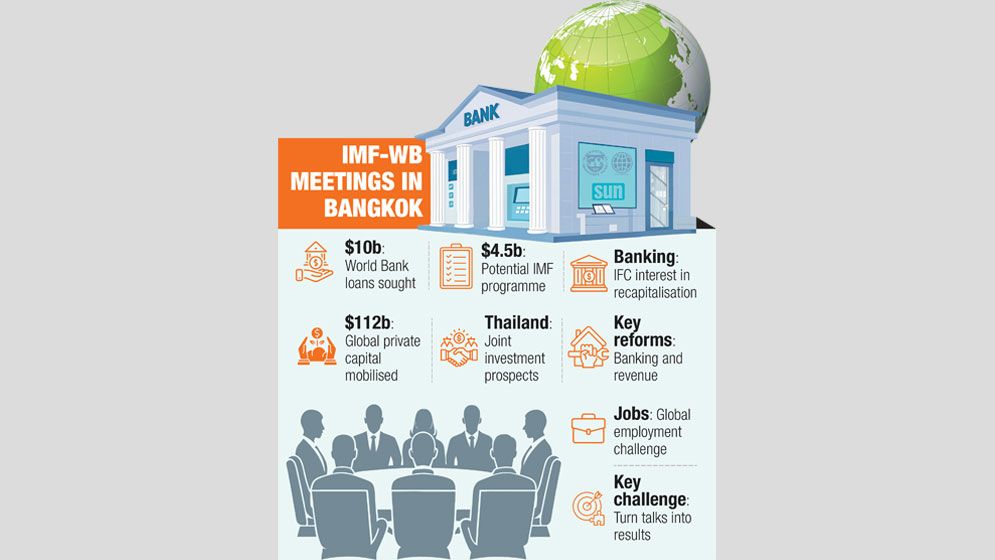
Bangladesh has wrapped up its participation at the World Bank-IMF annual meetings in Bangkok after seeking billions of dollars in fresh development financing, though the week-long summit ended without any major loan approvals or signed investment deals.
During the talks held on 12-18 October, Finance and Planning Minister Amir Khosru Mahmud Chowdhury led the Bangladeshi delegation in requesting an additional US$10 billion in World Bank loans over the next three years, citing rising state spending pressures triggered by elevated global energy prices.
The delegation also advanced negotiations on a proposed $4.5 billion IMF programme.
On the private-sector front, the International Finance Corporation (IFC) signaled interest in supporting the recapitalisation of Bangladeshi banks, while bilateral discussions with Thailand laid groundwork for potential trade and industrial cooperation.
While officials noted that the meetings established a valuable framework for future financing, all proposed loans remain subject to further negotiation, with no firm investment commitments finalised.
The requested funds would come on top of the World Bank’s regular assistance to Bangladesh.
The government aims to build a financial buffer over the next two to three years to cushion the economy against external shocks.
Bangladesh and the World Bank are also working to finalise a three-year Country Partnership Framework (CPF), which will determine the institution’s future development priorities and areas of support.
A Finance Ministry official clarified that the $10 billion was a request, not an approved loan. The amount eventually available, along with borrowing terms and disbursement schedules, will depend on further negotiations.
Additional financing could ease pressure on the national budget, particularly energy expenditure, although its benefits would depend on borrowing costs, repayment obligations and attached conditions.
IMF talks advance, but reforms remain a challenge
Bangladesh also made progress in discussions with the IMF over a potential new loan programme worth around $4.5 billion.
Following a meeting with IMF Deputy Managing Director Nigel Clarke on 15 October, the finance minister said negotiations were progressing well, although some issues remained unresolved.
The discussions focused on banking sector reforms, raising the tax-to-GDP ratio and maintaining macroeconomic stability.
A finance ministry official said the government preferred to implement reforms gradually rather than introduce multiple measures simultaneously.
Bangladesh wants international lenders to consider its economic circumstances and institutional capacity when determining the pace of reforms, the official added.
A new IMF programme could help strengthen external financing and restore confidence in the country’s economic management. However, no final approval or disbursement was announced in Bangkok.
Banking and revenue reforms remain central to the negotiations, with their implementation likely to influence both future IMF support and investor confidence.
IFC interest raises hopes for bank recapitalisation
Potential foreign investment in Bangladesh’s troubled banking sector emerged as another significant development during the meetings.
The finance minister said the IFC had expressed interest in supporting the recapitalisation of local banks, while private equity investors had also responded positively. Their participation could help reduce pressure on public finances as Bangladesh seeks to address capital shortfalls and restore the financial health of struggling lenders.
However, no investment commitments have been confirmed. The amount of potential investment, financing terms and any required changes to bank governance and management remain unclear.
Experts say fresh capital alone will not resolve the sector’s longstanding problems without stronger regulatory oversight, improved accountability, effective loan recovery and transparent financial reporting.
Private capital offers another financing avenue
Beyond traditional development loans, Bangladesh explored opportunities to attract greater private investment through financing mechanisms promoted by the World Bank Group.
These include investment guarantees, risk-sharing arrangements, local-currency financing and stronger domestic capital markets.
According to World Bank Group figures cited during the discussions, the institution helped mobilise $112 billion in private capital for developing economies in the 2026 financial year, compared with $35 billion in 2022.
The figures represent financing mobilised across developing economies, not funds secured specifically for Bangladesh.
Such mechanisms could help Bangladesh attract long-term investment in energy, renewable power, transport infrastructure, manufacturing, technology and climate-resilient projects.
However, converting these opportunities into investment will require better project preparation, lower investment risks and a more predictable business environment.
Thailand talks explore trade, joint production
Bangladesh also held discussions with Thailand on expanding trade, investment and industrial cooperation, particularly in agro-processing, halal food products and joint manufacturing.
The two countries explored ways to combine Bangladesh’s workforce, agricultural resources and domestic market with Thailand’s technology, manufacturing expertise and access to regional markets.
Such partnerships could promote technology transfer, increase value addition and generate employment, particularly in agro-processing and export-oriented industries.
Discussions also covered potential maritime connectivity between Thailand’s Ranong port and Chattogram port, which could strengthen regional supply chains and facilitate trade.
However, the proposals remain at an exploratory stage, with no specific investment amounts, binding agreements or implementation schedules announced.
Reforms, implementation hold the key
Bangladesh used the meetings to highlight its broader economic priorities, including fiscal discipline, higher revenue collection, banking sector stability, stronger social protection, industrial development and job creation.
The government has sought to align its reform agenda with the expectations of international development partners while retaining flexibility over the timing and sequencing of reforms.
The challenge will be to strengthen public finances and the banking system without placing additional pressure on low-income households already struggling with rising living costs.
Employment generation remains another major concern.
The World Bank Group estimates that around 120 crore young people in developing economies will reach working age over the next 10 to 15 years, while only about 42 crore new jobs are expected to be created during that period.
The projections highlight the need for greater investment in productive industries, small and medium-sized enterprises, technology, agro-processing and export-oriented businesses.
For Bangladesh, access to financing will need to be accompanied by workforce development, lower business costs, efficient project implementation and stronger investor confidence.
Economist Mohammad Muslim Chowdhury said annual meetings of the World Bank and IMF generally served as platforms for bilateral discussions rather than final decisions on major financing arrangements.
He described the reported progress in Bangladesh’s discussions as encouraging but stressed that tangible outcomes would depend on implementation.
He also pointed out that the IMF had repeatedly emphasised banking and revenue reforms under both previous and potential new lending programmes.
The Bangkok meetings have therefore opened several possible avenues for financing and investment, but their economic impact will depend on whether the government can turn preliminary discussions into approved funding, concrete investment commitments and effective reforms.