



 For all latest news, follow the Daily Sun's Google News channel.


Bangladesh showcases capabilities beyond apparel in Germany
Experts recommend simplifying business and investment processes in order to attract German investment
Daily Sun Report, Dhaka
Published: 06 Oct 2026, 07:03 PM
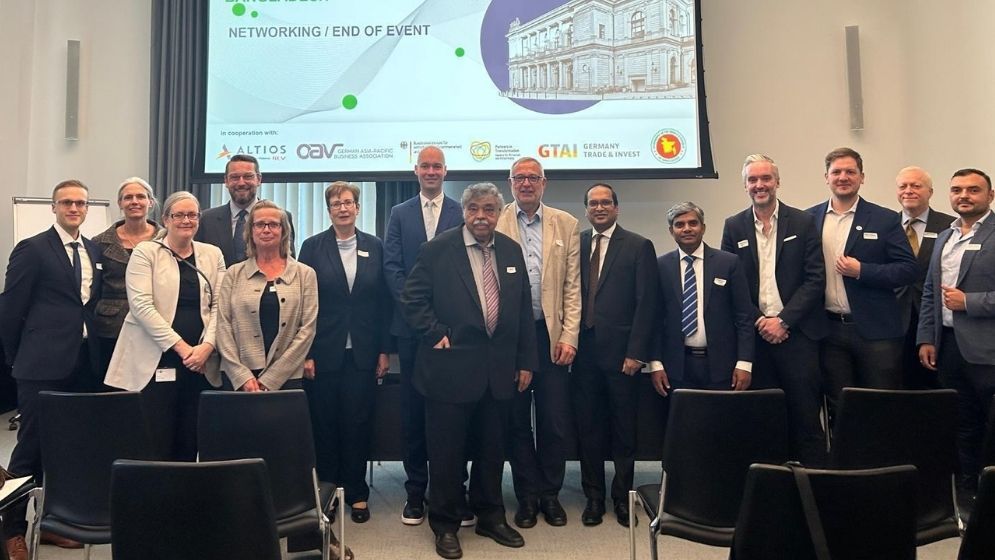
Photo: Courtesy
Businesspeople, investors and policymakers have stressed the need to move Bangladesh-Germany economic ties beyond one-way exports towards a partnership based on two-way trade, technology transfer, joint ventures and investment.
They made the remarks at a business and
investment seminar titled “Beyond
Textiles: Business Opportunities in Bangladesh” held at the Hamburg
Chamber of Commerce in Germany to showcase Bangladesh’s growing capabilities
beyond the ready-made garment (RMG) sector.
Around 40 German businesspeople, investors,
policymakers and representatives of business and development organisations attended
the seminar, according to a press release issued on Tuesday.
Speakers said the Bangladeshi and German
economies could complement each other, creating new opportunities for trade and
investment.
Delivering the keynote address, Bangladesh’s
Ambassador to Germany Muhammad Zulqar Nain said Bangladesh could no longer be
viewed solely as an economy dependent on RMG.
The country is evolving into an emerging hub
for diversified manufacturing, technology and services, he said.
Although RMG remains the mainstay of
Bangladesh’s export economy, rapid growth is taking place in sectors including
engineering products, leather and leather goods, jute and jute products,
pharmaceuticals, agriculture and food processing, electronics, light
engineering and information technology.
Export growth in some emerging sectors has already
exceeded 20%, with engineering product exports growing by around 21.8%, the
ambassador said.
He also highlighted Bangladesh’s capabilities in newer areas such as machinery and components, artificial flowers and decorative items, as well as electric vehicle production, local mobile phone manufacturing and assembly, PCB/PCBA production, and advanced electronics and engineering.
Chip design gains
prominence
The keynote address placed particular
emphasis on semiconductors and chip design.
Bangladeshi engineers and technologists are
providing high-value design and engineering services to the international
semiconductor industry, Nain said.
He cited ULKASEMI, which employs more than
600 design engineers in Bangladesh, and the involvement of Bangladeshi
engineers with international semiconductor companies as evidence of growing
global confidence in the country’s capabilities.
This is helping Bangladesh move from labour-intensive
manufacturing towards a high-tech, knowledge-based economy, he said.
Ch Md Golam Rabbi, commercial counsellor at
the Bangladesh Embassy in Berlin, said the embassy had been conducting
sustained economic diplomacy initiatives to showcase Bangladesh’s trade and
investment potential across Germany.
Six similar events have been organised over
the past 18 months, and the Hamburg seminar was part of the initiative, he
said.
“There is ample scope for further cooperation
and collaboration to enhance trade and investment opportunities,” Rabbi said,
highlighting Bangladesh’s strategic location, access to a regional market of
around four billion consumers, and trade and investment incentives.
Calls for reform
During a panel discussion, German business representatives
exchanged views on investment potential, practical challenges and market-entry
experiences.
Participants expressed interest in
Bangladesh’s large domestic market, manufacturing capabilities, infrastructure
development, and progress in renewable energy and technology-driven sectors.
Speakers also stressed the importance of
projecting a positive image of Bangladesh through mainstream media in both
countries.
Participants included representatives of
trade bodies, an investment authority, consultancies, private companies and a
federal ministry, including Barbara Schmidt-Ajayi of the Hamburg Chamber of
Commerce, Ines Budarick of OAV, Mareen Haring of German Trade and Invest, and
Barbara Schafer, head of the South Asia Division at the Federal Ministry for
Economic Cooperation and Development (BMZ).
Also taking part were Adelina Papenburg of Euler Hermes Aktiengesellschaft, Matthias Koster of PricewaterhouseCoopers GmbH, Rudigar Schroder of Alton’s Germany GmbH, Thomas Bressler of WGC-Holding GmbH and GerBan Fibres Ltd, and Christina Prieser of Hamburg Port Consulting GmbH.