


 For all latest news, follow the Daily Sun's Google News channel.


What it took to make Bangladesh click ‘Add to Cart’
Kamrul Hasan
Published: 27 Sep 2026, 04:45 PM
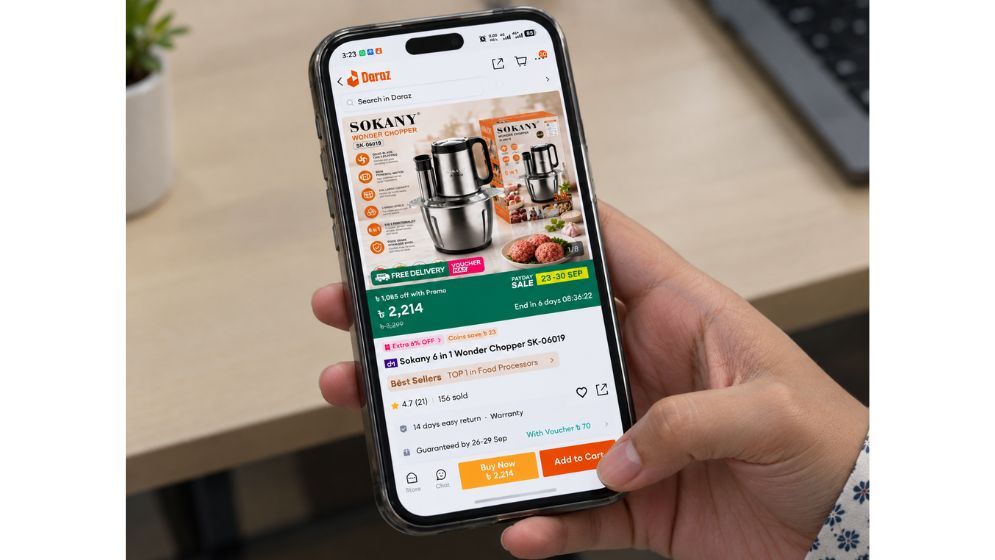
Photo: Courtesy
Remember when clicking "Add to Cart" felt like a small risk? You would look at the product photo a few times and wonder - will it actually arrive? Will it look anything like the picture? Will the seller send the right thing? And after paying, there was always one more thought lurking. Okay, now what?
It is hard to imagine that feeling today. We order a phone,
a pair of shoes, groceries or household essentials in a few taps. But
Bangladesh did not arrive here overnight. Technology played a role. So did
payments, logistics and connectivity. Mostly, though, it took years to build
confidence on both sides of the marketplace, the buyer and the seller.
Bangladesh's e-commerce story is often traced back to
January 2000, when Munshigi.com launched as the country's first e-commerce
platform, taking cash-on-delivery orders for gifts. The idea was simple, browse
from home and have something arrive at your door.
But internet access was limited, online payments barely
existed, and there was no delivery network built for this kind of shopping. The
real question back then wasn't whether people wanted to shop this way. It was
whether something seen on a screen could actually become a package on the
doorstep.
That question took a long time to answer fully. Even today, industry estimates put Bangladesh's e-commerce market in the range of $6 billion to $7 billion, still a small slice of total retail spending, though growing steadily year over year. The opportunity, in other words, was never really in doubt. What was missing was the infrastructure.

Having spent more than 15 years across e-commerce and
telecom, I have watched that infrastructure get built from close range. What
stands out to me is that the hardest part was rarely getting people to visit a
website. The harder task was making the experience consistent enough that
people would trust it, use it again, and eventually stop thinking about it at
all.
When Daraz started in Bangladesh, the platform had around
150 sellers. Today there are more than 50,000, with delivery reaching all 64
districts. Those numbers matter less as milestones than as signs of how much of
the underlying ecosystem had to be built alongside them, sellers who needed
tools, customers who needed reasons to trust, delivery routes that simply did
not exist before.
Large-scale shopping campaigns have played an important role
in accelerating e-commerce adoption, bringing new consumers onto digital
platforms and creating opportunities for businesses to participate in online
retail.
However, the long-term development of the industry depends
on what happens beyond these campaign periods. Sustainable growth requires
customers to return because they can consistently find the products they need,
at competitive prices, supported by reliable delivery and customer service.
The industry's transition from acquiring first-time shoppers
to building long-term customer relationships represents an important stage in
its maturity.
Trust sits right underneath that. A customer returns when
the product arrives on time and matches what they ordered, and when they know there's
a clear path if it does not. Over the years we have had to treat that almost as
an operations problem as much as a branding one.
Delivery time across most of Bangladesh has come down from
around five days to under three. Our return rate now sits below 1% of total orders.
Numbers like these are not just internal metrics, they are a rough proxy for
how much uncertainty we have managed to take out of the process, one order at a
time.
Logistics mattered here in a very specific way, because
Bangladesh was never only a Dhaka market. Fast Delivery, for instance, launched
covering nearly 50,000 products from more than 2,500 sellers, and has kept
expanding since.
More than half of
Daraz's buyers today are outside Dhaka, which tells me where the next phase of
growth actually sits. It is not only about going deeper into cities that
already shop online. It is about connecting businesses and customers across the
rest of the country, which will take better regional logistics, more accessible
payments, and more local businesses willing to go digital in the first place.
Expanding e-commerce also means enabling businesses to
participate meaningfully in the digital economy. For smaller enterprises,
establishing an online presence is only the first step. Sustained growth
requires capabilities in inventory management, digital merchandising, customer
engagement and demand forecasting.
Through initiatives such as Daraz University, which trains
approximately 5,000 sellers each month, we are working to strengthen these
capabilities and help local businesses reach customers beyond their traditional
markets.
Payments followed a similar arc. Digital payments now make
up around 30 -35% of transactions on Daraz Bangladesh on a regular day,
climbing to somewhere between 40% and 50% during major campaigns, a shift that
would have seemed unlikely a decade ago. As people grow comfortable paying
digitally for everyday things, a lot of the remaining friction around online
shopping simply falls away on its own.
The next shift will likely come through AI and data, not
just in how products get recommended, but in how sellers manage inventory,
price competitively and understand demand without needing a large team to do
it. For smaller businesses especially, that could mean access to capabilities
that used to belong only to bigger players.
Looking back, Bangladesh's e-commerce industry had to solve
one problem before it could move to the next. First, proving that a package
would actually arrive. Then, making payments and service reliable enough to
trust. Now, the work is about turning a first purchase into a habit, and
extending that habit well beyond the biggest cities.
The writer is the Chief Commercial Officer of Daraz
Bangladesh.