


 For all latest news, follow the Daily Sun's Google News channel.


NBR to be split into two separate institutions: Finance minister
Daily Sun Report, Dhaka
Published: 18 Aug 2026, 03:31 PM
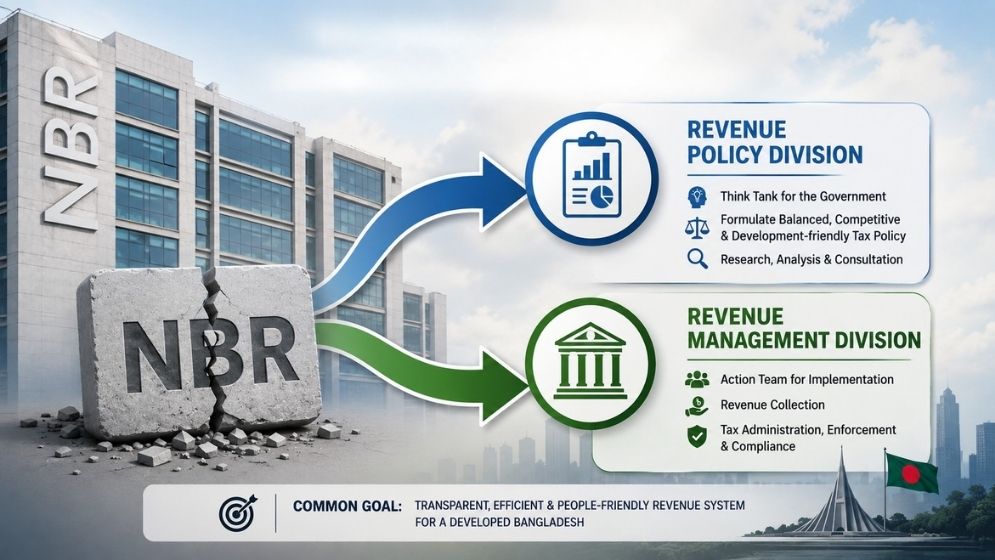
Finance Minister Amir Khosru Mahmud Chowdhury said on Tuesday the government has taken the final decision to split the existing National Board of Revenue (NBR) into two separate and transparent institutions -- the Revenue Policy Division and the Revenue Management Division.
“The Revenue Policy Division will serve as
the government’s think tank, while the Revenue Management Division will work as
its action team,” he said.
The policy division will formulate a
balanced, competitive and development-friendly tax structure with the help of
experts, while the management division will be responsible for revenue
collection, the minister said.
He made the remarks while addressing the
‘Revenue Conference-2026’ at Bangladesh-China Friendship Conference Centre in
the capital on Tuesday.
Prime Minister Tarique Rahman attended the
event as the chief guest.
Amir Khosru said the government’s objective
was to simplify the tax payment process and ensure proper enforcement of the
law.
He said the opinions of economists, private
sector representatives, researchers and experts from trade and business
organisations would be given importance in formulating tax policies.
Although the economy has expanded, the
country’s capacity to collect revenue has not increased accordingly, he said.
“Simply increasing the tax burden on existing taxpayers will not bridge this gap,” the finance minister said, stressing the need to expand the tax base, rationalise tax exemptions, prevent tax evasion and avoidance, and increase taxpayer compliance through automation.
Regarding the revenue target for fiscal year
2026-27, he said the target had been set at Tk604,000 crore, which was 46%
higher than that of the previous fiscal year.
“Although the target is ambitious, it has been
set deliberately,” he said.
Amir Khosru said the government, under the
leadership of Prime Minister Tarique Rahman, wanted to shift the economy from
being debt-dependent to investment-driven.
“We have to finance development from our own
resources,” he said.
The minister said the government was
prioritising three areas in reforming the revenue system -- modernisation,
expansion and partnership.
End-to-end automation has been given the
highest priority, he said, adding that the practice of taxpayers having to
visit tax officials would be discontinued unless specifically necessary.
“The government’s goal is to build a
completely contact-free and faceless revenue administration,” he said.
He said several business-friendly initiatives
had already been introduced, including e-Tax Management, ASYCUDA World, the
National Single Window and modern scanning systems.
The finance minister also identified the
country’s very low tax-to-GDP ratio as one of the major structural weaknesses of
Bangladesh’s revenue system.
The tax-to-GDP ratio declined from 6.8% to
6.7% in fiscal year 2024-25, he said, describing it as one of the lowest rates
in the world.
In 2023, the average tax-to-GDP ratio in the
Asia-Pacific region was 19.5%, while Bangladesh’s was only 7.2%, he added.