


 For all latest news, follow the Daily Sun's Google News channel.


Experts highlight gap between technical skills and global demands, outline steps taken
Daily Sun Report, Dhaka
Published: 05 Aug 2026, 09:20 PM
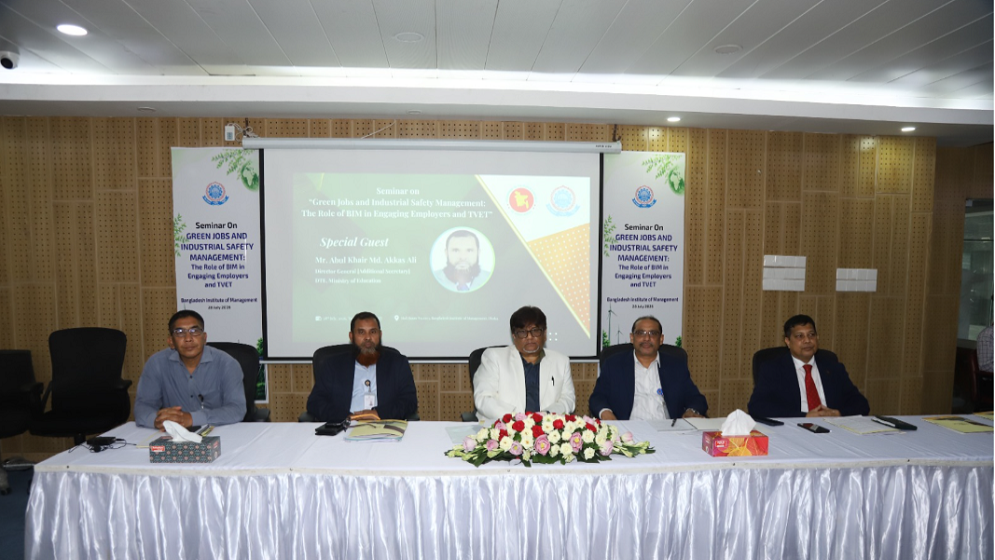
Photo: Courtesy
A seminar on the mismatch between the skills of the technical
workforce in Bangladesh and the fast-changing demands of global industries was
held at the BIM, Sobhanbagh in the capital.
The ongoing and proposed initiatives of the Bangladesh
Institute of Management (BIM) in helping address the crisis was also discussed
at the event, read a press release.
The seminar titled "Green Jobs and Industrial Safety
Management: The Role of BIM in Engaging Employers and TVET" was aimed at
discussing the need to strengthen the employability of Technical and Vocational
Education and Training (TVET) graduates by aligning their competencies with the
evolving needs of industries.
The seminar brought together policymakers, industry leaders,
technical education administrators, employers, human resource professionals,
development partners and academics to deliberate on emerging industrial skill
requirements, green jobs, industrial safety management and stronger collaboration
between industries and the TVET sector.
At the event, Abdur Nasar Khan, secretary, Ministry of
Industries, emphasized that Bangladesh's aspiration for sustainable industrial
development depends largely on developing a skilled technical workforce capable
of meeting the demands of modern industries. He highlighted the growing
importance of green skills, industrial safety and industry-oriented technical
education, and stressed the need for stronger partnerships among government,
industries, TVET institutions and BIM to improve the employability of technical
graduates.
Abul Khair Md Akkas Ali, director general, Directorate of Technical
Education (DTE); Mohammad Naveed Shafiullah, additional secretary, Ministry of
Environment, Forest and Climate Change; Engineer Md Ruhul Amin, chairman, Bangladesh
Technical Education Board (BTEB); Md Salim Ullah, director general of
Bangladesh Institute of Management (BIM); and Dr Mohammad Nazmi Newaz, senior
management counsellor at BIM; were also present at the seminar.
Abul Khair Md Akkas Ali emphasized the need to align TVET
with evolving industrial demands through stronger industry participation in
curriculum development, practical training and competency assessment. He
appreciated BIM's initiative to this end, and reaffirmed DTE's commitment to
collaborating to improve the employability of TVET graduates.
Mohammad Naveed Shafiullah stressed that sustainable
industrial growth depends on stronger collaboration among government, industry
and educational institutions.
Engineer Md Ruhul Amin emphasized the importance of
modernizing the TVET curriculum to meet changing industrial needs. He
highlighted the need for stronger industry engagement in curriculum
development, apprenticeship and certification, and expressed BTEB's willingness
to work with BIM to enhance graduate employability.
Md Salim Ullah reaffirmed BIM's commitment to supporting
national industrial development by serving as a bridge between industries and
technical education. He highlighted BIM's ongoing initiatives to enhance the
employability of TVET graduates through industry engagement, professional
development and policy dialogue.
Dr Mohammad Nazmi Newaz outlined the changing nature of
industrial management, the increasing importance of green jobs and industrial
safety, and the need to strengthen collaboration among industries, employers
and TVET institutions. He also presented BIM's proposed initiatives to promote
specialized career pathways in industrial safety management and other emerging
occupational areas for TVET graduates.
The discussion highlighted that while Bangladesh has made
remarkable progress in expanding technical education, industries continue to
face shortages of skilled technical personnel due to the mismatch between
training outcomes and labour market requirements. Participants emphasized the
need to modernize curricula, expand apprenticeship and internship
opportunities, promote industry-led competency development and strengthen
institutional collaboration to address this gap.
The seminar concluded with a collective commitment to work
towards developing a future-ready technical workforce through stronger
partnerships among government, industries, BIM, employers and technical
education institutions. Participants expressed optimism that BIM would continue
to play a catalytic role in improving the employability of TVET graduates while
contributing to Bangladesh's sustainable industrial transformation and green
growth agenda.
Bangladesh Institute of Management (BIM) reaffirmed its commitment to undertaking further research, policy dialogue, professional training and stakeholder engagement to support green industrial development, industrial safety management and enhanced employment opportunities for technical education graduates in Bangladesh.