


 For all latest news, follow the Daily Sun's Google News channel.


Experts see high potentials in cotton, stress coordination for expanding cultivation
Daily Sun Report, Dhaka
Published: 30 Jul 2026, 11:45 PM
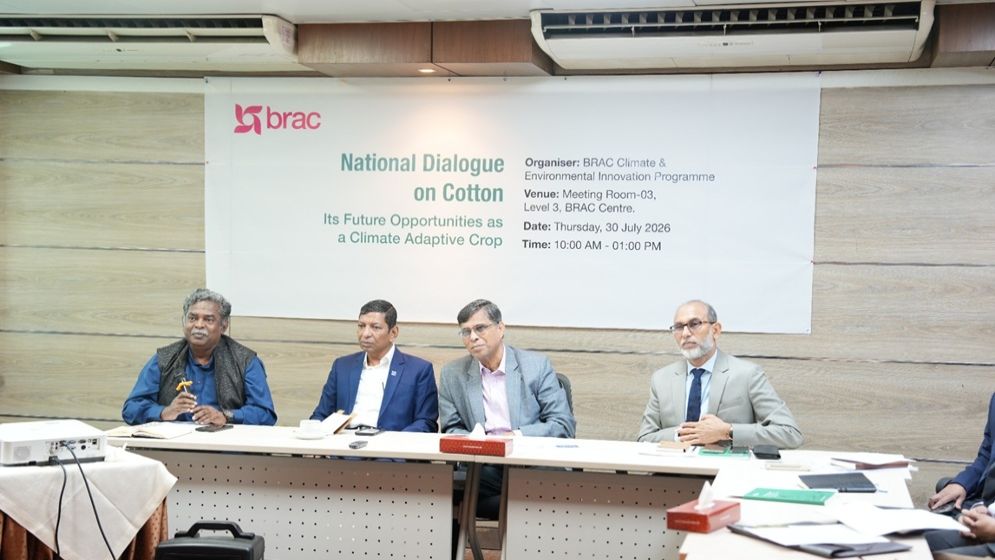
Photo: Courtesy
Experts have called for coordinated action to expand cotton
cultivation in Bangladesh, highlighting its potential as a climate - adaptive
and economically viable crop.
They mentioned that although Bangladesh is the world’s
second largest exporter of ready-made garments, around 97 % of the cotton used
by the country’s textile industry is imported, costing the country more than $3
billion annually.
These observations were made at the “National Dialogue on
Cotton: Its Future Opportunities as a Climate Adaptive Crop,” organised by
BRAC's Climate and Environmental Innovation Programme (CEIP) at the BRAC Centre
in Mohakhali, Dhaka, on Thursday.
The dialogue examined the structural barriers to expanding
domestic cotton production and explored practical measures relating to policy,
research, financing, agricultural extension services, market development, and
post-harvest management.
Speaking at the event, Md. Rezaul Amin, executive director
(Routine Duties) of the Cotton Development Board, said that cotton is a
beneficial crop from multiple perspectives. In addition to increasing farmers'
incomes, cotton cultivation can contribute to climate change adaptation and
generate employment opportunities across the value chain. He added that the
government is providing incentives to encourage farmers to cultivate cotton.
Dr Md Liakath Ali, director of BRAC's Climate and
Environmental Innovation Programme (CEIP) and Disaster Risk Management
Programme (DRMP), said that cotton offers a promising alternative in areas
where agricultural production has been affected by climate change. He emphasised
that expanding cotton cultivation across the country would require close
collaboration among government agencies, the private sector, development
organisations, and other stakeholders.
Dr. M. Farid Uddin, Senior Agronomic Adviser/Consultant at
CottonConnect South Asia Private Limited and former Executive Director of the
Cotton Development Board, said that Bangladesh currently cultivates cotton on
approximately 45,000 hectares of land, producing an estimated 200,000 bales
annually (each bale weighing 220 kilograms), meeting only around 2 per cent of
national demand. He also noted that cotton is a carbon-positive crop and that
the government officially declared cotton an agricultural commodity one year
ago.
Among those attending the event was Mitali Chakma, a cotton
farmer from Manikchhari in Rangamati. She said, "I received seeds and
training from the Cotton Development Board. I have been cultivating cotton for
the past three years. There is considerable interest in cotton cultivation
among farmers. With the necessary support, cotton cultivation can expand
significantly across the Chattogram Hill Tracts."
Participants observed that the challenges facing cotton
production extend beyond cultivation itself. Cotton competes with rice,
tobacco, and high-value winter vegetables for agricultural land. Harvesting
remains largely manual, while farmers continue to face constraints in accessing
finance, agricultural inputs, extension services, storage facilities, ginning
services, and reliable markets.
The discussion also highlighted the significant potential
for cotton cultivation in climate-vulnerable regions, including the Barind
Tract, coastal saline areas, riverine chars, and the Chattogram Hill Tracts. As
a heat- and drought-tolerant crop, cotton requires less water than rice, making
it a suitable option for climate adaptation and livelihood diversification.
Participants also noted that replacing tobacco cultivation with cotton in
selected regions could provide farmers with a more sustainable alternative.
The dialogue opened with remarks by Abu Sadat Moniruzzaman
Khan, Programme Head, Climate and Environmental Innovation Programme (CEIP),
BRAC.
Other speakers included Dr. Abed Chaudhury, Independent
Agro-specialist; Md. Kutub Uddin, Deputy Director (HQ), Cotton Development
Board; Md. Manirul Islam, Additional Director (Cash Crop), Department of
Agricultural Extension (DAE); and Prof. Mohammad Kamrul Hasan, Professor
(Department of Agroforestry), Bangladesh Agricultural University.