


 For all latest news, follow the Daily Sun's Google News channel.


Experts call for stronger tobacco tax reforms in FY27 budget
Daily Sun Report, Dhaka
Published: 22 Jun 2026, 11:35 PM
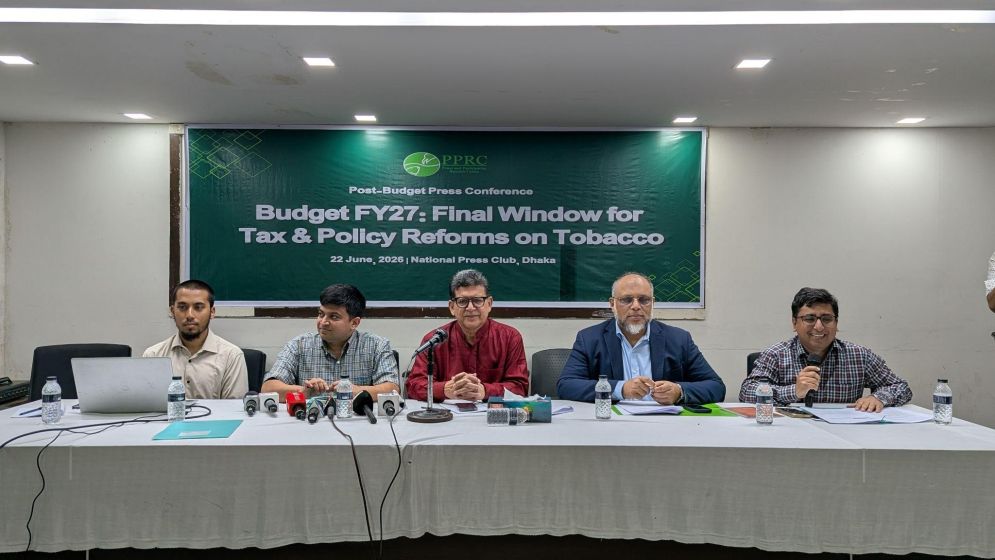
Photo: Courtesy
Public health and economic experts on Sunday urged the government to strengthen tobacco tax reforms through the Finance Bill, saying Bangladesh still has an opportunity to reduce tobacco consumption, protect public health and increase domestic revenue in the FY2026-27 budget.
They made the call at a post-budget press conference titled "Budget FY27: Final Window for Tax and Policy Reforms on Tobacco," organised by the Power and Participation Research Centre (PPRC) at the National Press Club.
PPRC Executive Chairman Hossain Zillur Rahman moderated the discussion. Prof Shafiun N Shimul, director of the Institute of Health Economics at the University of Dhaka, and Associate Prof SM Abdullah of the university's Department of Economics spoke at the event. Mohammad Ihtesham Hassan, senior research associate at PPRC, presented the keynote paper.
Presenting the findings, Hassan said cigarettes remained affordable despite repeated tax and price increases. He said tobacco revenue had continued to rise while cigarette supply had started declining since 2024, indicating further room for tax-driven price increases.
He said Bangladesh's four-tier cigarette tax structure continued to weaken the public health impact of tobacco taxation because smokers often switched to cheaper brands instead of quitting. He recommended merging the low- and medium-price tiers, setting a minimum retail price of Tk100 for 10 sticks and imposing a specific tax of Tk4 per pack.
Shimul said Bangladesh still sold around 70 billion cigarette sticks annually, while smoking rates had not fallen as expected despite successive price hikes. He argued that tobacco companies captured a significant share of the additional revenue generated by higher prices instead of the government.
"When the price of a medium-tier pack rises from Tk80 to Tk92, the critical question is who benefits from that increase. A greater share of the gain should accrue to the government rather than tobacco companies," he said.
He also warned about the growing risks posed by emerging nicotine products, including nicotine pouches, and urged Bangladesh to introduce stronger regulations before youth use expands.
SM Abdullah said tobacco taxation remained one of the most cost-effective measures to prevent non-communicable diseases but described Bangladesh's tobacco tax system as one of the world's most complex.
"If Bangladesh is serious about shifting from curative to preventive healthcare, tobacco taxation must become a central policy instrument," he said.
He also highlighted weak regulation of smokeless tobacco products, particularly because of their widespread use among women, and called for licensing, registration and traceability systems to strengthen enforcement.
Syed Mohammad Akram stressed the need to enforce existing tobacco control laws more effectively. He said authorities should make greater use of mobile courts and smarter monitoring systems to reduce violations and detect tax evasion.
Concluding the discussion, Hossain Zillur Rahman said the proposed budget had increased tobacco prices but questioned whether the measures would achieve Bangladesh's public health and revenue goals.
"The issue is not simply whether prices have increased, but whether the increase is sufficient to reduce tobacco use and maximise public revenue," he said.
He also expressed concern over illicit tobacco trade and market evasion, saying stronger enforcement remained essential. Rahman further criticised the government's approach to e-cigarettes, warning that regulatory changes could increase health risks for young people while generating only limited additional revenue.