


 For all latest news, follow the Daily Sun's Google News channel.


Business slowdown pushes default loans higher
Daily Sun Report, Dhaka
Published: 03 Jun 2026, 08:39 AM
Daily Sun Illustration
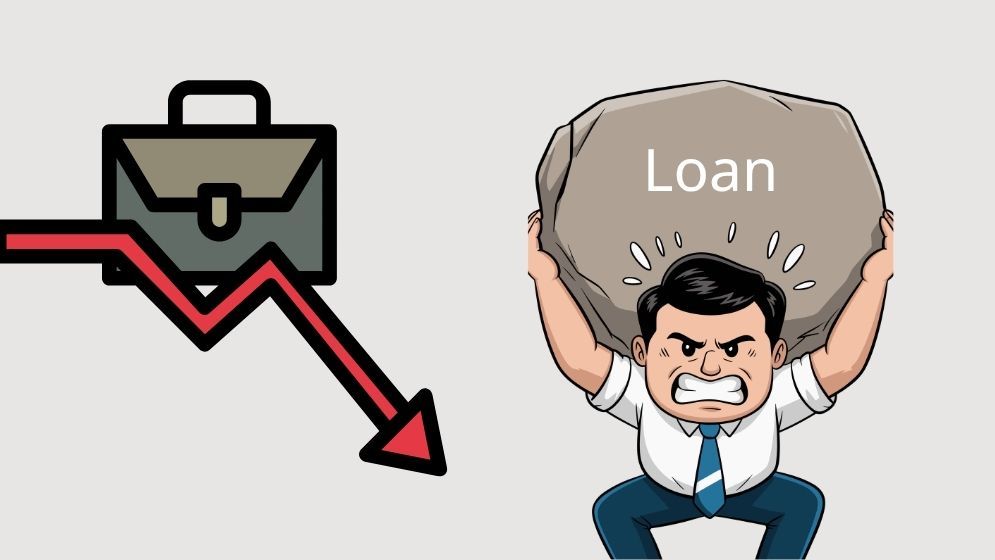
Business, trade and investment remained nearly stagnant during the tenure of the interim government, with entrepreneurs and businesspeople facing frustration amid attacks, legal cases, vandalism, mob violence, account freezes, harassment and obstacles to overseas travel, affecting overall economic activities.
As a result, many businesses suffered losses
despite investing borrowed funds, as conditions failed to improve.
Consequently, it became increasingly difficult for many entrepreneurs to repay
loan instalments or interest payments, a trend that continues to persist and is
now reflected in the country’s rising default loans.
Many businesses are turning into defaulters
despite their unwillingness to do so, according to the latest Bangladesh Bank
report on default loans for March.
The report showed that default loans
increased by Tk31,487 crore within just three months.
According to the central bank, total default
loans in the banking sector stood at Tk557,217 crore at the end of December. By
the end of March 2026, the amount rose to Tk588,704 crore, accounting for 32.26%
of total outstanding loans.
Currently, total outstanding loans in the
banking sector amount to Tk1,824,668 crore.
Bangladesh Knitwear Manufacturers and Exporters
Association (BKMEA) Executive President Fazlee Shamim Ehsan told journalists
that businesses have been facing multiple challenges for a long time, including
high interest rates, rising dollar prices, international conflicts and
political instability.
“There was no elected government for a long
period. As a result, private sector credit growth fell to the bottom. The
interim government failed to create an investment-friendly environment, which
prevented businesses from operating properly,” he said.
He alleged that instead of supporting the
private sector, the government borrowed heavily from banks, further harming
business activities.
“The government was anti-business. Not only
trade, but it also weakened banks by publicly declaring them fragile,” he said.
He expressed optimism that investment would
recover within the next two years under the elected government, provided policy
support remains and global conditions improve.
“If international conflicts subside, the
country’s investment climate will improve and stability will return to the
banking sector,” he added.
However, former chief economist of the World
Bank’s Dhaka office, Dr Zahid Hussain, offered a different explanation.
According to him, many borrowers renewed
loans ahead of the 12 February election, which temporarily reduced default loans
during the December quarter.
“Those loans have again turned
non-performing. That is now reflected in the overall figures,” he said.
He argued that the rise in default loans was
expected because authorities have yet to enforce strict legal measures against
defaulters.
“As long as legal actions are not taken
against loan defaulters, default loans will continue to rise,” he said.
He further criticised what he described as
unequal application of laws.
“In our country, rules vary from one borrower
to another. Laws often appear ineffective for powerful people but are strictly
applied to ordinary customers. If this continues, the default culture could
spread further and become severe,” he warned.
According to Zahid Hussain, Bangladesh Bank
itself bears responsibility for rising default loans due to delayed
decision-making.
He alleged that large-scale loan
irregularities and anonymous borrowing were ignored for years while default
loans were effectively hidden.
“Those hidden problems are now becoming
visible and affecting even good borrowers,” he said.
Bangladesh Bank data showed that total loan
disbursement among the country’s 61 scheduled banks rose to Tk1,824,668 crore
by March, an increase of nearly Tk4,000 crore within three months.
However, default loans increased by Tk31,487
crore during the same period.
State-owned banks recorded the highest
default loan ratio, with nearly 46% of their distributed loans becoming
non-performing.
Despite this, default loans in state-owned
banks declined slightly during the January-March quarter compared with the
previous quarter, with total default loans standing at Tk149,785 crore.
Private commercial banks accounted for
Tk416,482 crore in default loans, representing 30.11% of their total
distributed loans.
Meanwhile, foreign banks recorded Tk3,262
crore in default loans, while specialised banks reported Tk19,175 crore.
When the Awami League-led alliance government
assumed office in January 2009, default loans stood at Tk22,481 crore. Before
leaving office, default loans had increased to Tk211,391 crore by June 2024.
Following the fall of the Awami League
government, the interim administration took office and began presenting what
officials described as the actual picture of the banking sector.
Many borrowers reportedly linked to the
previous government were no longer visible publicly, contributing to a sharp
increase in default loans.
The interim government later introduced
special loan rescheduling facilities, temporarily reducing defaults, though the
upward trend has resumed.
Bankers say that widespread irregularities,
fraud, corruption and financial scandals during the Awami League government’s
15-and-a-half years significantly contributed to rising default loans.
Several major corporate groups, including S
Alam, Beximco, Nassa, Bismillah and Hallmark, along with scandals involving
National Bank, Islami Bank and Basic Bank, contributed substantially to the
increase.
Analysts believe another major reason behind
the surge in default loans is the prolonged slowdown in business activities.
With investment remaining weak, employment
opportunities declining and many factories shutting down or operating below
capacity, businesses are struggling to maintain profitability.
Where business growth remains absent,
analysts say, regular loan repayments become increasingly difficult --
ultimately contributing to rising default loans.