


 For all latest news, follow the Daily Sun's Google News channel.


Oil, gas surge as Iran conflict disrupts Middle Eastern flows
Reuters, London
Published: 02 Mar 2026, 09:59 PM
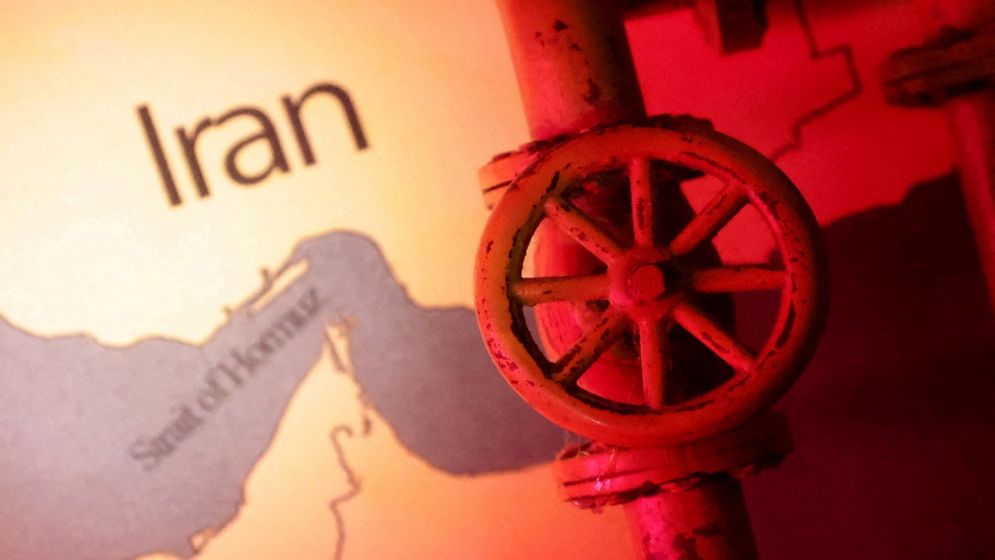
A map showing the Strait of Hormuz and Iran is seen behind a 3D printed oil pipeline. Image Illustration: REUTERS
Oil and natural gas prices surged on Monday as Israeli and US
strikes on Iran and retaliation by Tehran forced shutdowns of oil and gas
facilities across the Middle East and disrupted shipping in the crucial Strait
of Hormuz.
A sustained rise in oil prices would threaten a global
economic recovery, reignite inflation and could push up US retail gasoline
prices, a risky outcome for President Donald Trump and his Republican Party
ahead of midterm elections this November.
Brent crude futures LCOc1 rose as much as 13% to $82.37 a
barrel, their highest since January 2025, before retreating to trade up $6.27,
or 8.6%, at $79.14 a barrel at 1403 GMT.
US West Texas Intermediate crude CLc1 was up $5.05, or 7.5%,
at $72.07, having risen more than 12% to $75.33, its highest since June.
"The latest move reflects uncertainty around the scale
and duration of the current conflict and recognises that Iran’s political
future may have major implications for the stability of the Middle East,"
said James Hosie of Shore Capital.
Oil's surge on the restart of trading after the weekend,
however, was smaller than expected. On Sunday, some analysts had predicted oil
would open above $90 a barrel and closer to $100.
Saudi Arabia shut its biggest domestic oil refinery after a
drone strike, a source said. QatarEnergy halted production of liquefied natural
gas and is set to declare force majeure on LNG shipments and the widening
conflict also damaged at least four tankers, killed a seafarer and left 150
ships stranded around the Strait of Hormuz.
The big questions now are how long shipping through the
Strait will be disrupted and how much oil importers, especially in Asia, have
in storage to endure the disruption.
On a typical day, ships carrying oil equal to about
one-fifth of global demand sail through the Strait along with tankers hauling
diesel, gasoline and other fuels to major Asian markets including China and
India. The waterway is also the route for about 20% of the world’s liquefied
natural gas.
Gas jumps, sugar also rallies
The Dutch front-month contract at the TTF hub, the benchmark
European price, was up more than 50% by 1341 GMT at 48.66 euros per megawatt
hour (MWh) on the Intercontinental Exchange.
Asian LNG prices jumped almost 39% on Monday with the
S&P Global Energy Japan-Korea-Marker (JKM), widely used as an Asian LNG
benchmark, at $15.068 per million British thermal units (mmBtu), Platts data
showed.
World sugar prices rallied around 2% on Monday on fears the
conflict and resulting disruption to energy supplies will prompt Brazilian cane
mills to produce more ethanol and less sugar.
Oil prices pare gains
Oil pared gains after its steep surge in early Asian trade,
a move that analysts attributed to buyers already factoring a risk premium into
prices in anticipation of the conflict.
In the view of the International Energy Agency and other
analysts, the oil market is well supplied with additions to supply from
producers such as the United States, Guyana and OPEC+ expected to outpace
global demand this year.
Despite the fears of a glut, Brent had risen over 19% this
year until Friday's close, while WTI was trading about 17% higher.
"Markets are acknowledging the seriousness of the
conflict, but are also signalling that, for now, this is a geopolitical shock,
not a systemic crisis," said Priyanka Sachdeva, senior analyst at Phillip
Nova.
OPEC+ agreed on Sunday to raise oil output by 206,000
barrels per day in April. Every OPEC+ producer is essentially producing at
capacity except for Saudi Arabia, RBC Capital analyst Helima Croft said.
The IEA is in touch with major producers in the Middle East,
director Fatih Birol said on Sunday. The energy watchdog coordinates the
release of strategic petroleum reserves from developed countries during
emergencies.
Globally, visible oil inventories stood at 7.827 million
barrels, enough for 74 days of demand, which is near a historical median,
Goldman Sachs wrote in a note.
Citi analysts expect Brent to trade between $80 and $90 a
barrel this week amid the ongoing conflict.
A three- to four-week squeeze on Strait of Hormuz traffic
could force Gulf producers to shut output and push Brent above $100, JPMorgan
said.
Analysts are also warning retail gasoline prices in the US,
the world's biggest fuel consumer, may break above $3 a gallon because of the
conflict.
US gasoline futures surged by as much as 9.1% to $2.496 a
gallon, their highest since July 2024, and were last up 4.9%.