


 For all latest news, follow the Daily Sun's Google News channel.


Bangla QR to enable P2P transfers from November
Daily Sun Report, Dhaka
Published: 01 Oct 2026, 12:00 AM
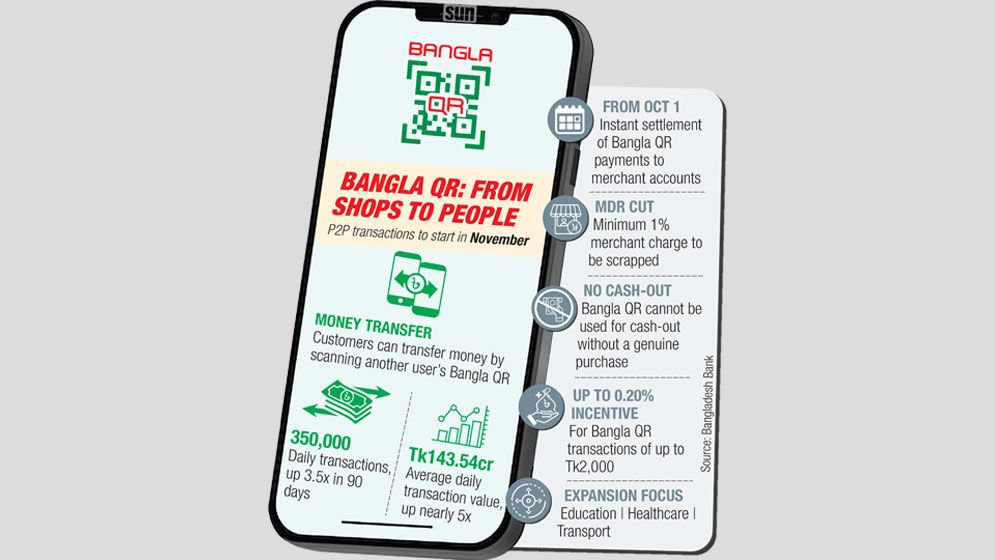
Bangladesh Bank (BB) will introduce person-to-person (P2P) transactions through Bangla QR from November, allowing customers to transfer money interoperably by scanning another person’s Bangla QR code or uploading an image of the code through their mobile apps.
Bangladesh Bank Executive Director and spokesperson Arief Hossain Khan announced the plan at a press briefing on Wednesday.
“Bangla QR is a government initiative,” he said, adding that businesses that fail to adopt the system risk being left behind.
He said some mobile financial service (MFS) providers fear their business could decline as banks expand QR-based services. “Both MFS providers and banks have their own limits,” he said.
Currently, customers of banks and MFS providers can use their mobile apps to scan Bangla QR codes and make payments to merchants. The system is available at nearly 3.9 million merchants nationwide.
According to the central bank data, around 100,000 Bangla QR payments were made daily on average in June, with the average daily transaction value exceeding Tk28 crore.
The figures have since risen to around 350,000 transactions a day, with an average daily value of approximately Tk143.54 crore.
This means the average number of daily transactions has increased about 3.5 times within 90 days since 1 July, while the value has risen nearly fivefold.
As part of efforts to expand the system and simplify regulations, BB replaced proprietary QR codes with Bangla QR from 1 July. It has also introduced measures related to the system’s functionality, promotion and pricing.
A working committee comprising representatives of banks and MFS providers and a steering committee headed by the Bangladesh Bank governor, with representatives from various ministries and divisions, are working to identify policy and strategic measures for further expansion.
Instant merchant payments from today
From 1 October, payments made through Bangla QR will be deposited instantly into merchants’ accounts.
BB expects instant settlement to encourage more merchants to adopt the system by eliminating settlement delays.
Arief said Bangla QR must not be used merely to cash out funds without purchasing goods or services. Accounts found being used for such transactions will be blocked.
“Bangla QR has been introduced to develop cashless transactions. Its main purpose is to keep a footprint of every transaction,” he said.
He added that appropriate action would be taken against any bank, MFS provider or other institution that delays providing the service.
Responding to complaints that bKash customers cannot make Bangla QR payments above Tk10,000, Arief said Bangladesh Bank had received similar complaints and warned the company. bKash has also been warned over alleged non-cooperation by its agents, he said.
Merchant QR fees to fall
From 1 October, the minimum 1% merchant discount rate (MDR) imposed by acquiring institutions on Bangla QR payments will be scrapped.
The interchange reimbursement fee for issuing institutions will also be set at zero.
BB said the measures are expected to significantly reduce transaction costs for merchants, allowing banks and MFS providers to offer Bangla QR services either free of charge or at a low cost.
Incentives for transactions up to Tk2,000
BB will also introduce an incentive scheme from 1 October to encourage Bangla QR transactions. Under the scheme, acquiring institutions will receive an incentive equivalent to 0.10% of the transaction value, while issuing institutions will receive 0.20% for Bangla QR transactions of up to Tk2,000 processed through the National Payment Switch Bangladesh (NPSB) at merchant points.
Education, healthcare and transport in focus
Bangladesh Bank is also prioritising the expansion of Bangla QR payments in the education, healthcare and transport sectors, Arief said.
In healthcare, QR payments could reduce queues at outpatient ticket counters, where patients often face difficulties receiving change. For example, a patient paying Tk10 with a Tk50 note may have to wait for change, he said.
With Bangla QR, patients could instead scan a code and pay directly using their mobile phones.
In education, the system could be used to pay school fees and make small purchases, including food at school canteens and stationery.
Arief said the Education Ministry has already issued instructions to make private school fee payments cashless, while initiatives are being taken to facilitate such payments through Bangla QR.
Transport is another potential area for expansion. QR-based payments could be introduced for toll collection to reduce queues at toll plazas, including those on the Padma Bridge, he said.
Such a system would reduce reliance on cash and speed up toll collection, according to the central bank spokesperson.