


 For all latest news, follow the Daily Sun's Google News channel.


Home internet access falls despite smartphone growth
BBS survey shows 75.1% of households have smartphones, while internet access slips to 58.2%

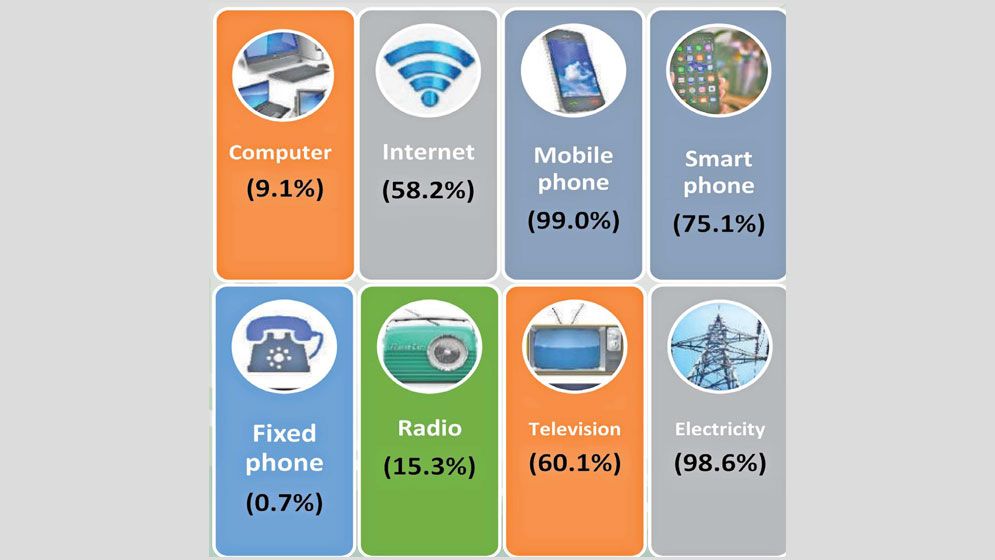
The digital landscape is showing a mixed trend, with smartphone access expanding while household internet connectivity has declined, according to the latest survey by the Bangladesh Bureau of Statistics (BBS).
The ICT Access and Use Survey 2025-26, covering April-June 2026, found that 99% of households had access to mobile phones and 75.1% had access to smartphones. However, household internet access fell to 58.2% in the fourth quarter from 59.7% in the same quarter a year earlier.
At the individual level, the picture was different. Internet use among people aged five and above increased to 59.2% in the latest quarter, compared with 55% a year earlier.
The figures highlight the growing dominance of mobile technology in Bangladesh, while internet access remains available to fewer than 60% of households.
Smartphone access expands
Smartphone access increased steadily during FY26, rising from 72.4% in the first quarter to 73% in the second, 73.4% in the third and 75.1% in the fourth.
The latest figure was also slightly higher than the 74.8% recorded in the fourth quarter of FY25.
The rise in smartphone access, however, was not reflected in the year-on-year household internet figures.
Household internet access increased during the latest financial year, from 56.2% in the first quarter to 57.2% in the second, 57.4% in the third and 58.2% in the fourth.
Despite the quarterly increase, the fourth-quarter figure was 1.5 percentage points lower than a year earlier.
The BBS survey does not provide an explanation for the decline, so the figures alone do not establish why household internet access fell.
Mobile connectivity dominates
Mobile phones remain by far the most widely available ICT device among households.
The survey found that 99% of households had access to mobile phones in the fourth quarter, compared with 98.9% in each of the first three quarters.
At the individual level, mobile phone use among people aged five and above reached 89.6%, up from 80.6% in the first quarter.
Mobile phone ownership also increased to 65.6% from 64.2% in the fourth quarter of the previous financial year.
Fixed-line phones, meanwhile, have become marginal. Only 0.7% of households had access to both fixed and mobile phones, while fixed-phone access declined from 0.9% a year earlier.
Individual internet use rises
While household internet access declined year-on-year, individual internet use increased significantly.
The share of people aged five and above using the internet rose to 59.2% in the fourth quarter from 55% in the corresponding quarter of FY25.
Individual internet use also increased sharply during the year, from 48.9% in the first quarter to 58.4% in the second, 58.6% in the third and 59.2% in the fourth.
The BBS measures household internet access and individual internet use as separate indicators. The two figures should therefore not be treated as identical measures of connectivity.
Computer access remains low
Computer access continues to lag far behind mobile connectivity.
Only 9.1% of households had access to a computer in the fourth quarter, compared with 9.2% a year earlier.
Individual computer use stood at 11.8%, up slightly from 11.6% in the corresponding quarter of the previous year.
During FY26, individual computer use rose from 10% in the first quarter to 11.4% in the second, 11.7% in the third and 11.8% in the fourth.
Electricity and traditional devices
Electricity access remained almost universal, with 98.6% of households reporting access in the fourth quarter, compared with 98.3% a year earlier.
Television access increased to 60.1% from 59.1% over the same period. Radio access, however, declined to 15.3% from 16%.
The figures underline the continuing shift towards mobile-based digital connectivity, while computer and fixed-line access remain limited.
District-level ICT data
The survey is being conducted under the BBS project “Measuring District-based Opportunities and Use of ICT at Individual and Household Levels”, aimed at generating district-level estimates of ICT access and use.
It covers individuals aged five and above and households across the country, with data collected through Computer Assisted Personal Interviewing (CAPI).
According to the BBS, the survey covers 2,568 sample areas, with 61,632 households surveyed each quarter and 246,528 annually. A total of 214 trained data collectors conduct fieldwork across all 64 districts.
The BBS says the data will support the monitoring of Sustainable Development Goal indicators, national policymaking and efforts to address the digital divide.
The latest findings show that mobile connectivity is almost universal and smartphone access continues to expand.
Yet household internet access remains below 60% and has declined compared with a year earlier, highlighting the uneven pace of Bangladesh’s digital transition.