


 For all latest news, follow the Daily Sun's Google News channel.


CPD urges reforms to decarbonise RMG
30% renewable energy could cut RMG sector’s monthly energy costs by 15.7%, study finds
Daily Sun Report, Dhaka
Published: 17 Aug 2026, 12:00 AM
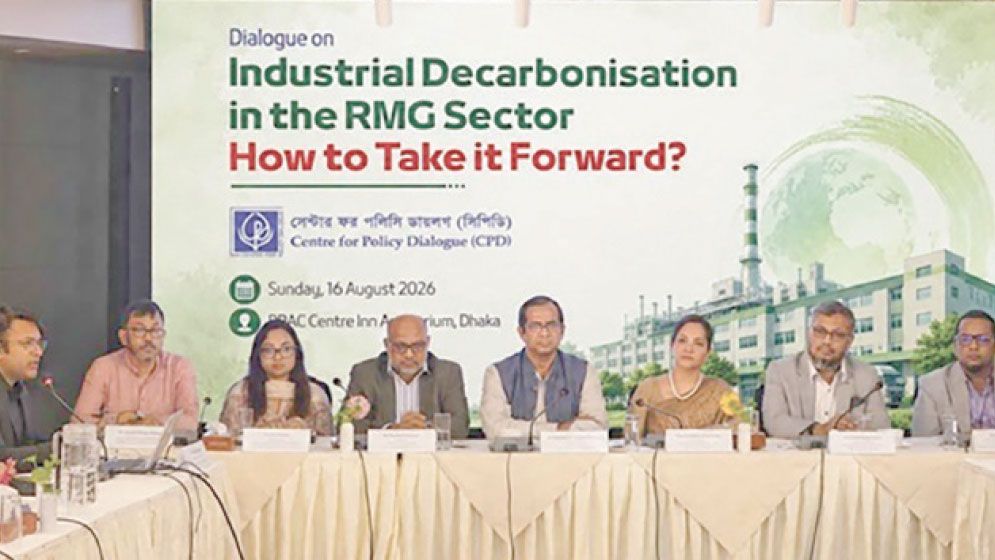
The Centre for Policy Dialogue (CPD) has urged the government to urgently form a high-level committee under the Prime Minister’s Office to tackle the national gas crisis and accelerate renewable energy adoption.
Speaking on Sunday at a dialogue titled “Industrial Decarbonisation in the RMG Sector: How to Take it Forward?” at the BRAC Inn in Dhaka, CPD Research Director Dr Khondaker Golam Moazzem warned that routine measures are no longer enough.
He also called on the government to publish official data on the country’s gas and electricity supply situation within seven days.
“Every day, gas shortages are crippling industrial production, agriculture, and residential supply,” Dr Moazzem said, citing heavy reliance on gas and diesel infrastructure as a core vulnerability.
During the event, CPD Research Associate Atikuzzaman Shazeed presented a study covering 350 ready-made garment (RMG) factories, which analysed energy efficiency, renewable adoption, and institutional barriers facing the sector.
Speaking at the event, Vidiya Amrit Khan, BGMEA vice president and deputy managing director of Desh Garments Ltd, said shifting from traditional energy sources to renewable energy had become a global requirement for the RMG industry.
“There are multiple EU and UK directives and regulations coming into enforcement in the coming years that require energy transition, so we have very little time in hand,” she said.
She said BGMEA wanted renewable energy investments to be exempt from taxes and additional VAT.
“We want 0% tax, without an additional 15% VAT on RE. If the government is going for 0% tax, then why is the NBR not aligning with this?” she said.
Fazlee Shamim Ehsan, executive president of the Bangladesh Knitwear Manufacturers and Exporters Association (BKMEA), said Bangladesh was lagging behind global competitors in renewable energy adoption.
“There are many EU regulations. We have many funds, but those are not accessible. We must explore those pathways to access those funds,” he said.
Mostafa Al Mahmud, president of the Bangladesh Sustainable and Renewable Energy Association (BSREA), said that although the government had set a 10,000MW renewable energy target, policy bottlenecks remained, particularly regarding taxation of solar technologies.
“The NBR’s SRO is still a bottleneck, where more than 50% VAT remains on solar technologies,” he said.
“Without taking out-of-the-box decisions by the government and clearing these bottlenecks, we are heading towards a bigger energy disaster,” he warned.
30% renewables to cut RMG energy costs by 15%
Bangladesh’s garment industry could reduce average monthly energy costs by 15.7% if renewable sources supply 30% of its electricity, according to the CPD study.
The RMG sector contributes 15.4% of the country’s total greenhouse gas emissions and has pledged a 30% emissions reduction by 2030 under the UN climate framework.
To support this transition, the CPD recommended targeted machinery replacement incentives for areas where energy savings are most technically feasible.
Cutting machines, for example, account for around 5.5% of the installed machine stock but could deliver about 27% of total savings.
Sewing machines represent around 85% of the machine stock but provide less than 3% of substitution-based savings.
The think tank also called for a shift towards broader renewable electrification, alongside long-term research and development into lower-energy sewing technologies.
It stressed that policy support should not focus solely on machine substitution, particularly because sewing has a large irreplaceable machine base.
Under an illustrative 30% solar-offset scenario, average monthly energy costs could fall by 15.7%, while a 10% offset – the maximum observed in the sample – could reduce costs by 5.5%, according to the CPD.
A simulation of energy-price uncertainty showed that renewable energy adoption could reduce monthly energy-cost volatility, with the coefficient of variation falling from 0.1148 to 0.1102 under the renewable-offset scenario.
The study said the reduction was positive for 96% of factories.
However, implementing the recommended machine reallocation would require substantial investment.
The estimated sector-wide cost ranges from Tk6,604 crore for 50% adoption to Tk13,209 crore for full adoption, with the largest factories accounting for the bulk of the cost.
The CPD recommended giving greater policy attention to thermal processes in washing and dyeing, which the study identified as the most energy-intensive production stage.
Rooftop solar can offset grid and captive electricity consumption, but it cannot currently replace gas-fired boilers used in thermal processes.
The study found that smaller factories face the largest efficiency gaps, with the smallest group showing a 57.3% energy-saving gap compared with 8.9% for the largest factories.
Formalising buyer-driven incentives
The study suggested formalising buyer-driven incentives by encouraging preferential sourcing from factories that demonstrate verified progress in decarbonisation.
It also proposed wider dissemination of model-factory experiences to overcome information and behavioural barriers.
The CPD further called for outcome-based regulation, including mandatory energy audits and standardised emissions reporting, rather than an approach focused mainly on procedural compliance.