



 For all latest news, follow the Daily Sun's Google News channel.


Govt needs two years to stabilise economy: Khosru
CPD questions budget’s equity and employment focus, while economists warn of deepening crises in jobs
Daily Sun Report, Dhaka
Published: 22 Jun 2026, 12:00 AM
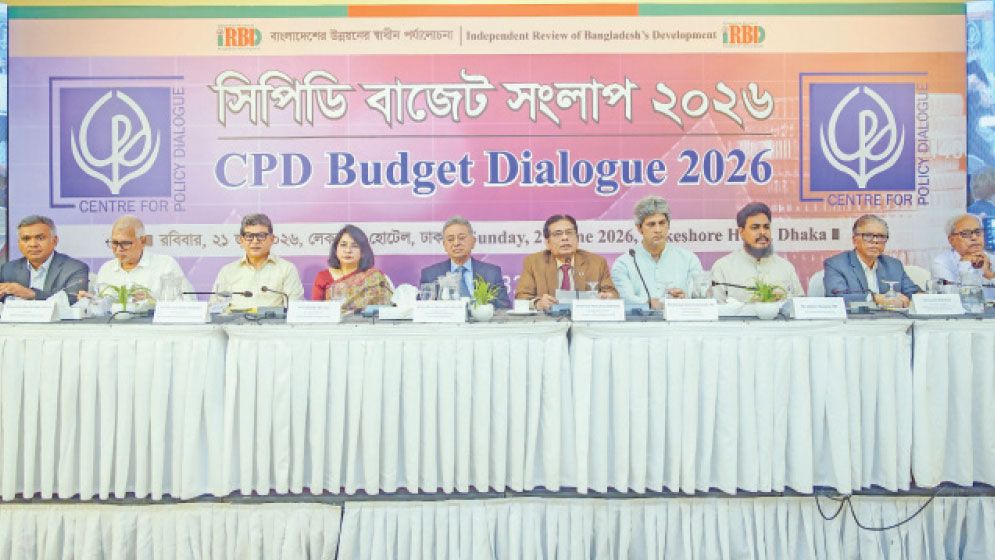
Finance and Planning Minister Amir Khosru Mahmud Chowdhury speaks at a CPD budget dialogue on Bangladesh’s economic challenges.
Finance and Planning Minister Amir Khosru Mahmud Chowdhury said the government would need at least two years to restore stability to the fragile economy and put it back on the path to prosperity.
Speaking as the chief guest at a budget dialogue organised by the Centre for Policy Dialogue (CPD) on Sunday, he described the current economic situation as a major challenge and urged citizens to remain patient.
“We believe the economy will move from fragility to stability within two years. From the third year, it will begin to recover, and by the fourth and fifth years, it will advance toward prosperity,” he said.
The event was chaired by CPD Distinguished Fellow Dr Mustafizur Rahman and attended by State Minister for Planning Zonayed Saki, along with economists, business leaders and labour representatives.
Presenting the keynote paper, CPD Executive Director Dr Fahmida Khatun criticised the proposed budget for the fiscal 2026-27 for widening disparities in the personal income tax structure.
She said taxpayers with annual taxable incomes between Tk6 lakh and Tk15 lakh could see their tax burden rise by 12.5% to 16.7%, while those earning more than Tk30 lakh annually would face an increase of only 7.6%.
Describing the structure as inconsistent with social equity and justice, Fahmida also argued that the government’s pledge to create one crore jobs within 18 months was not adequately reflected in the budget.
Allocations for key ministries linked to employment generation have either declined or remained stagnant, she noted.
Without a dedicated national employment programme and necessary reforms, the job-creation target risks remaining a “political aspiration,” she warned.
Fahmida also questioned the government’s target of reducing inflation to 7.5% in the next fiscal year, noting that average inflation stood at 8.63% through May.
Achieving the target, she said, would require stable food and energy supplies and prudent monetary policies.
Energy crisis remains a key challenge
Highlighting gas and electricity shortages as major obstacles to economic recovery, Amir Khosru said such problems could not be resolved overnight.
“I cannot solve these issues in three months. Even with money, solutions cannot be delivered that quickly,” he said.
Bangladesh Chamber of Industries (BCI) President Anwar-ul-Alam Chowdhury said the energy crisis was threatening the survival of existing industries, while high lending rates were creating additional pressure.
“At this moment, economic growth is not the priority; keeping existing industries alive is,” he said, adding that businesses remained concerned about law and order and did not yet feel fully secure.
The finance minister said the previous government had failed to take adequate initiatives to explore new gas resources, while the current administration had begun doing so.
However, importing, storing and distributing gas would require at least 18 months.
Reiterating the government’s ambition to transform Bangladesh into a trillion-dollar economy by 2041, he stressed that gas, electricity and reliable internet connectivity are essential for future growth.
Digital dashboard for project monitoring
Responding to suggestions for stronger budget oversight, Amir Khosru announced that the government would launch a special digital dashboard in the first week of July to address chronic delays and inefficiencies in project implementation. “Rather than conducting quarterly reviews, we are introducing a dashboard through which every project will be monitored on a daily basis,” he said.
Addressing concerns raised by Fahmida Khatun over large lump-sum allocations in the proposed budget, he clarified that no such allocations had been earmarked for operational expenditures.
“Whatever lump-sum allocations remain are solely for development projects,” he added.
The minister also announced the formation of a task force to oversee the implementation of regulatory simplification measures introduced in the budget.
A dedicated website will be launched to allow citizens and businesses to report regulatory violations, poor implementation of rules and administrative harassment.
To boost exports, the government has significantly reduced duties and taxes on industrial raw material imports and expanded export incentives beyond the ready-made garment sector.
Exporters across all sectors will be able to access bonded warehouse facilities or import raw materials duty-free through bank guarantees. Opening letters of credit (LCs) for raw material imports will no longer be mandatory.
State Minister for Planning Zonayed Saki said the government was reviewing the causes of persistent delays and cost overruns in development projects.
A comprehensive roadmap and action plan to address the challenges would be prepared within the next one to two months, he added.
Economists warn of three major crises
PPRC Executive Chairman Dr Hossain Zillur Rahman said many low-income households were increasingly relying on loans merely to survive rather than to invest.
Families were cutting food consumption, postponing healthcare and taking on multiple jobs, contributing to growing mental health concerns, he said.
He identified three major crises facing the country: employment, investment and the quality of education.
RAPID Chairman Dr Mohammad Abdur Razzaque highlighted widening wealth inequality, saying an estimated 1% of the population now controls nearly 50% of the country’s wealth.
He called for the introduction of a properly designed wealth tax and inheritance tax to help address growing disparities.