


 For all latest news, follow the Daily Sun's Google News channel.


Bank deposits rise nearly 12% in March as confidence returns
Daily Sun Report, Dhaka
Published: 02 Jun 2026, 12:00 AM
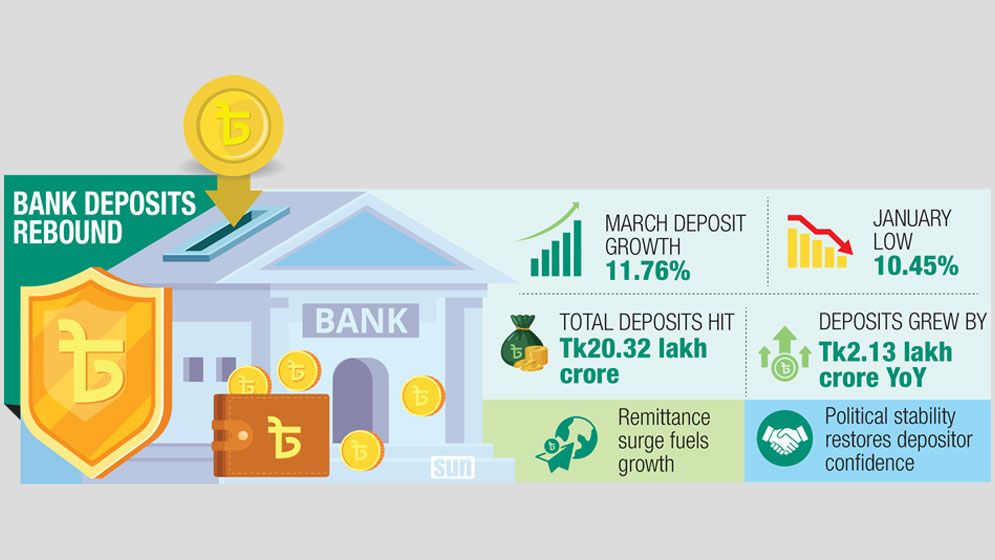
Bank deposit growth has begun to recover following the national election, supported by easing political uncertainty, rising remittance inflows, and a gradual restoration of public confidence in the banking sector.
According to Bangladesh Bank data, deposit growth in the banking sector rose to 11.76% in March from 11.28% in February.
Earlier, amid election-related uncertainty, the growth rate had fallen to 10.45% in January.
Although investment activity has remained sluggish for an extended period, the election of the BNP-led government initially raised hopes among businesses for a revival in private investment.
However, the energy crisis stemming from instability in the Middle East has tempered some of that optimism.
At the same time, election-related uncertainty among the public has largely subsided, contributing to a renewed flow of deposits into the banking system.
Increasing remittance inflows from expatriate Bangladeshis have also played a significant role in boosting deposits.
Deposit growth remained below 7% throughout the previous fiscal year due to political uncertainty surrounding the change in government and persistent inflationary pressures. Since July – the first month of the current fiscal year – however, deposit growth has been on a steady upward trajectory.
Bangladesh Bank data show that total deposits in the banking sector stood at Tk20.32 lakh crore at the end of March, up from Tk18.18 lakh crore during the same period in 2025. This represents an increase of Tk2.13 lakh crore, or 11.76% year-on-year.
During the period, term deposits rose to Tk18.16 lakh crore, while current deposits increased to Tk2.15 lakh crore.
Stakeholders attributed the improvement in deposit growth to several factors. Banking sector reform initiatives have begun to restore public confidence, encouraging depositors to return funds to banks.
In addition, many individuals who had withdrawn money during the period of political uncertainty have started redepositing their funds.
Strong remittance inflows, along with Bangladesh Bank’s dollar purchases, have also injected liquidity into the financial system and supported deposit growth.
Former World Bank lead economist Dr Zahid Hussain told the Daily Sun that recent initiatives by Bangladesh Bank have helped rebuild confidence in the banking sector, prompting people to redeposit excess cash into banks.
“The biggest contributor to deposit growth is the continued rise in remittance inflows,” he said. “Because of sluggish business activity, many expatriate families are not spending all of their remittance income, and a large portion is being held in banks as deposits.”
He added that interest rates have also contributed to the increase in deposits.
Lower returns on savings certificates have encouraged many savers to keep their funds in banks instead.
Furthermore, Bangladesh Bank’s dollar purchases have injected substantial liquidity into the banking system.
However, Dr Zahid cautioned against viewing higher deposits as evidence of a full economic recovery.
“Investment conditions and employment generation have not yet returned to normal levels,” he said. “While deposits are rising, investment is not increasing at the same pace. Without stronger investment, employment, income and savings will not grow sustainably, creating longer-term economic challenges.”
He stressed the need for a stable investment environment to maintain economic momentum.
Data analysis also showed that while overall deposits are increasing, weaker banks continue to lose deposits, while stronger institutions are attracting more customers and funds.
Banks recording notable deposit growth include City Bank, BRAC Bank, Pubali Bank, Eastern Bank, Jamuna Bank, Trust Bank, Prime Bank, NCC Bank, Mutual Trust Bank, Dutch-Bangla Bank, Shahjalal Islami Bank, Uttara Bank, Midland Bank and Citizens Bank.
Mohammed Nurul Amin, an experienced banker and newly appointed chairman of Krishi Bank, said people cannot keep money outside the banking system indefinitely and eventually return to banks.
However, he noted that deposit withdrawals increased significantly at several weak banks after Bangladesh Bank identified troubled institutions and restructured their boards, prompting many customers to shift their funds to stronger banks.
Mutual Trust Bank Managing Director and CEO Syed Mahbubur Rahman said public confidence in the banking sector is gradually returning, leading to higher deposit growth. He expressed optimism that the positive trend would continue.
Another Bangladesh Bank report showed that, ahead of the national election, people increasingly preferred holding cash outside the banking system. However, that trend has slowed considerably in recent months.
Cash held outside banks stood at Tk3.03 lakh crore in March, compared with Tk2.86 lakh crore in February.
This marked a monthly increase of 5.8% and a year-on-year increase of 2.22%, significantly lower than the growth recorded in previous months.
The data suggest that the growth of cash held outside banks is gradually declining as confidence in the banking sector improves.