



 For all latest news, follow the Daily Sun's Google News channel.


MCCI urges 100-day reform push to revive growth
Business leaders call for banking reforms, stronger investment climate, energy security and export diversification as Bangladesh faces fragile economic recovery
Daily Sun Report, Dhaka
Published: 10 Mar 2026, 12:00 AM
The Metropolitan Chamber of Commerce and Industry, Dhaka (MCCI) urged the government to prioritise an action plan for its first 100 days to revive private sector-led growth, stabilise the macroeconomy, strengthen financial management and boost export competitiveness for diversification.
The leading trade body also recommended that the government focus on stabilising the banking and financial sector, catalysing private investment, developing skills for job creation and competitiveness, and ensuring a sustainable and secure energy supply during the initial 100-day period.
In cooperation with the Policy Exchange of Bangladesh (PEB), MCCI identified seven priority areas to address the country’s current economic challenges.
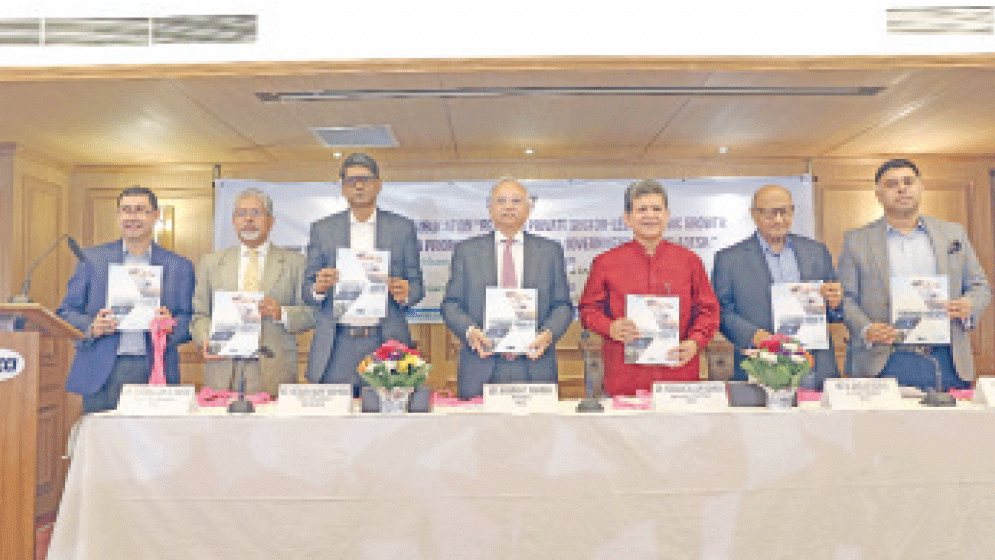
MCCI President Kamran T Rahman unveiled the key areas at the launching ceremony of an MCCI publication titled “Reviving Private Sector-Led Economic Growth: Critical Issues and Priorities Facing the New Government in Bangladesh” at the chamber’s Gulshan office in Dhaka on Monday.
Economy facing multiple challenges
“Since 2022, our economy has been passing through a challenging period,” Kamran T Rahman said.
He noted that rising global commodity prices, supply chain disruptions and tight global financial conditions have coincided with domestic structural weaknesses.
As a result, the country has experienced high inflation, pressure on foreign exchange reserves, exchange rate instability and a slowdown in investment and growth.
He added that recent political uncertainty has further affected economic confidence and activity.
“Today we see that balance-of-payments pressures are easing and inflation is gradually declining. However, the recovery remains fragile,” he said.
According to him, investment growth is weak and credit growth subdued, while adjustments have often occurred through demand compression rather than productivity-driven expansion.
“This is not a sustainable path for restoring jobs, incomes and competitiveness,” he added.
Rahman also noted that Bangladesh is approaching another major transition, graduation from Least Developed Country (LDC) status, which will bring new challenges.
Preferential market access will gradually change, compliance requirements will increase and global competition will intensify, he said.
“If we do not strengthen our policy framework and institutional capacity now, we risk losing momentum at this critical moment,” he added.
He said the research initiative aims to present the perspectives and experiences of the business community to the newly elected government so that the key constraints faced by enterprises, investors and employers are reflected in the national development agenda.
“Our objective was not only to highlight problems but also to present an evidence-based and practical reform roadmap that policymakers can use to design realistic and effective economic policies,” he said.
Bangladesh at a ‘critical juncture’
PEB Chairman Masrur Reaz said Bangladesh stands at a “critical juncture” as the economy moves from crisis management toward recovery amid structural constraints and global uncertainty.
He noted that although Bangladesh experienced decades of strong growth averaging 6%-7%, economic momentum has slowed significantly since 2022 due to a combination of global shocks, domestic policy weaknesses and institutional challenges.
“Without comprehensive reforms, these vulnerabilities could push the economy toward prolonged stagnation,” he warned, adding that the study also examined policy priorities outlined in BNP’s election manifesto.
Call for forensic audits
Speaking at the event, noted economist Hossain Zillur Rahman said the government must address harassment, corruption and institutional capacity constraints.
He suggested conducting forensic audits of major state-owned institutions to improve transparency and performance.
He also urged the government to initiate a national dialogue involving civil society, economists and trade bodies to address the country’s economic challenges.
Editor and Publisher of Banik Barta, Dewan Hanif Mahmud, said it is important to examine the true size and actual condition of the economy.
“There are questions regarding the US$450 billion economy,” he said.
He added that although Bangladesh’s tax-to-GDP ratio is often reported to be around 6%-6.5%, citizens pay taxes at various stages of economic activity.
“Therefore, it is necessary to examine whether this statistic reflects the actual situation or if it is overstated,” he said.