


 For all latest news, follow the Daily Sun's Google News channel.


‘Abrupt cuts in lending rates risky’
Finance adviser says inflation has political and supply-side dimensions, warns sudden rate moves could destabilise banks
Daily Sun Report, Dhaka
Published: 11 Jan 2026, 12:00 AM
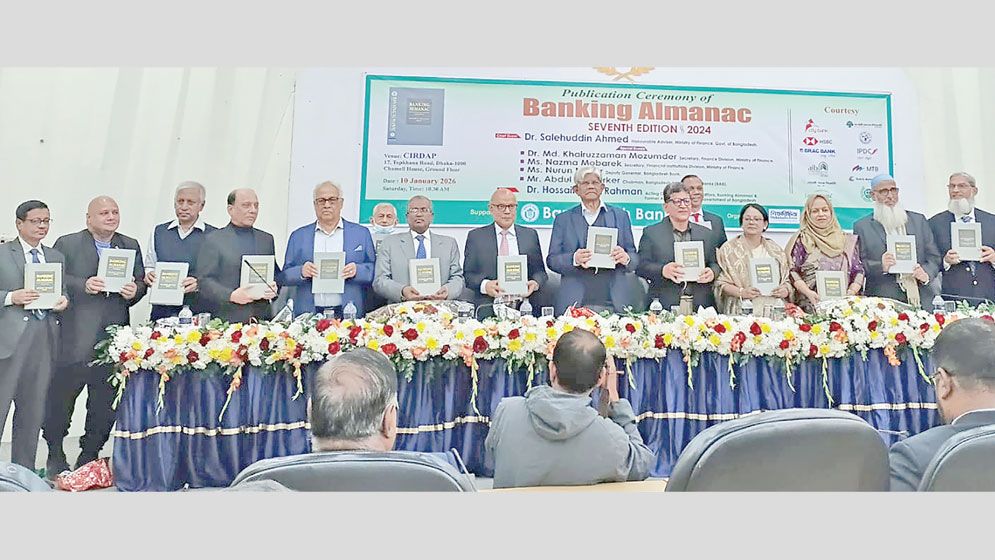
Finance Adviser Dr Salehuddin Ahmed has said that sharply lowering elevated bank lending rates to rein in inflation is “not a very easy task,” citing structural and market complexities.
Speaking as chief guest at the unveiling of the seventh edition of the Banking Almanac at the CIRDAP Auditorium on Saturday, Salehuddin said Bangladesh’s economy has stabilised and expressed hope that the next government would sustain the momentum.
He emphasised that the government is not pursuing overnight fixes, but aims to build a strong and sustainable economy through patience, consistent policy implementation and collective cooperation.
Inflation, he noted, cannot be controlled solely by adjusting policy or bank interest rates, as it also has political and supply-side dimensions.
Explaining the challenges of interest rate adjustments, the finance adviser said reducing lending rates involves a delicate balance between bank rates and Treasury bill rates.
“A sudden cut on one side can destabilise the other. Consistency is crucial,” he said, adding that Treasury bill rates have already declined gradually, from around 12% to about 10%, with the impact now filtering through the market.
He also warned that raising Treasury bill or savings certificate rates could trigger large-scale deposit withdrawals from banks, posing systemic risks to the financial sector.
Banks and non-bank financial institutions, he said, play a critical intermediary role by channeling savings into productive credit.
Abdul Hai Sarker, chairman of the Bangladesh Association of Banks, said the reasons behind persistently high bank interest rates remain unclear.
He blamed politically motivated approvals made without adequate scrutiny for creating structural weaknesses that have pushed up borrowing costs and eroded export competitiveness.
Highlighting recent improvements, Salehuddin said the banking sector was in crisis when the interim government took office, but recent data shows positive trends in provisioning and loan performance, as reflected in the Banking Almanac.
The publication, produced by the educational weekly ShikkhaBichitra with support from Bangladesh Bank, presents comprehensive data on capital adequacy, provisioning, credit-deposit ratios and other key banking indicators.
Former caretaker government adviser Dr Hossain Zillur Rahman said Bangladesh must accelerate economic progress to meet national aspirations, stressing the need for stronger governance in the banking sector and protection of foreign exchange reserves.
Financial Institutions Division Secretary Nazma Mobarek described the Banking Almanac as an important record of Bangladesh’s economic history and banking realities, noting that the sector accounts for roughly 60% of GDP.
The event also featured remarks by Bangladesh Bank Deputy Governor Nurun Nahar, Banking Almanac Executive Editor Syed Ziauddin Ahmed, and former ABB chairman Mahbub ur Rahman.