



 For all latest news, follow the Daily Sun's Google News channel.


Construction sector rebounds amid multiple challenges
Public projects, real estate activity lift demand, but high costs and weak investment weigh on recovery

The country’s construction sector is showing signs of recovery after a prolonged slump, though high financing costs, elevated material prices, and subdued private investment continue to test its resilience.
As public infrastructure projects resume and demand for housing, commercial, and industrial real estate ticks up, momentum is building across the industry.
However, insiders caution that a full turnaround hinges on a stabilised investment climate, lower interest rates, and predictable material costs.
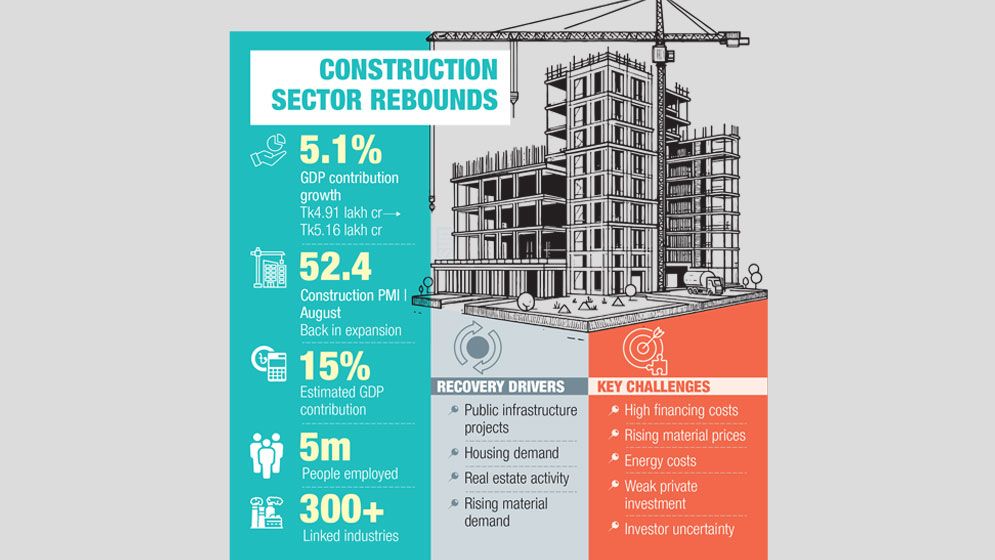
A sustained rebound is vital for the broader economy. According to the Real Estate and Housing Association of Bangladesh (REHAB), the sector contributes roughly 15% to Bangladesh’s GDP, employs nearly five million people, and feeds into more than 300 backward-linkage industries – from steel and cement to ceramics, transport, and real estate.
Bangladesh Bureau of Statistics (BBS) data cited in recent industry reports show that the construction sector’s nominal GDP contribution rose to Tk5.16 lakh crore in the fiscal 2025-26 from Tk4.91 lakh crore in FY25, an increase of about 5.1%.
The August reading of the Bangladesh Purchasing Managers’ Index (PMI), released by the Metropolitan Chamber of Commerce and Industry (MCCI), Dhaka, and Policy Exchange Bangladesh (PEB), showed stronger growth in manufacturing and services, while the construction sector returned to expansion.
The construction index reached 52.4 in August, with both activity and employment moving into expansion, indicating renewed momentum in the sector.
The PMI report identified lower business costs, stronger financial support and a more supportive policy environment as important factors for strengthening economic activity.
It said improvements in energy supply, easier access to finance, better control of operating costs and business-friendly tax and policy support could further boost business confidence and accelerate the recovery.
Policy Exchange Bangladesh Chairman and CEO Dr M Masrur Reaz said the August PMI reading of 49.9 showed that Bangladesh’s overall economic activity remained broadly near the neutral threshold.
He said continued expansion in agriculture and the return of construction to growth highlighted the economy’s underlying resilience.
Speaking to Daily Sun, Niamul Sadeque, manager of M/S Abul Kashem Trading Corporation at Shahjadpur, said sales had recently increased somewhat due to a pickup in real estate activity.
“We are currently selling high-quality BSRM rods at Tk92,000 per tonne, while AKS and GPH Ispat rods are selling at Tk90,000 and Salam Steel at Tk87,000. A 50kg sack of cement is selling for between Tk500 and Tk560 in the capital,” he said.
“Rod prices have risen by around Tk5,000 per tonne and cement prices by Tk20-30 per bag as demand has increased. Government projects and private housing activity have also picked up, and we expect demand for construction materials to grow further,” he said.
Tapan Sengupta, deputy managing director of BSRM Ltd, said high gas and electricity prices were driving up production costs, while a sharp rise in freight charges had further increased the cost of importing raw materials.
As a result, raw material costs remain high, putting additional pressure on manufacturers and affecting their competitiveness, he said.
Sengupta also called for a permanent solution to the persistent gas crisis, saying reliable and uninterrupted energy supply was essential to keep factories operational and production costs predictable.
Md Muzammel Haque Akanda, chief executive officer of Ratul Properties, a sister concern of Rupayan Group, said sales of commercial properties, particularly office spaces and shops, had recently improved somewhat.
He said there was some demand for properties in the Tk1-1.5 crore range, while the Tk2-4 crore upper-middle segment remained relatively active.
“At present, many investors are showing greater interest in secure land development projects than in ready properties, as they consider land investment relatively safer,” he said.
He, however, said client response had not improved significantly compared with the period before 2024, while investors had yet to regain full confidence.
One of the main reasons is the rise in construction material costs, which has pushed up real estate prices. Buyers also remain concerned about the security of their investments, he said.
Rising global oil prices and the cost of essential goods have created additional economic pressure, affecting investment in real estate. Large business owners are also not investing as actively as before, Akanda said.
Those who are investing are mainly looking for opportunities and, in many cases, seeking properties at prices 10%-20% below prevailing market rates.
“As a result, a gap has emerged between buyers’ and sellers’ expectations. Sellers are reluctant to lower prices, while buyers are looking for discounts, making it more difficult to match buyers and sellers in the secondary market,” he added.
Furkaan N Hossain, deputy managing director of Anwar Cement Ltd, said the industry supported the government’s development agenda but believed the current tax structure was putting additional pressure on both manufacturers and consumers.
He said revenue ultimately depended on demand, while the construction sector was currently operating at less than 50% capacity.
“The cement industry will need to reach nearly 85% capacity utilisation to achieve the budget’s projected revenue target. That will be difficult without policies that stimulate construction activity and broader economic growth,” he said
Dr Ali Afzal, chairman of Glorious Lands and Developments Limited, said overall activity had picked up somewhat, but multiple challenges remained in the real estate sector.
Business leaders have proposed a public-private partnership-based housing programme to deliver affordable apartments for low- and lower-middle-income people.
Under the proposal, government land and policy support would be combined with private-sector investment and expertise to widen access to safe and affordable housing.
Afzal, also president of REHAB, called for the full digitalisation of building plan approvals, land registration and apartment registration to reduce unnecessary delays, bureaucratic complexities and unwanted interference.
“A fully digital system would make public services faster, more transparent, more accountable and less of a hassle, accelerating growth across the sector,” he said.
Recommended Stories
Read More