





 For all latest news, follow the Daily Sun's Google News channel.


A major pay disparity persists at Sammilito Islami Bank PLC, with employees in the same post and grade and performing broadly similar duties receiving significantly different salaries.
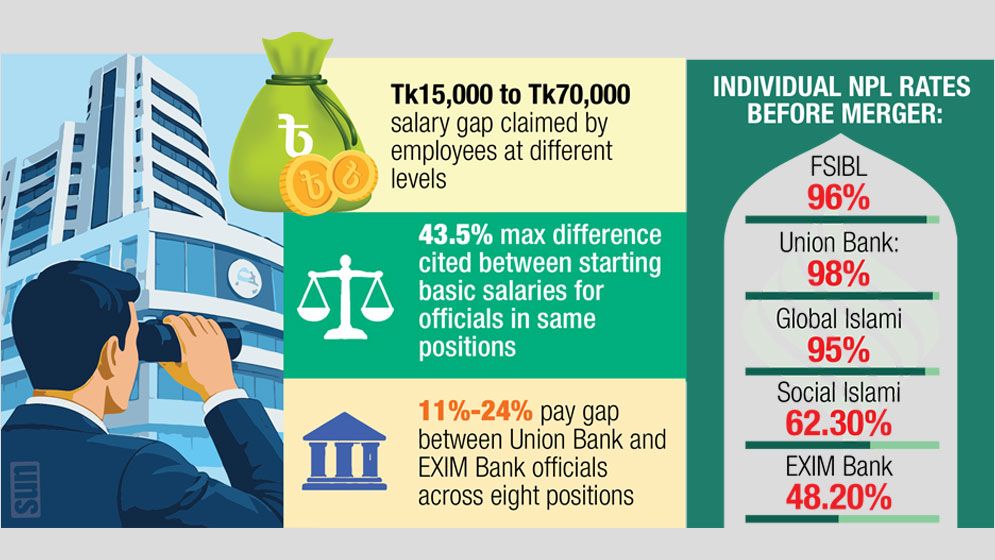
In some cases, the starting basic salary of an official from one legacy bank is as much as 43.5 percent lower than that of a colleague in the same position who came from another bank.
A comparative analysis of the existing pay structures of the five banks shows that the disparity is particularly pronounced at lower- and mid-level positions, from senior officer to assistant officer.
Employees concerned claim that the salary gap ranges between Tk15,000 and Tk70,000 at different levels, particularly from junior officer to senior principal officer. In some cases, officials remain behind their colleagues in the same position even after receiving four or five increments.
The disparity also exists at higher positions, although it is comparatively smaller.
Several officials of Social Islami Bank (SIBL) said that after August 5, 2024, the board of EXIM Bank was allegedly pressured to introduce automatic promotions without financial benefits for all employees.
They said that at around the same time, the new chairman of First Security Islami Bank (FSIBL) granted relatively large promotions to officials of his choice.
No such promotions were given at Union Bank, Global Islami Bank or SIBL, they claimed.
However, officials of EXIM Bank painted a different picture. According to them, the starting salaries at SIBL and FSIBL are higher than those at EXIM Bank for most positions. A position-wise comparison between Union Bank and EXIM Bank also shows a similar pattern, they said.
As per the comparison, the pay gap ranges from around 11 percent to 24 percent across eight positions, from deputy managing director (DMD) to first assistant vice president (FAVP).
One of the main reasons for the disparity, according to officials concerned, is that the five legacy banks had different salary structures. Some had eight salary scales while others had 10.
Some banks also had positions such as management trainee officer (MTO) and executive officer (EO), which did not exist in the others.
As a result, bringing employees from the five banks under a single structure has become a complex task from both administrative and human resources perspectives.
Employees complain that although officials and staff of the five legacy banks are now working as employees of the same institution, their salaries and benefits are still determined by their respective legacy-bank structures.
They question why two employees should receive different salaries when they work in the same grade, perform the same duties, work in the same office and operate under the same management.
As part of the merger process, Bangladesh Bank appointed one administrator and five assistant administrators for the five banks on November 4, 2025. Subsequently, payment operations for customers began under a circular issued by the central bank’s Bank Resolution Department.
The government then appointed a chairman, board of directors and, eventually, a managing director for Sammilito Islami Bank. Even after the same chairman and MD were appointed for the merged entity, employees of the five legacy banks continued to receive salaries under separate pay structures for months.
EXIM Bank, FSIBL, Social Islami Bank, Union Bank and Global Islami Bank were merged under a government initiative to form Sammilito Islami Bank. Bangladesh Bank listed the bank as a scheduled bank on December 1, 2025. The bank currently has more than 16,000 employees.
Sammilito Islami Bank Chairman Quazi Shairul Hassan told the Daily Sun that as the bank was formed by merging five others, the salary structures are also different.
“But we are trying to develop a new model that can satisfy all officials and employees. Everyone will see an outcome in this regard soon,” he said.
Bangladesh Bank Executive Director and Spokesperson Arief Hossain Khan said although five different banks were merged to form Sammilito Islami Bank, its board will now take independent decisions on its internal matters.
Bangladesh Bank’s former chief economist Dr Mustafa K Mujeri said several approaches could be considered, including bringing everyone under a common salary scale and gradually reducing existing gaps or adjusting the differences through various allowances and benefits.
However, the final decision would depend on the bank’s board and the central bank, he added.
Mustafa described the process as highly challenging, saying it would be difficult to satisfy everyone.
“Except EXIM Bank, the other four were previously Islamic banks. So, their salary structures were broadly similar,” he said. “If a common salary structure is introduced, some employees will see their salaries reduced while others will remain unchanged. There is little that can be done about that. In a merger, if one group gains, another may end up losing.”
According to Bangladesh Bank data, before the merger, non-performing loans accounted for 96 percent of the total loans at FSIBL, 98 percent at Union Bank, 95 percent at Global Islami Bank, 62.30 percent at Social Islami Bank and 48.20 percent at EXIM Bank.
In other words, the loans, deposits, financial distress and restructuring responsibilities of the five banks now rest with a single institution.
Sammilito Islami Bank’s legal framework gives its board powers over the employment terms, salaries and benefits of employees transferred from the five legacy banks.
Under the provision, employees who were serving the transferor banks immediately before the effective date and had no pending complaints or cases against them were deemed to have been transferred to the new bank.
However, the provision allows the board to redefine the terms and conditions of employment at the new bank, giving it legal scope to revise existing salaries, allowances and other benefits following the merger.
The provision also suggests that employees may have limited scope to object if their existing benefits are reduced.
An employee who submits written notice that they do not wish to join the new bank will not be considered an employee of the new entity.
The authority may also dismiss an employee without issuing a show-cause notice if evidence is found of fraudulent activities or conduct violating service rules.
Meanwhile, Bangladesh Bank retains the authority to decide matters involving employees whose transfer process was pending before the closure date.