


 For all latest news, follow the Daily Sun's Google News channel.


'Bangladesh First' is our strategic compass in shifting global order: Shama Obaed
State Minister for Foreign Affairs addresses BIISS seminar on navigating foreign policy
Daily Sun Report, Dhaka
Published: 12 Oct 2026, 08:41 PM
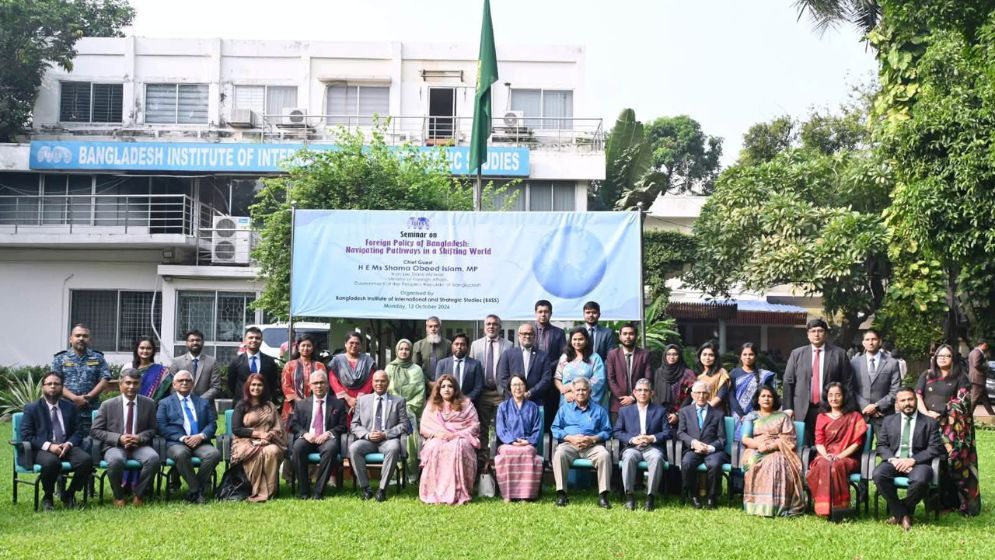
Photo: MoFA
State Minister for Foreign Affairs Shama Obaed Islam on Monday said that "Bangladesh First" serves as the nation's guiding principle and strategic compass to engage confidently with the global community while adapting to shifting international dynamics.
She made the remarks as the chief guest at a seminar titled
"Foreign Policy of Bangladesh: Navigating Pathways in a Shifting
World," organised by the Bangladesh Institute of International and
Strategic Studies (BIISS) at the BIISS auditorium in the capital.
Major General ASM Ridwanur Rahman, awc, afwc, psc, G,
Director General of BIISS, delivered the welcome address and chaired the
session, where four research papers were presented by BIISS researchers.
Speaking at the session, Shama Obaed underscored that the
evolving geopolitical landscape requires an adaptive yet principle-driven
foreign policy.
"As the international landscape continues to evolve, navigating the tumultuous waters requires a foreign policy that is not only responsive to emerging realities but also firmly anchored in our national interests. This is the essence of Prime Minister Tarique Rahman's 'Bangladesh First' foreign policy," she said.
"For us, 'Bangladesh First' is both our guiding
principle and our strategic compass, enabling us to engage confidently with the
world, adapt to changing circumstances, and pursue cooperation without
compromising our national interests," she added.
Elaborating on the doctrine, the state minister said:
"It means placing Bangladesh’s national interests, sovereignty, dignity,
and the well-being of our people at the centre of our international engagement.
It means building partnerships without dependency, pursuing cooperation without
compromising our independence, and strengthening relations on the basis of
mutual respect, sovereign equality, and shared interests."
The seminar brought together senior officials from various ministries, members of diplomatic missions, journalists, business leaders, researchers, representatives of think tanks, as well as academics and students from different universities.