



 For all latest news, follow the Daily Sun's Google News channel.


BILIA to draft bill to amend anti-rape law by March
Legal experts, academics and students attended the seminar organised by BILIA
Daily Sun Report, Dhaka
Published: 11 Oct 2026, 09:11 PM
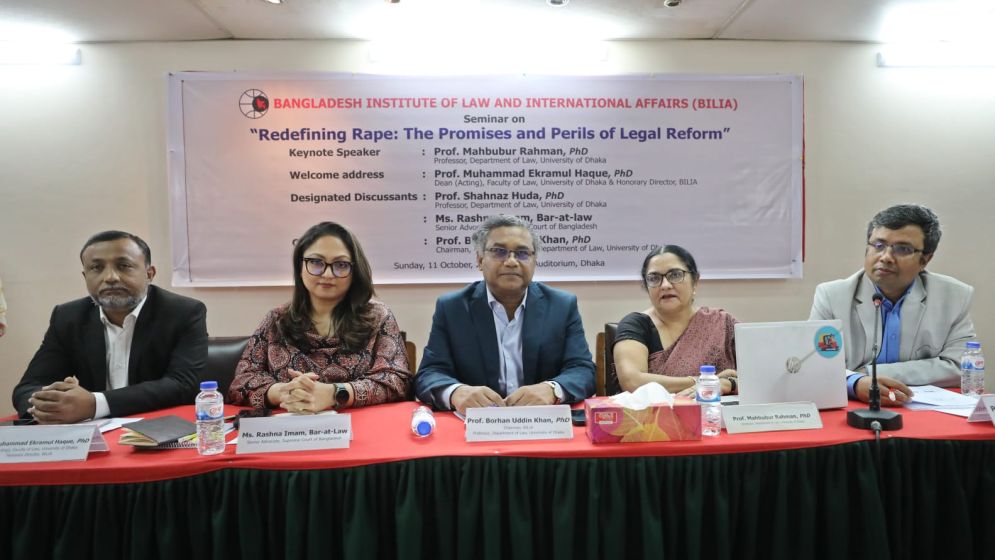
Photo: Kamrul Islam Ratan
The Bangladesh Institute of Law and International Affairs (BILIA) will draft a bill to amend the Women and Children Repression Prevention (Amendment) Ordinance, 2025, by March next year, its chairman said.
"BILIA will take the initiative to draft an
amendment bill on the latest amendment to the rape law by March next
year," said Prof Borhan Uddin Khan, chairman of BILIA and a professor at
the Department of Law, University of Dhaka.
He made the remarks as the concluding session of a
seminar titled "Redefining Rape: The Promises and Perils of Legal
Reform", held on Sunday in the capital.
"We will not make hasty decisions. We will take
our time and plan every necessary step properly," he said.
Legal experts, academics and students attended the
seminar organised by BILIA.
Prof Md Ekramul Haque, acting dean of the Faculty of
Law at the University of Dhaka and honorary director of BILIA, delivered the
welcome address.
Prof Mahbubur Rahman of the Department of Law,
University of Dhaka, presented the keynote address.
He began with the low conviction rate in rape cases,
then discussed the strengths and weaknesses of the 2025 Ordinance, which amends
the Women and Children Repression Prevention Act, 2000.
He said the amendment makes the offence
gender-neutral, so both the perpetrator and the victim can now be male or
female. It also broadens the types of penetration that count as rape compared
with earlier law.
On marital rape, he said the law still leaves
significant grey areas and the 2025 amendment does not address the issue.
Citing other countries, he said non-consensual
intercourse between spouses is punishable there as sexual assault or sexual
violence rather than rape.
"Bangladesh's law remains silent on this, even
after the latest amendment," he said.
He also said Bangladesh law recognises four
categories of rape-related offences, three of them aggravated and one
non-aggravated. Yet the punishments for all four are nearly identical with only
minor differences.
Prof Shahnaz Huda of the Department of Law, University
of Dhaka, said police officers lack adequate investigative skills and doctors
at upazila level lack adequate forensic capacity. "Delays and errors at
this stage often cause further harm to the survivor," she said.
She said neighbouring countries have stricter laws
on sexual violence and define consent more clearly, whereas Bangladesh's law
does not properly define it.
Senior Supreme Court lawyer Rashma Imam said the law
is drafted in a way that leaves much open to interpretation, which affects how prosecutors
prove their cases.
She also said the law offers no protection to
witnesses.
"Perpetrators often come from positions of
power and they silence witnesses with money or threats of violence," she
said, adding that this discourages survivors from seeking justice.