


 For all latest news, follow the Daily Sun's Google News channel.


Mahdi Amin, WB officials discuss plans for education sector
Daily Sun Report, Dhaka
Published: 29 Sep 2026, 08:44 PM
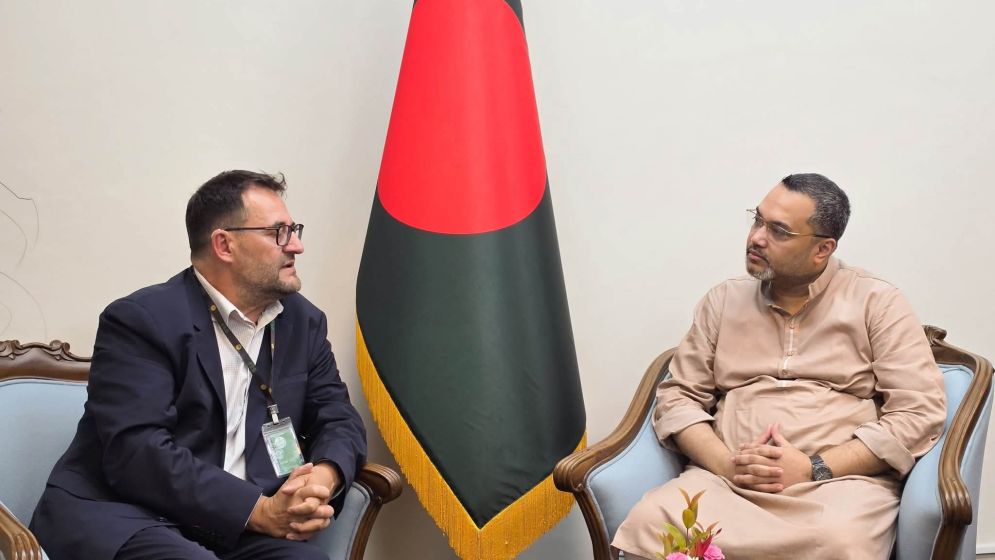
Photo: Courtesy
The World Bank and Mahdi Amin, the prime minister’s adviser
on education, held a meeting on education sector policies, planning and mutual
cooperation at the Prime Minister’s Office in Tejgaon on Tuesday afternoon.
Discussions focused on the government’s priorities at
different levels of the country’s education system, modernization of education,
skills development, and strengthening the link between education and
employment. They also discussed various stages of formulating and implementing
priority-based education plans in line with the current government’s election
manifesto.
The World Bank delegation included Jean Pesme, Country
Director for Bangladesh and Bhutan; Sherezad Monami Latif, Practice Manager for
Education and Skills Global Practice in the South Asia region; Dr Gail H
Martin, Operations Manager for Bangladesh and Bhutan; Senior Education
Specialist Abdul Hai Sofizada; Senior Economist Syed Rashed Al Zayed; and
Senior Education Specialist Tasneena Rahman.
The meeting discussed the introduction of midday meals at
the primary education level, distribution of free school uniforms and school
bags, adding two new books to the Grade 4 curriculum, and introducing the
“Learning with Happiness” curriculum from Grade 6.
Discussions also covered plans for the secondary and higher
secondary levels: making third-language education compulsory, expanding access
to technical education, making education free up to the secondary or equivalent
level for male students, establishing modern laboratories and multimedia
classrooms, and ensuring free Wi-Fi facilities.
For higher education, the government plans to ensure free
education up to the postgraduate level for female students, expand innovation
and startup activities at universities, establish job ecosystems and career counseling
offices, and introduce student loan programs for higher education abroad.
The meeting also emphasized establishing technical education
institutions at the upazila level and introducing mandatory technical
laboratories.
The meeting further held productive discussions on elements
from the government’s election manifesto: launching an employment exchange,
strengthening the capacity of the National Skills Development Authority, and
implementing the Bangladesh National Qualifications Framework (BNQF).