


 For all latest news, follow the Daily Sun's Google News channel.


BTMA seeks policy support to protect textile sector
Urgent policy support sought to safeguard primary textile sector, boost exports; President assures consideration
Daily Sun Reporter, Dhaka
Published: 21 Sep 2026, 05:16 PM
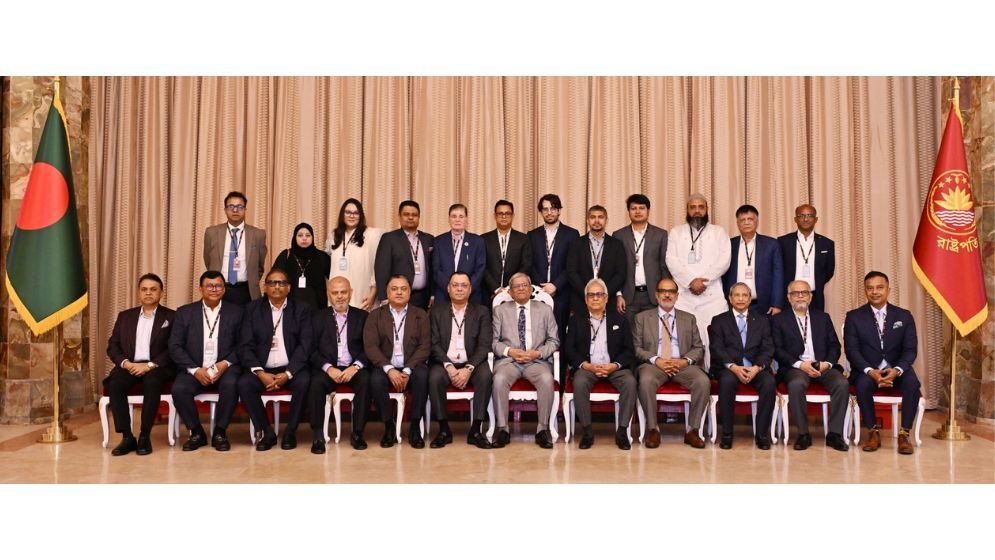
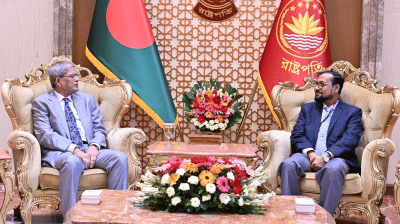
President Mirza Fakhrul Islam Alamgir with a 23-member BTMA delegation at Bangabhaban on Monday, 21 September 2026. Photo: Daily Sun
A 23-member delegation of the Bangladesh Textile Mills
Association (BTMA), led by its President Showkat Aziz Russell, on Monday sought
urgent policy support from President Mirza Fakhrul Islam Alamgir to safeguard
the domestic primary textile industry and sustain export competitiveness post-LDC
graduation.
During the courtesy meeting held at
Bangabhaban, the BTMA leadership briefed the President on the sector's present
condition, future potential, and operational challenges, submitting a
five-point written proposal outlining immediate policy interventions.
Showkat Aziz Russell expressed gratitude
to the government led by the Prime Minister for recent measures that
significantly improved gas supply to spinning and textile mills, positively
impacting factory output, and requested that steady supply be maintained.
In its written proposal, the association urged the government to sustain the National Board of Revenue (NBR) order issued on 7 September 2026, which scrapped bonded warehouse facilities on the import of 10–30 count cotton yarn under HS headings 5205, 5206, and 5207, while permitting genuine exporters to import yarn against bank guarantees.
The BTMA
noted that retaining the order would curb reliance on foreign yarn that can be
manufactured domestically, saving approximately Tk30,000 crore in foreign
currency equivalent to the import figure of the 2024–2025 fiscal year.
The trade body further demanded reinstating a mandatory 30% local value-addition condition for raw materials imported by non-bonded industries against bank guarantees, alongside enforcing a minimum 40% value-addition threshold across all export lines to secure competitive advantages after graduating from the Least Developed Country (LDC) category.
Additionally, the BTMA called for the
formulation of an integrated Textile and Apparel Competitiveness Policy aligned
with competing nations—incorporating tariffs, taxes, energy tariffs, financing,
and export incentives—while guaranteeing uninterrupted gas supplies at adequate
pressure and ramping up surveillance to curb the misuse of bonded warehouse
facilities.
President Mirza Fakhrul Islam Alamgir
acknowledged the severity of the challenges facing local textile and spinning
mills, assuring the delegation that their recommendations would be given due
consideration and referred to relevant ministries and divisions for necessary
action.
The President’s Military Secretary Major
General ASM Baha Uddin, Public Division Secretary AJM Salahuddin Nagari, and
the Press Secretary attended the meeting.
The BTMA delegation included former president Abdul Hai Sarker, Vice-Presidents Md Shamim Islam and Shafiqul Islam Sarker, as well as current and former directors and senior leaders of the association.