



 For all latest news, follow the Daily Sun's Google News channel.


Opposition walks out of JS as bills on enforced disappearance, Human Rights Commission passed
The treasury bench also passes the 'Transfer of Property (Amendment) Bill, 2026,' which allows parents to retain lifetime rights to properties even after transferring ownership to children
Daily Sun Report, Dhaka
Published: 06 Sep 2026, 09:27 PM
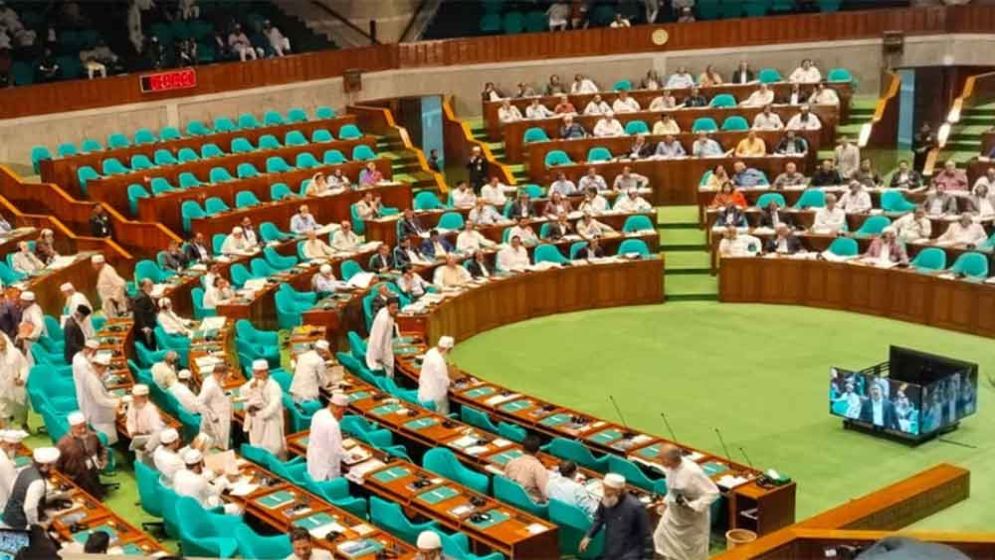
Three
key bills — the National Human Rights Commission Bill, 2026; the Enforced
Disappearance Prevention and Redress Bill, 2026; and the Transfer of Property
(Amendment) Bill, 2026 — were passed in the Jatiya Sangsad (JS) on Sunday amid
strong objections and a walkout by opposition MPs.
They
alleged that the bills on Human Rights Commission and enforced disappearance
were weak, and left loopholes for state-backed and law enforcement agencies to avoid accountability
at their will.
Several opposition and independent lawmakers, including Barrister Najibur Rahman Momen of Pabna-1, Dr Shafiqul Islam Masud of Patuakhali-2 and Barrister Rumeen Farhana of Brahmanbaria-2, raised objections and spoke against the bills.
They
argued that key provisions had not received sufficient scrutiny, contained
procedural gaps and required broader consultations with stakeholders before
being passed. They also claimed that some proposed provisions under the
transfer property bill were inconsistent with the Quran and Hadith.
Home
Minister Salahuddin Ahmed moved the Enforced Disappearance Prevention and
Redress Bill, 2026, which seeks to prohibit enforced disappearance and
establish legal mechanisms for accountability and redress.
Leader
of the Opposition Shafiqur Rahman also spoke on a point of order, strongly
opposing the Transfer of Property (Amendment) Bill, 2026. He urged the House
not to pass the bill and suggested seeking opinions from the Islamic Foundation
and noted Islamic scholars before enacting the law.
Opposition
lawmakers subsequently staged a walkout.
They
had staged a similar walkout shortly before the bills were placed before the
House on 27 August. The bills were later sent to the respective parliamentary
standing committees for further scrutiny. Opposition MPs also boycotted the
meetings of the JS bodies considering the bills.
Law
Minister Md Asaduzzaman moved the Transfer of Property (Amendment) Bill, 2026,
which seeks to amend the century-old Transfer of Property Act, 1882.
One
of its key provisions is to allow parents to retain lifetime rights to use and
occupy property even after transferring ownership to their children.
Speaking
before the passage of the bill, the law minister said it was not contrary to
Islamic values or Quranic rules.
He
also moved the National Human Rights Commission Bill, 2026, which seeks to
strengthen the institutional capacity and investigative powers of the statutory
rights watchdog.
Under
the proposed law, the commission will comprise a chairperson and four
commissioners, with at least one woman. It also gives priority to qualified
candidates from ethnic minority and underprivileged communities based on
recommendations from a search committee.
The search committee will include university professors, civil society representatives and representatives of ethnic minority and underprivileged communities.