


 For all latest news, follow the Daily Sun's Google News channel.


Load-shedding to ease significantly soon: Zahed
Daily Sun Report, Dhaka
Published: 01 Sep 2026, 12:46 PM
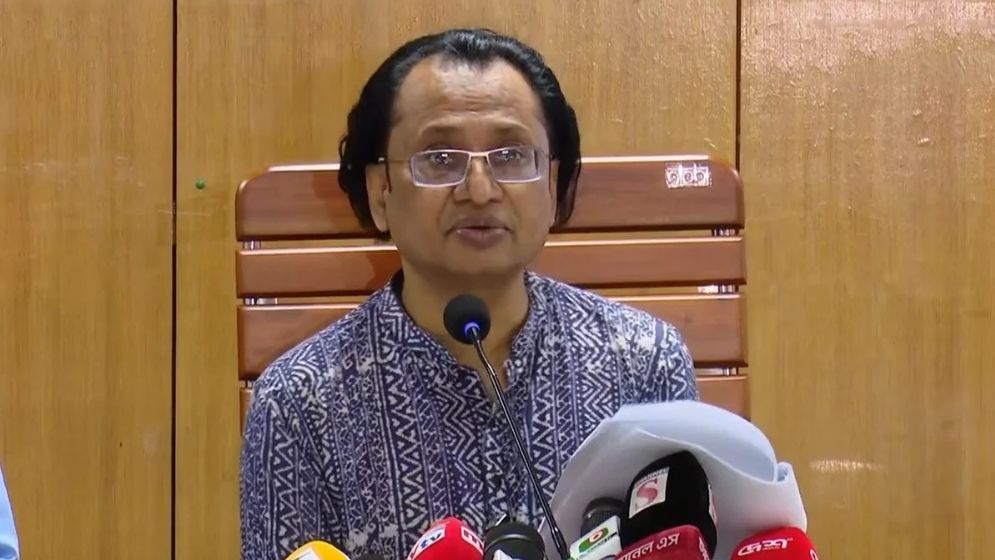
Photo: Collected
Prime Minister’s Information and Broadcasting Adviser Dr Zahed Ur Rahman said on Tuesday that load-shedding across the country is expected to ease significantly within a short time.
He said the burden of load-shedding caused by
the power shortage was now being distributed relatively evenly between urban
and rural areas.
He made the remarks at a press briefing at
the Secretariat on the progress of various government activities.
“We are trying to provide you with detailed
data on load-shedding. There has been a lot of discussion about fuel. We hope
the current level of load-shedding will decrease significantly within a very
short time,” Zahed Ur Rahman said.
He said Dhaka had recently experienced
load-shedding that was comparatively uncommon in the past.
“Previously, more load-shedding was imposed
on rural areas after ensuring power supply in Dhaka. But the current government
has decided to share the burden of the crisis among everyone,” he said.
He said there was a policy priority for
supplying electricity to major cities because economic activity was higher
there.
“However, the government has not adopted a
policy of supplying more electricity simply because influential people live in
cities. Everyone has to share the hardship during a crisis,” he said.
“Since the government has taken this
decision, everyone will share the burden of load-shedding. That is why we are
now seeing load-shedding in Dhaka,” he said.
Zahed Ur Rahman said data would also be released on the extent of load-shedding during the previous Awami League government and the interim government, despite claims of uninterrupted power supply at the time.
“I hope to provide you with that data next
week. I am working on it. It will show how much load-shedding there was at that
time and how many megawatts were shed. A large part of the load-shedding then
was imposed on villages and remote areas. We have moved away from that
approach,” he said.
Explaining the reasons behind the power
shortage, he said the current crisis had been caused by fuel shortages, sudden
mechanical failures at power plants, maintenance work, limitations in the
transmission grid and rapidly rising demand.
Outlining the government's measures to tackle
the crisis, the adviser said load-shedding was being coordinated to an
appropriate extent in areas under the Dhaka Power Distribution Company (DPDC)
and Dhaka Electric Supply Company (DESCO) to keep load-shedding in rural areas
at a tolerable level and avoid prolonged outages in any particular area.