



 For all latest news, follow the Daily Sun's Google News channel.


HSIA third terminal’s costs hiked by Tk902cr despite 99.91% completion rate
According to project documents, the progress rate of the project has been 99.91% till June 2026, with less than 1% left
Daily Sun Report, Dhaka
Published: 29 Aug 2026, 09:05 AM
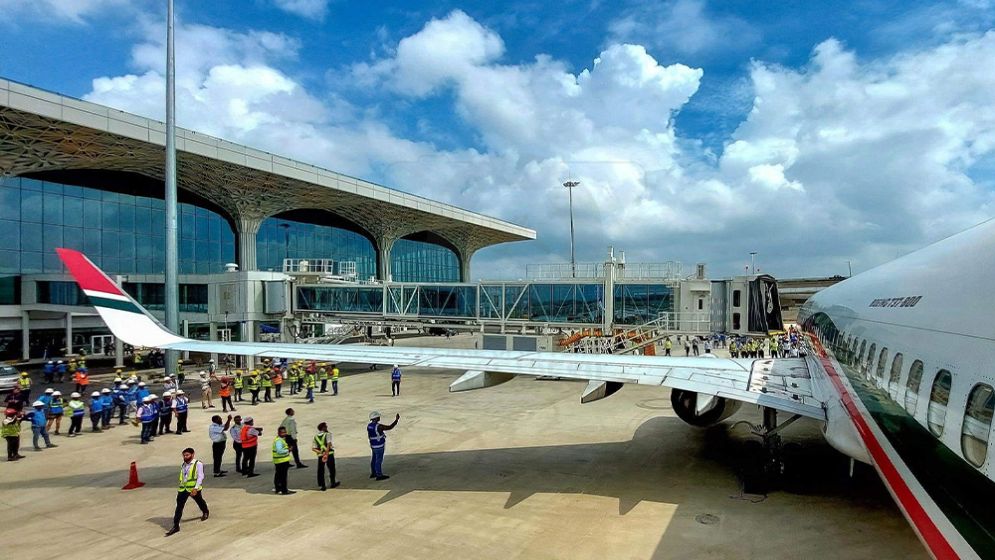
File Photo
Hazrat Shahjalal International Airport’s third terminal could not be opened completely in the last three years despite almost completing the construction with a 99.91% progress rate and finishing up the terminal building.
On the contrary, the authorities have decided to
ramp up the construction costs by Tk902 crore despite almost 100% completion
rate of the project.
Additionally, the project’s tenure is being extended
by one more year, which will take the project costs to Tk22,267.67 crore from
Tk13,610 crore, with a six-year project being turned into a 11-year project.
The first phase of HSIA Extension Project was
approved in 2017 to make the country’s aviation sector modern and
internationally standardised. The third terminal was built under the project
with an initial cost of Tk13,610 crore and a timeline till June 2022.
However, the work was not completed according to
schedule. The timeline was extended by three years till 2025 in the first
revision, and by another year till June 2026 in the second revision, which also
failed. As a result, the authorities have proposed another extension of the
project timeline till June 2027.
According to project documents, the progress rate of
the project has been 99.91% till June 2026, with less than 1% left. However,
both the project timeline and costs have been proposed to be extended for this
minimal work. The Civil Aviation Authority of Bangladesh (CAAB) has sent the third
amendment proposal to the Planning Commission with an additional cost of
Tk8,657.19 crore.
Besides time and costs overruns, the opening of the
project is also facing a lag. Former prime minister Sheikh Hasina had launched
a ‘soft opening’ of the terminal on 7 October 2023. At that time, it was said
that the terminal would be opened in phases. Although three years have passed
since then, the terminal could not be opened yet. On the contrary, Civil Aviation
and Tourism Minister M Rashiduzzaman Millat has laid out a plan to launch
another soft opening on 16 December 2026, adding that the government is initiating
a process to sign an agreement with a Japanese company for the terminal’s
operations.
Even though construction of the terminal building
has been completed, prolonged delays in appointing an operator are adding to
the government’s costs.
Under the third revision of the project, Tk667.48
crore has been proposed for maintenance. The money will be spent until an
operator is appointed. However, no allocation for maintenance was included in
the original development project proposal. As a result, the additional
expenditure has been added at the final stage of the project.
Recently, Japanese company Sojitz submitted a
proposal to operate and maintain the terminal. Representatives of the company
submitted technical and financial proposals at the headquarters of the Civil
Aviation Authority of Bangladesh (CAAB) on 25 August. The proposals are now
expected to be evaluated, followed by negotiations and discussions toward
reaching an agreement.
Meanwhile, the cost of several components of the
project is also increasing at the final stage. An additional Tk647.52 crore has
been proposed for runway and taxiway-related infrastructure under civil works, while
Tk372.94 crore has been proposed as additional expenditure for building works.
In addition, a proposal has been made to extend
consultancy services by 359 person-months at an additional cost of Tk41.67
crore. However, at a meeting of the Planning Commission’s Project Evaluation
Committee on 20 August, instructions were given to reduce these proposed
expenditures.
Dispute over contractor’s claims
Questions have also been raised over the decision to
pay a substantial amount to settle claims made by the project contractor,
Aviation Dhaka Consortium (ADC).
A dispute arose between ADC and CAAB over various
claims by the contractor. A dispute board was formed to resolve the matter, and
the board issued its decision on 16 February.
Later, an Amicable/Global Settlement Committee was
formed on 7 April to settle the contractor’s outstanding claims. Based on the
committee’s recommendations, a decision has been taken to pay the contractor an
additional Tk1,522.55 crore.
According to the dispute board’s decision, the
payment of Tk1,579.51 crore in outstanding bills, along with Tk47 crore in
penalties, also came under consideration.
Officials concerned said allegations of ambiguity
and repeated changes regarding the project’s design, scope of work and various
products have existed since the beginning. These factors contributed to the
increase in project costs at the final stage, they said.
Audit objections and financial concerns
The project’s financial management has also raised
several questions. Audit objections have been raised over additional
allocations, VAT, customs clearance of goods and transportation costs, among
other issues.
There have also been allegations that transportation
costs for drying liquid mud were shown twice.
Questions have also been raised over additional
payments made against the contractor’s claims concerning VAT payable to the
National Board of Revenue (NBR).
An audit also raised the issue of Tk68.72 crore
spent on clearing goods at the port being shifted from the contractor to the
state.
Technical problems
Apart from financial irregularities, questions have
also been raised about the project’s technical aspects.
Defects have reportedly been found in machines used in
the Explosive Detection System, an important component of airport security. The
machines allegedly take around 20 minutes to restart after a power outage.
Problems have also emerged with the backup power
system because the tender documents did not specify the required UPS load
calculation and configuration.
Water and mud have reportedly entered the duct bank
constructed for electronic systems. Allegations have also been made that some
products were supplied without complying with the required specifications.
Amid these irregularities and concerns, 121 audit
objections related to the project remain unresolved.
Documents related to the project indicate that the
objections stemmed from weaknesses in project supervision and various
inconsistencies in financial management. The Implementation Monitoring and
Evaluation Division (IMED) has urged authorities to resolve the outstanding
audit objections promptly.
Experts say the third terminal is highly important
for Bangladesh’s aviation connectivity and economy. Although it was intended to
provide modern facilities and international-standard passenger services, the
failure to fully launch its operations even after such a long period is
disappointing, they said.