



 For all latest news, follow the Daily Sun's Google News channel.


DUCSU calls for state reform at int’l conference on July uprising
The day-long conference featured 80 research papers across 15 panels
Daily Sun Report, DU
Published: 19 Jul 2026, 08:22 PM
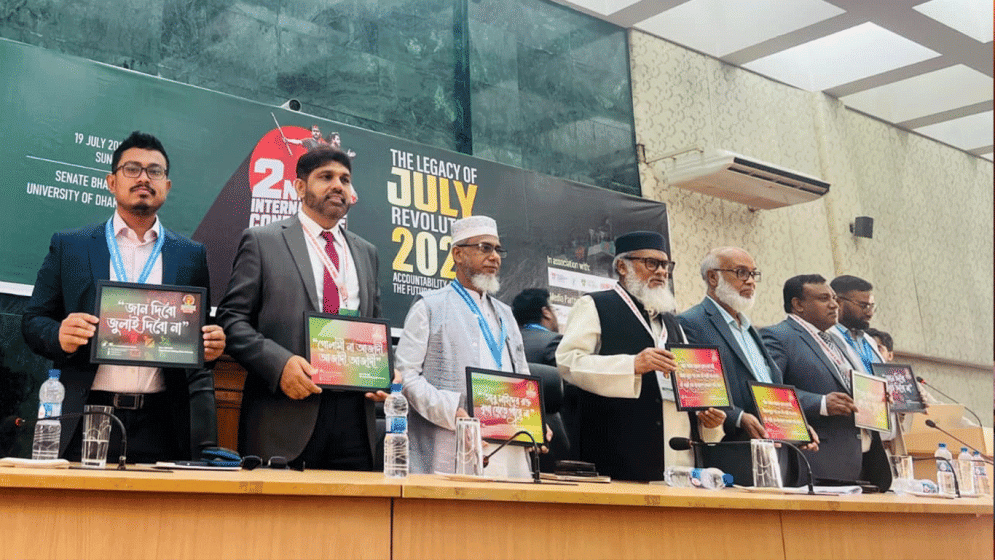
DUCSU members and other officials attending international conference on July uprising at Dhaka University campus on Sunday. File Photo
The Dhaka University Central Students' Union (DUCSU) hosted the Second International Conference on July Revolution (ICJR-2, 2026) at the campus on Sunday, calling for a speedy trial of the killings during the uprising and immediate state reforms.
Academicians, researchers, human rights experts,
diplomats and student leaders from home and abroad attended the day-long event
at the university senate building to mark the second anniversary of the 2024
uprising.
This year, organisers set the conference theme as
"The Legacy of the July Revolution 2024: Accountability, Reform and the
Future of Bangladesh".
Research and Integrated Thought (RIT), Youth for
Better Future Society, University of Regina in Canada, International Islamic
University Chittagong and Nanyang Technological University in Singapore
co-organised the event alongside DUCSU.
Member of Parliament Rokeya Begum, mother of martyr
Jaber Ibrahim, expressed disappointment at the slow pace of trials during the
inaugural session.
"The main demand of the martyrs' families is
justice," Begum said. "We want a speedy, transparent and credible
trial. At the same time, the martyrs must be given due state status and
necessary reforms must be completed to implement the aspirations of July."
Former religious affairs adviser Prof AFM Khalid
Hossain attended the event as the chief guest.
"To make the sacrifices of this revolution
meaningful, the state must be run on the basis of justice, human dignity,
people's rights and morality," Hossain said. "July is not the
property of any particular party or group, it is the collective legacy of the
people of Bangladesh."
Former Dhaka University vice-chancellor Prof Niaz
Ahmed Khan urged citizens to reject pessimistic propaganda and trust the power
of the people to advance national reconstruction.
The conference presented the “Friends of July
Revolution” award to Huma Khan, the United Nations high commissioner for human
rights representative on Syria, for her stand on human rights in Bangladesh.
Speaking online, Khan noted that the struggle for
equality, dignity and justice continues. Retired US diplomat John Danilovich
also spoke online, emphasising the preservation of the revolution's history to
prevent the return of authoritarian rule.
The day-long conference featured 80 research papers
across 15 panels, covering state violence, human rights violations, the
participation of women and youth, and necessary constitutional reforms.
Presenters included Associate Professor Saidul
Islam, Prof Syeda Sultana Razia, Assistant Professor Usama Al-Azmi and
Associate Professor Takian Fakhrul.
RIT Chairman Prof Mohammad Ismail and DUCSU Vice
President Md Abu Shadik Kayem stressed the need for objective, multidimensional
research to guide public policy.
DUCSU executive member Md Miftahul Hossain Al Maruf
warned that fallen fascist groups are spending millions to defame the movement,
promising an intellectual and political fight to protect its legacy.
In the closing declaration, RIT Executive Director
Ekram Uddin joined other participants in demanding a digital archive of the
uprising and effective reforms in the judiciary, police and electoral systems
to build an inclusive Bangladesh.