


 For all latest news, follow the Daily Sun's Google News channel.


DHORA urges science-based flood management to tackle climate risks
Daily Sun Report, Dhaka
Published: 18 Jul 2026, 03:47 PM
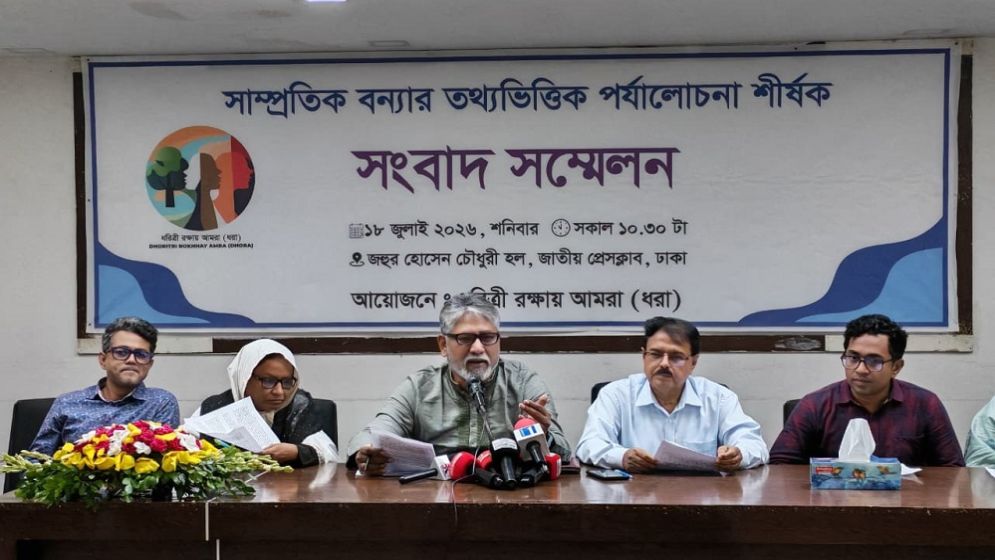
DHORA urges science-based flood management to tackle climate risks. Photo: Courtesy
Environmental platform Dhoritri Rokhhay Amra (DHORA) has called on the government to adopt science-based flood management and environmentally sustainable development strategies, warning that Bangladesh's recent floods were driven not only by heavy rainfall but also by climate change and years of unplanned development.
The call came at a press conference titled "A Data-Based Review of the Recent Floods", held at the National Press Club in Dhaka on Saturday.
Speaking at the event, DHORA leaders said the recent flooding was the combined result of climate change, unplanned infrastructure development, encroachment on rivers, canals and wetlands, hill cutting, deforestation and the obstruction of natural water flows.
Chairing the programme, DHORA Co-Convener M. S. Siddiqui said the organisation had prepared a comprehensive assessment based on field-level information and reports published in five national newspapers between 6 and 16 July.
"The recent floods were not caused by natural factors alone. Their severity has been intensified by unplanned development, the filling of rivers and canals, disruption of natural drainage systems and the impacts of climate change," he said.
He urged the government to prioritise long-term flood management solutions and ensure that national interests take precedence over vested interests in development planning.
Presenting the keynote paper, DHORA Member Secretary Sharif Jamil said continuous heavy rainfall between 7 and 12 July, coupled with upstream hill runoff and abnormal rises in the water levels of transboundary rivers, caused severe flooding and waterlogging in at least 17 districts across Bangladesh.
According to DHORA's assessment, more than one million people were directly affected, including around 600,000 in Chattogram, 158,000 in Cox's Bazar, 108,000 in Rangamati, 83,500 in Bandarban, and 136,000 in Kurigram. The floods also damaged thousands of hectares of cropland, fish farms, roads, bridges and other key infrastructure.
Sharif Jamil argued that the disaster was not solely the result of extreme weather, saying the impacts had been exacerbated by river and wetland encroachment, declining river navigability, poorly planned roads and infrastructure, hill cutting, deforestation and climate change.
He also claimed that a significant share of flooding and prolonged waterlogging experienced in the three hill districts, Chattogram and Cox's Bazar between 2023 and July 2026 could be linked to the Chattogram-Cox's Bazar railway project, while calling for integrated river basin management, modern early warning systems, stronger transboundary river cooperation, restoration of rivers and canals, climate-resilient infrastructure and faster rehabilitation of affected communities.
Convener of Haor Rokkhay Amra-DHORA, Jafor Siddique, said flooding had long been a recurring disaster in Bangladesh but stressed that coordinated preparedness at both national and local levels, along with stronger local response capacity, would be essential to minimise future losses.
Other speakers, including Mir Mohammad Ali, Assistant Professor at Sher-e-Bangla Agricultural University, Sanjida Rahman, Coordinator of Chunati Rokhhay Amra-DHORA, Faridul Alam Shahin from Cox's Bazar and Badrun Nahar Koli from Matamuhuri, shared field observations from flood-hit areas and highlighted the urgent need for improved management of polders and sluice gates.
At the press conference, DHORA urged the government and relevant authorities to adopt an integrated river basin management approach, restore natural watercourses, ensure environmentally sustainable development and formulate long-term flood management strategies that reflect the realities of climate change.
The event was attended by environmental activists, researchers, development professionals and journalists from print, electronic and online media.