



 For all latest news, follow the Daily Sun's Google News channel.


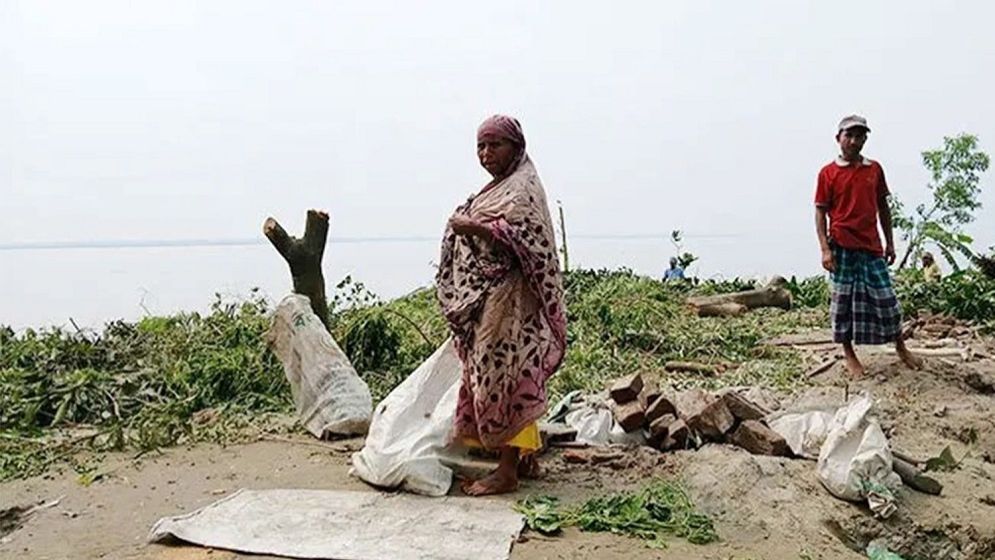
Photo: Kongkon Karmaker
Here's the thing about the floods in Kurigram: the water
going down isn't actually good news – it just means the next disaster is
starting.
Once the rivers drop below danger level, the ground itself
starts giving out. Soaked through for days, the banks along the Brahmaputra,
Teesta and Dudhkumar simply collapse — and homes that made it through the flood
go under a week later anyway.
Ask anyone living on the chars or the low floodplains and
they'll tell you the pattern by hear: the floods come first, then the land
disappears out from under you.
Momena Begum is 70. She's stopped counting her age in years
— she counts it in how many times she's had to pack up and move. Twenty-five
times she and her 80-year-old husband Abdul Jabbar have rebuilt their house on
the Brahmaputra's edge. Twenty-five times, the river has come back and taken
it. They're in the Bisharpura shelter now, and even that's starting to look
shaky.
"My land stretched as far as the eye could see,"
she said, standing outside the shelter. "Now I own nothing. There was a
time my husband didn't even need to work — the land gave us enough. These days
we go hungry some days. This char is probably where I'll die."
Down the way, Nazrul Islam has been through this 18 times.
Four of those were in just the last six months. People here don't really treat
losing a house as an emergency anymore — it's more like something you plan
around. Build it knowing you'll probably have to tear it down. Plant knowing
the crop might not make it to harvest.
More than 300 kilometres with nothing protecting them
Part of why this keeps happening is just geography. Sixteen
rivers cut through Kurigram, and between them they've got something like 374
kilometres of riverbank. Only about 66 of those kilometres have any real
protection — concrete, permanent structures. Everything else, about more than
300 kilometres, is just exposed.
And this year it was proved again. In Ramhari Mouza, under
Bidyananda Union in Rajarhat, the Teesta started eating into homes almost the
moment the floodwater pulled back. An autorickshaw driver and two farming
families watched parts of their houses get swept away. More than 50 other
households are sitting right on the edge, waiting. The BWDB had put down
thousands of geo bags there just weeks before — they didn't hold.
"The river first took the trees, then the farmland,
then the geo bags," farmer Ataul Haque said. He watched it start one
morning, out of nowhere. "I've already shifted one house. Two more are
still standing on the edge."
Majnu Sarkar, a day labourer, has lost count somewhere
around five or six times by now. "I don't know where we'll go now,"
he said. That was pretty much all he had to say about it.
When the embankment itself gives way
It's not just individual houses, either. Over in Nageshwari,
a stretch of embankment along the Dudhkumar River finally buckled — days of
rain plus water pressure from upstream did what erosion had already been
working on for a while. Around 20 villages in Bamandanga Union went under.
Thousands of people were left stranded, watching helpless as water poured into
homes, roads, fields.
Local Union Parishad representatives say nearly 20 villages
across four wards were swallowed once that embankment failed, and a lot of
families ended up scrambling for higher ground. The water's dropping again now,
but people who live nearby say the broken section is still just sitting there —
one more heavy rain and it could happen all over again.
Farmers are getting hit twice
For farmers, it's a one-two punch. First the flood drowns
the fields. Then, once the water pulls back, the riverbank itself gives out and
takes whatever crops actually survived the flooding.
Officials put the flooded cropland in Kurigram Sadar,
Nageshwari, Bhurungamari and Roumari at around 204 hectares so far — Aman rice
seedbeds, jute, vegetable plots, nurseries, all of it. And that's on top of
hundreds more hectares lost elsewhere in the district. Chilli, eggplant,
cucumber, pointed gourd — gone. A lot of Aman seedbeds washed out before they
were even old enough to transplant. Some farmers watched their jute fields go
straight into the river, and now they're stuck with loans against land that
isn't there anymore.
Plenty of families are looking at months with no harvest
income at all, while also trying to figure out how to rebuild a house.
Buying land you know won't last
With solid ground running out, people have started doing
something that sounds almost desperate when you say it out loud: buying rights
to char land that everyone involved knows could vanish. These are informal
deals, and they end automatically the second the river takes the plot.
Faruk Mia put in Tk3 lakh — everything his family had —
for one bigha of exactly this kind of land. No compensation clause, nothing.
"If the Brahmaputra takes this land tomorrow," he said quietly,
"my money goes with it."
At this point, land along the river isn't really something
you own long-term. It's more of a bet you're making against a river that
doesn't lose.
The rivers right now
Per the latest BWDB readings, the Dudhkumar was sitting 23
centimetres above danger level at Pateshwari. The Dharla, Brahmaputra and
Teesta are all still below their danger marks. But forecasters are warning that
more heavy rain over the Brahmaputra basin could push things back up fast in
low areas of Rangpur Division — Kurigram, Nilphamari, Lalmonirhat included.
People here are watching that forecast nervously. Any rise
in the water and the erosion that's already chewing through weakened banks
could speed right up.
What officials are saying
Kurigram's Deputy Commissioner, Annapurna Debnath, said the
district has put together Tk 200,000 in emergency cash and handed out 1,100
packets of dry food to families in the low-lying areas. She said each of the
nine upazilas also has 1,000 geo bags on hand, ready to go wherever erosion
gets bad.
But she didn't pretend it was enough. "The allocation
currently available cannot fully meet the needs across all nine upazilas,"
she said — adding that the district has already put out everything it has and
is now asking for more.
BWDB's Rakibul Hasan, an executive engineer in Kurigram,
said emergency repair work on the broken section of the Dudhkumar embankment
would start right away, and that engineers are keeping an eye on the vulnerable
stretches around the clock, checking hotspots and prepping for whatever comes
next.
For families like Momena's, though, help tends to show up
after the fact. By the time the geo bags actually reach the collapsing bank,
people here say, the land — and everything built on it — is usually already
gone.