


 For all latest news, follow the Daily Sun's Google News channel.


Record rainfall causes severe waterlogging in Jashore
Residents alleged that the city's deteriorating drainage system has significantly worsened the crisis
Daily Sun Report, Benapole
Published: 11 Jul 2026, 07:52 PM
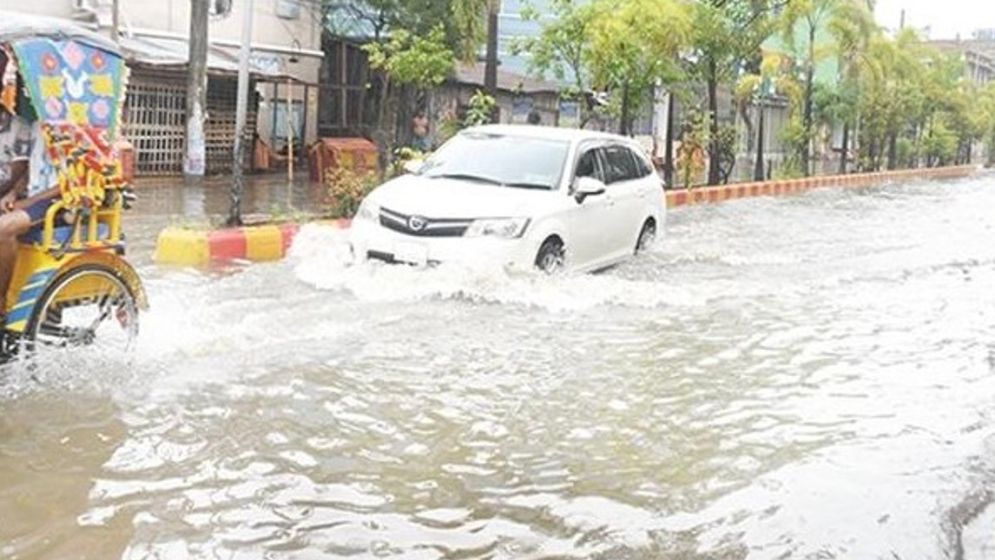
A flooded street in Jashore. Photo: Daily Sun
Record rainfall has inundated low-lying areas across Jashore, triggering widespread waterlogging and disrupting normal life throughout the district.
According to the Bangladesh Meteorological
Department (BMD), Jashore recorded 190 millimetres of rainfall in just 10 hours
and 199 millimetres over the past 24 hours, making it the country's second-highest
rainfall during the period.
Satkhira recorded the highest rainfall at 227
millimetres.
The latest downpour surpassed previous records in
terms of rainfall intensity. The earlier record was set on 25 August 2024, when
Jashore received 144 millimetres of rain in 24 hours, while 228 millimetres was
recorded over a 32-hour period.
Officials say no previous record exists of such a
large volume of rainfall within such a short time.
Residents said moderate to heavy rainfall, which
began on Friday night, submerged large parts of Jessore town, its outskirts,
and other low-lying areas across the district. Water entered numerous homes,
while the city's drainage system failed to cope with the heavy rain, causing
immense suffering for residents.
According to the weather office at Jashore Air Force
Base, 110 millimetres of rain fell between 2:00am and 6:00am, followed by
another 80 millimetres between 6:00am and 12:00pm, bringing the total rainfall
to 190 millimetres within 10 hours. The relentless downpour quickly submerged
low-lying neighbourhoods.
A visit to different parts of the town found major
roads and residential streets under water. Areas including TV Clinic, Kharki
Shah Abdul Karim Road, Dharmatala Road, Apon Mor, Char Khambar Mor, the
Railgate area on Mujib Road, Nazir Shankarpur, Kharki Rupkatha Mor, Bejpara
Chironikol Mor, Missionpara, Arabpur, Airport Road, Chopdarpara in Shankarpur,
and Stadium Para experienced severe waterlogging, with knee-deep water in
several locations.
Ponds, open fields and fallow land were also
submerged, while some residents were even seen catching fish in flooded
streets.
Expressing frustration, Rafiqul Islam, a resident of
the TV Clinic area, said, "This has become a recurring problem. Public
representatives repeatedly assure us that the situation will improve, but their
promises are never fulfilled."
Nasrin Akter, a resident of Shankarpur, said water
had entered many homes, forcing families to suspend cooking and wait for the
floodwater to recede.
Abdul Majid of Stadium Para said even light rainfall
usually causes waterlogging near the stadium's main gate, but this time
floodwater stretched from Apon Mor to the Municipal Hawkers' Market.
Azgar Ali, a resident of Kharki, blamed the
situation on poorly planned drainage infrastructure and indiscriminate dumping
of waste into drains.
Residents alleged that the city's deteriorating
drainage system has significantly worsened the crisis. Wastes from hotels,
restaurants and commercial establishments are frequently dumped directly into
drains, leaving many clogged with garbage and layers of silt.
As a result, rainwater cannot drain normally,
causing prolonged waterlogging and creating what many described as an
"urban flood."
Although the municipality has cleaned drains across
the city over the past year and removed hundreds of truckloads of waste, many
residents believe the situation would have been far worse without those
efforts.
Responding to the situation, BM Kamal Ahmed,
assistant engineer of the Jashore Municipality, said municipal officials, led
by the administrator, had visited the affected areas and were taking necessary
measures.
"We hope the water will recede soon," he
said.
He added that a narrow drain beside the Jashore
Medical College has become a major bottleneck, but efforts to widen it were
opposed by local residents.
"If that drain can be expanded, this problem
can largely be resolved," he said.