


 For all latest news, follow the Daily Sun's Google News channel.


Lack of quality vocational education hinders child labour elimination: Experts
The minister also highlighted the role of religious institutions in changing social attitudes towards child labour
Daily Sun Report, Dhaka
Published: 29 Jun 2026, 06:26 PM
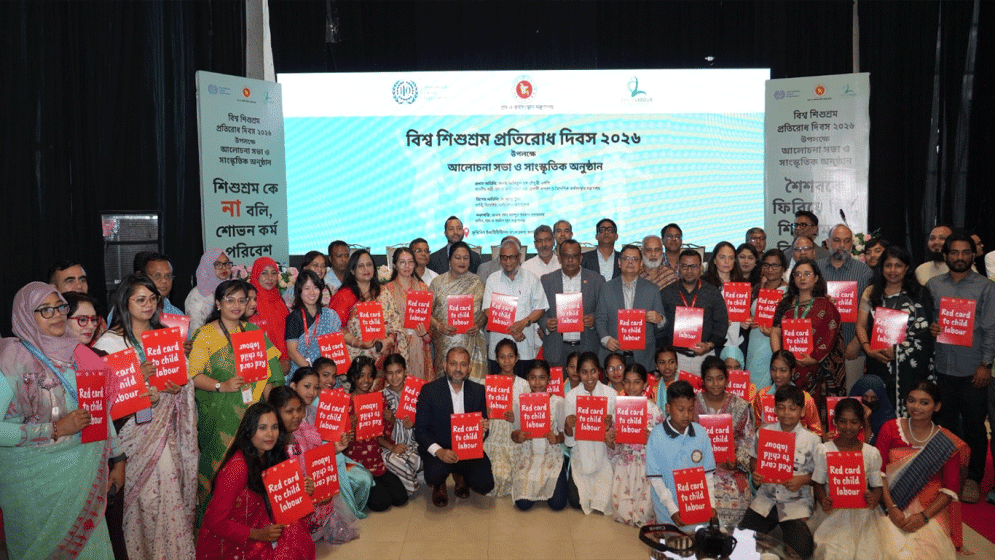
Attendees at an event marking World Day Against Child Labour in the capital on Monday. Photo: Daily Sun
The lack of quality vocational education has been identified as one of the biggest obstacles to eliminating child labour in Bangladesh, according to experts and stakeholders.
They made this remark at a programme marking the
World Day Against Child Labour in the capital on Monday under the theme
"Red Card to Child Labour: Fair Play for Children, Decent Work for
Adults".
The programme was jointly organised by the Ministry
of Labour and Employment (MoLE), the Child Labour Elimination Platform (CLEP)
and the International Labour Organization (ILO).
Speakers identified chronic poverty and economic
vulnerability, a large informal economy, lack of quality and vocational
education, social acceptance of child labour, migration and conflict, weak enforcement
of labour laws, and complex supply chains as the key challenges to eradicating
child labour in Bangladesh.
Among these, education and poverty are the main
challenges, they said.
Labour and Employment minister Ariful Haque
Choudhury attended the programme as the chief guest.
He stressed the need for a nationwide awareness
campaign against child labour, saying pilot programmes in urban slums could
provide sustainable solutions to the problem.
"We need to place greater emphasis on raising
awareness against child labour. If we initiate pilot programmes in slum areas,
we are likely to achieve better results," he said.
The minister also highlighted the role of religious
institutions in changing social attitudes towards child labour.
Labour and Employment Secretary Md Abdur Rahman
Tarafder chaired the event, while ILO Bangladesh Country Director Max Tunon was
present as the special guest.
Max Tunon said the ILO has been working with the
government and its partners for decades to prevent and eliminate child labour
by supporting national policies, strengthening institutions and improving data
collection.
He noted that the number of working children in
Bangladesh declined by nearly 50% between 2003 and 2013, but progress has
slowed in recent years due to the impacts of the COVID-19 pandemic and
continued economic hardship.
Tunon stressed the need to align compulsory
education with the minimum legal age for employment by extending compulsory
education to at least 14 years, ensuring that children remain in school instead
of entering the workforce prematurely.
Educo Bangladesh Country Director Abdul Hamid said,
"The number of child labourers in our country is not very high—around 1.7
million. Compared to the size of our national budget, child labour can be
eliminated with proper planning and effective implementation.
He emphasised a sector-based approach to eliminating
child labour and highlighted the collaborative initiatives being undertaken
through the Child Labour Elimination Platform (CLEP) to accelerate progress
towards a child labour-free Bangladesh.