


 For all latest news, follow the Daily Sun's Google News channel.


Govt committed to taking effective tobacco control measures: Ziauddin Hyder
Daily Sun Report, Dhaka
Published: 24 Jun 2026, 10:08 PM
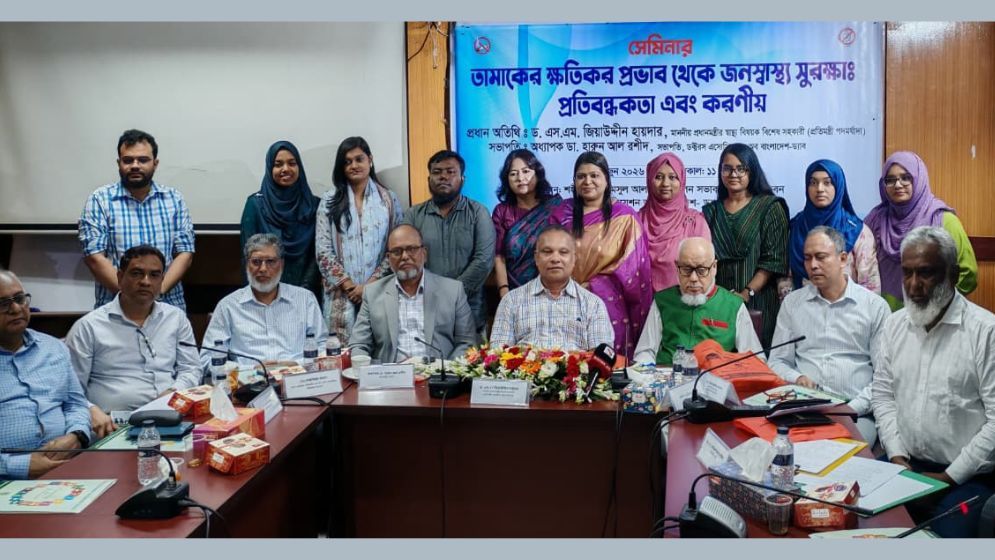
Photo: Courtesy
Prime Minister's Special Assistant on Health Affairs SM Ziauddin Hyder said on Wednesday that the incumbent government is committed to taking effective tobacco control measures.
Marking “World No Tobacco Day”, Prime Minister Tarique Rahman reiterated the government's firm stance on protecting children, adolescents, and future generations from the harmful effects of tobacco and nicotine, he said.
The period leading up to the finalisation of the national budget for the fiscal year 2026-27 (FY27) presents an important opportunity to take effective measures for protecting public health, he said while addressing a seminar titled “Protecting Public Health from the Harmful Effects of Tobacco: Challenges and Way Forward,” at the BMA Auditorium in Dhaka.
The Doctors Association of Bangladesh (DAB) and the Development Organisation of the Rural Poor (DORP) jointly organised the event.
Hyder said protecting public health and strengthening tobacco control measures were among the key commitments in the ruling party's election manifesto.
Presenting the keynote paper, Zeba Afroza said that public health and tobacco control experts proposed reducing the existing four-tier cigarette price structure to three tiers in order to simplify tax administration.
Since the prices of low- and medium-tier cigarettes are very similar, smokers can easily switch to a cheaper alternative when the price of one tier increases, she said, adding that experts, therefore, proposed merging these two tiers and setting the retail price of a 10-stick cigarette pack at Tk100.
They also recommended maintaining the existing 67% supplementary duty on all cigarette tiers while introducing a specific tax of Tk4 per 10-stick pack, Afroza said.
She noted that if implemented, this proposal would make tobacco products less affordable, particularly for young people.
Shafiun Nahin, director of the Institute of Health Economics at the University of Dhaka, said that the proposed budget includes only a marginal increase in cigarette prices.
He said the price of a 10-stick pack of low-tier cigarettes has been increased from Tk60 to Tk62, even though nearly 75% of all cigarettes sold in the market belong to this tier.
As a result, an increase of only Tk2 per pack is insufficient to discourage tobacco use, especially when inflation remains above 9%, he said.
Nahin further explained that the retail price of a low-tier cigarette under the proposed budget is Tk6.2 per stick, whereas these cigarettes are already being sold at Tk7 per stick at retail outlets across the country.
Consequently, tobacco companies stand to gain an additional profit of approximately Tk0.8 per stick, all of which would remain untaxed, he said.
Nahin added that Bangladesh sold 68.89 billion low-tier cigarettes in FY24. Based on an additional profit of Tk0.8 per stick, tobacco companies could earn approximately Tk5,512 crore in extra profits. This means that the government would lose a substantial amount of potential tax revenue.
The speakers thanked the government for amending the tobacco control law and expressed optimism that, in line with the commitments outlined in the election manifesto, the government would take appropriate measures to strengthen tobacco control and protect future generations from the harms of tobacco use.
In his remarks as the lead discussant, DAB Secretary General Md Zahirul Islam said that the proposed budget imposes taxes on nicotine pouches, nicotine granules, and heated tobacco products (HTPs).
“However, taxing these products effectively legitimises them in the market. This could facilitate the expansion of these new nicotine products and increase the risk of nicotine addiction, particularly among youth and adolescents,” he said.
Expressing DAB’s commitment to working with DORP on tobacco control initiatives in the long term, DAB President Harun Al Rashid urged the government to reconsider the tax and price structure of low-tier cigarettes and smokeless tobacco products in the FY27 national budget.
He noted that if the recommendations of public health and tobacco control experts are implemented, the government could generate approximately Tk44 billion in additional revenue.
At the same time, nearly 500,000 adult smokers would be encouraged to quit smoking, 372,000 young people would be prevented from initiating smoking, and nearly 400,000 premature deaths could be averted in the long term, he added.
The seminar was welcomed by AHM Noman, founder and CEO of DORP, and moderated by Mohammad Zobair Hasan, deputy executive director of the organisation.
Among those present were Iqbal Masud, director of the health sector of Dhaka Ahsania Mission; Sohel Reza Choudhury, head of the epidemiology and research department at the National Heart Foundation Hospital and Research Institute; members of DAB; and youth representatives Ratri, Sandhi, and others.